Japan Night Bus vs Shinkansen: The Full Tokyo-Osaka Cost and Comfort Breakdown
This post may contain affiliate links. If you book or buy through them, we may earn a commission at no extra cost to you.
Every first-time visitor doing the Tokyo-Osaka run hits the same fork in the road: pay for speed on the Shinkansen, or save money and a hotel night on an overnight bus. Both are safe, reliable, and easy to book without speaking Japanese — the real decision comes down to how you value your time, your budget, and your ability to sleep sitting up. This guide compares the two directly, using official fares and schedules as of August 2026, so you can pick based on numbers rather than guesswork.
Quick comparison table
All fares below are one-way, adult, standard (non-peak) period pricing for the Tokyo to Shin-Osaka route unless noted.
| Option | Fare | Travel time | Seat type |
|---|---|---|---|
| Nozomi (reserved seat) | ¥14,720[1] | ~2h 30min[2] | Standard reserved |
| Nozomi (non-reserved) | ¥13,870[1] | ~2h 30min | Standard non-reserved |
| Nozomi (Green Car) | ¥19,590[1] | ~2h 30min | Green (first class) |
| Hikari (reserved seat) | ¥14,400[3] | ~3h[2] | Standard reserved |
| Hikari (Green Car) | ¥18,270[3] | ~3h | Green (first class) |
| Kodama (reserved/non-reserved) | from ¥13,870[3] | ~4h[2] | Standard |
| Night bus, 3/4-row seat | ¥3,000–¥6,000 (from ¥2,000 on promotion)[4] | ~8h 40min[5] | Reclining coach seat |
| Night bus, premium single cabin | ¥18,000–¥20,000[6] | ~9h[6] | Enclosed pod with door |
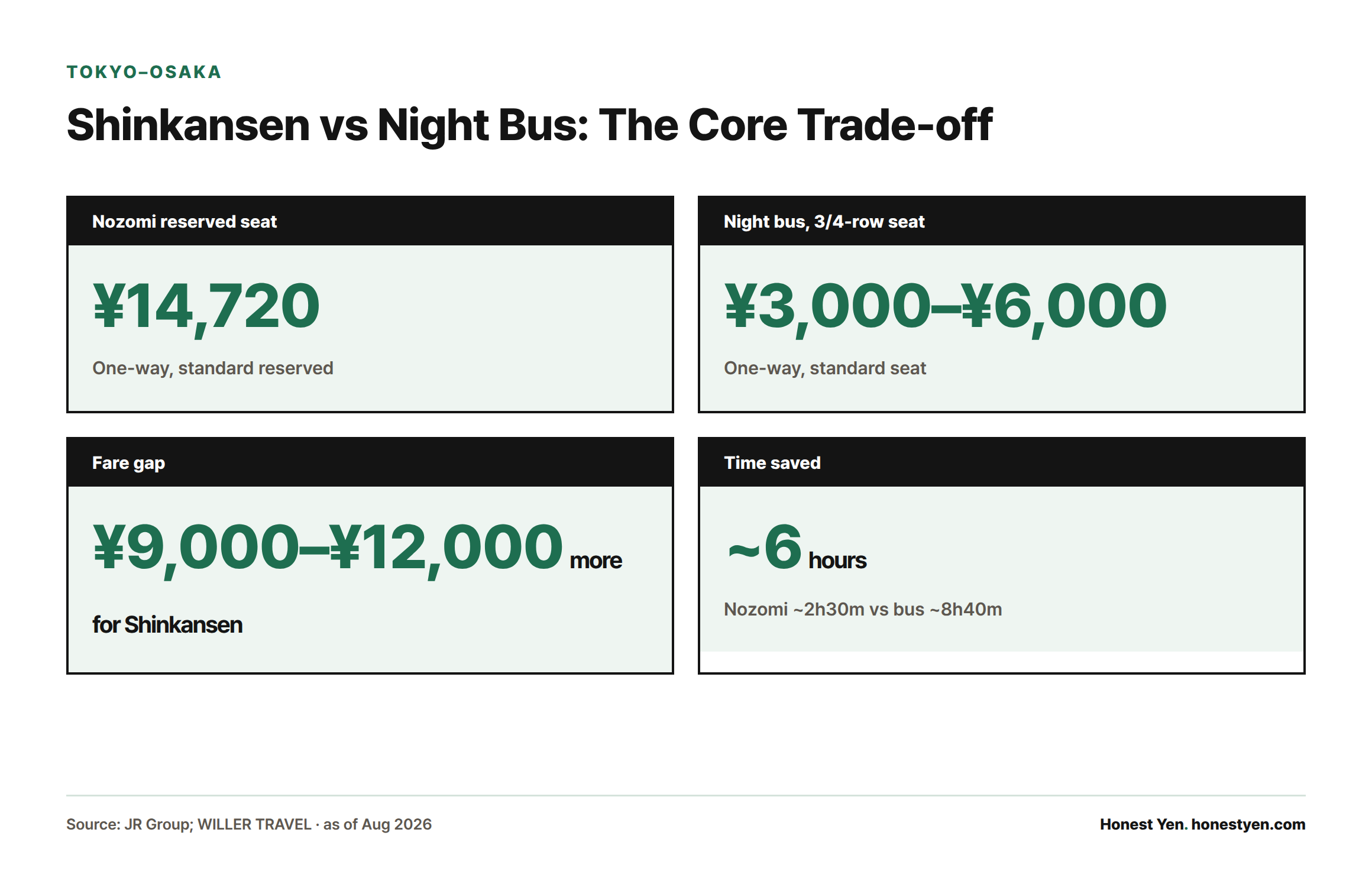
The headline gap: a reserved Nozomi seat costs roughly ¥9,000–¥12,000 more than a standard night bus seat, for a trip that’s about six hours shorter. That trade-off — money versus time — is the entire decision.
Shinkansen fares and train types: Nozomi, Hikari, Kodama
The Tokaido Shinkansen between Tokyo and Shin-Osaka runs three train types, and the difference isn’t just speed — it’s what your Japan Rail Pass (if you have one) will let you board.
- Nozomi is the fastest, stopping only at major hubs (Nagoya, Kyoto). It is NOT covered by the standard Japan Rail Pass — pass holders must use Hikari or Kodama instead.
- Hikari makes a few more stops and takes about 30 minutes longer than Nozomi, but costs slightly less on reserved seats[1][3] and is covered by the JR Pass.
- Kodama stops at every station on the line, taking roughly 4 hours — about 90 minutes longer than Nozomi — and is the cheapest of the three, also JR Pass-eligible.
Reserved-seat pricing shifts with the season: JR Central applies a ¥200 discount in the off-peak period, a ¥200 surcharge during peak periods (holidays, Golden Week edges), and a ¥400 surcharge during the busiest windows like Obon and New Year[1][3]. Non-reserved seat fares stay flat year-round. In practice, that means the price swing between the cheapest and most expensive reserved seat on the same route is only about ¥600 — seasonality barely moves Shinkansen pricing, unlike flights.
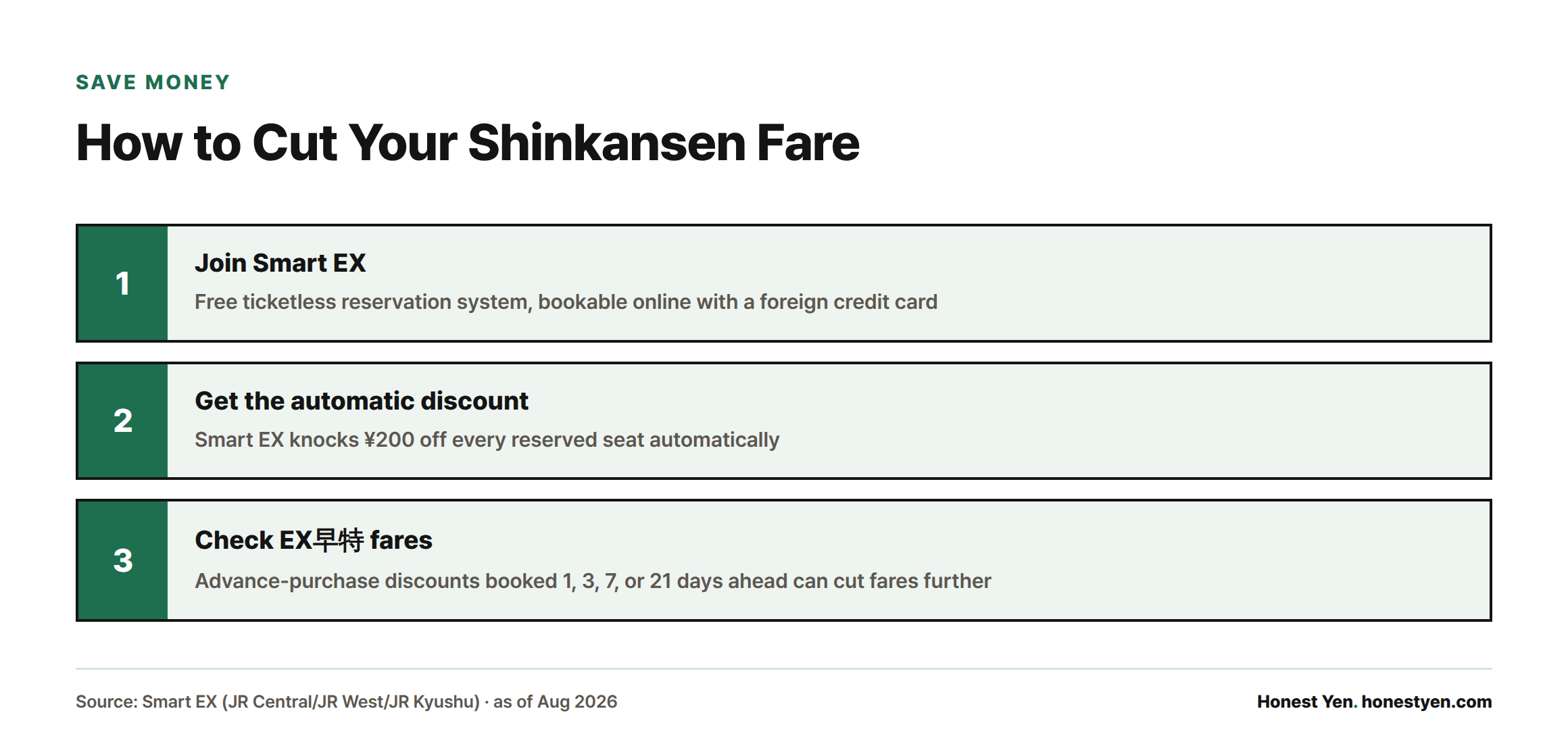
Booking is straightforward for foreign visitors: Smart EX is JR Central, JR West, and JR Kyushu’s free ticketless reservation system, bookable online with a foreign credit card, and it knocks ¥200 off every reserved seat automatically[7]. Layered discount fares called EX早特 (booked 1, 3, 7, or 21 days ahead) can cut fares further on specific dates, though exact savings vary by how far ahead you book[7]. If you’re carrying a large suitcase, note that JR Central requires a free advance reservation for an “oversized baggage” seat if your bag’s three dimensions add up to more than 160cm; skip the reservation with luggage over that threshold, and staff can charge a ¥1,000 handling fee on the spot. Anything over 250cm total isn’t allowed on board at all[8]. If you’re deciding between an IC card and a rail pass for the rest of your trip, our Suica vs ICOCA comparison covers which card makes more sense depending on your route.
Night bus seat grades and where to book them
Overnight buses on the Tokyo-Osaka corridor aren’t a single product — the seat grade changes the price by a factor of six or more.
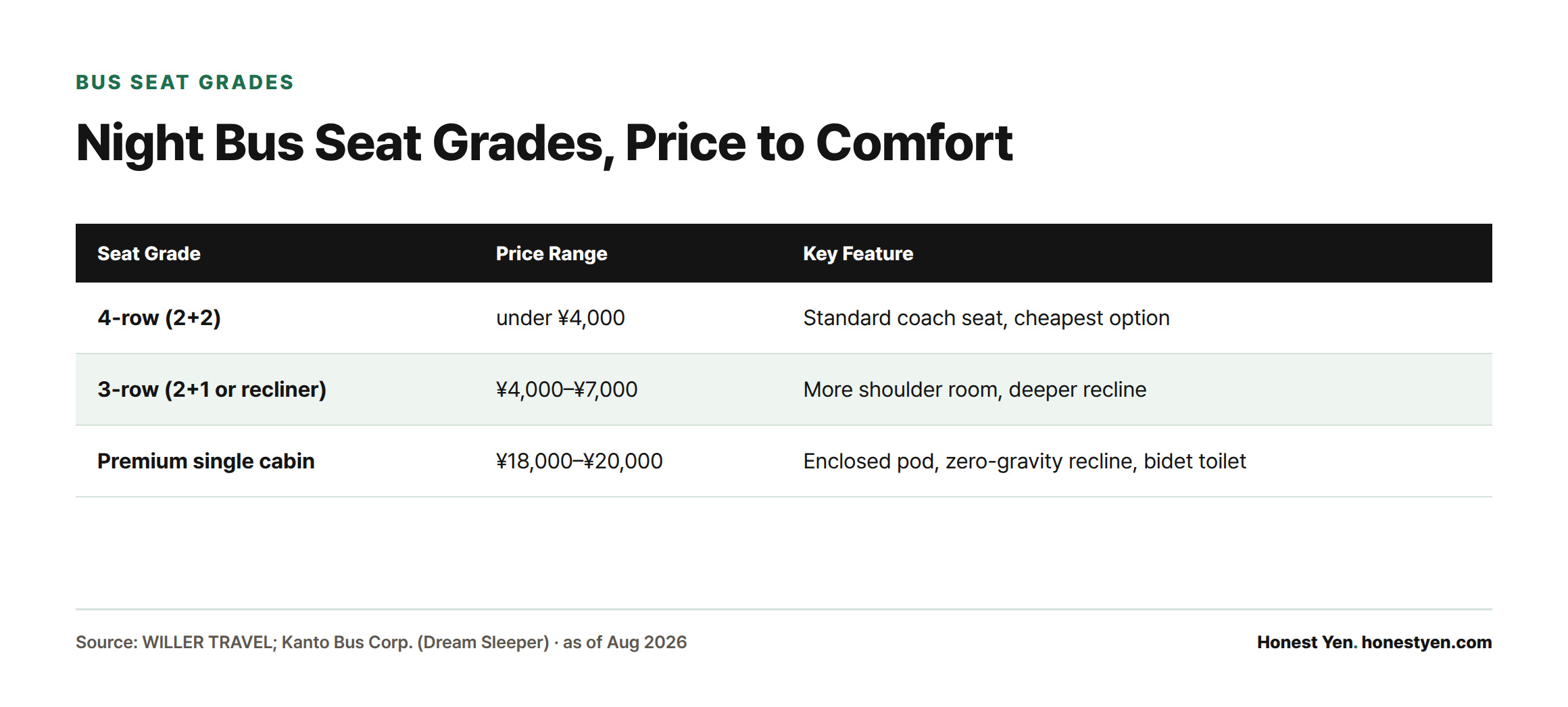
- 4-row seats (2+2 layout) are the cheapest, closest to a standard coach seat, and the entry point for the sub-¥4,000 fares.
- 3-row seats (2+1 or fully independent recliners) give more shoulder room and recline further; this is the most common “standard” night bus product, typically ¥4,000–¥7,000.
- Premium single cabins, like the Dream Sleeper operated by Kanto Bus, go further still: fully enclosed pods with a door, zero-gravity recline, a powder room, and a built-in bidet toilet, running ¥18,000–¥20,000 — priced closer to a Green Car Shinkansen seat than a budget bus[6].
The main booking platforms are WILLER Express and Japan Bus Lines, both of which run English-language sites built for foreign travelers, aggregating fares across dozens of operators so you can filter by seat type, women-only sections, and amenities like onboard toilets and Wi-Fi[4][9]. WILLER in particular is considered the most foreigner-friendly option, with app and web support in English, Chinese, and Korean[9]. Neither platform requires a Japanese phone number or address to complete a booking, which sets them apart from many domestic-only bus operators.
Luggage rules matter more on buses than trains. WILLER allows up to two checked pieces in the under-bus trunk, each within 155cm (length+width+height) and 30kg, with the two pieces combined capped at 240cm; carry-on items need to fit under the seat or in a slim overhead rack that isn’t present on every vehicle[10]. If you’re checking a large suitcase, plan to hand it over at the departure point rather than assuming there’s storage at your seat.
Comfort and fatigue: what an 8-9 hour overnight ride actually feels like
The Shinkansen side of this is simple: 2.5 to 4 hours in an upright, forward-facing seat with a snack cart and clean restrooms. Fatigue is a non-issue.
The night bus side is where the trade-off actually lives. Standard 3-row and 4-row seats recline significantly further than an airplane economy seat and come with a footrest, blanket, and privacy curtain or headrest wings, but you are still sleeping semi-upright for 8-9 hours with one or two rest-stop breaks at a highway service area (typically for a restroom stop, not a long layover). Most riders get broken, shallow sleep rather than a full night’s rest — the buses are built to make that tolerable, not to replicate a bed. This is the single biggest reason travelers with an early-morning activity the next day (a scheduled tour, a Shinkansen connection, a full day of walking) tend to regret the budget seat grades. The premium enclosed-cabin buses close that gap substantially, at a price that erodes most of the savings versus a Shinkansen reserved seat.
Toilets are onboard on most WILLER and Japan Bus Lines coaches, so you’re not solely dependent on service-area stops, but not every operator or every seat grade includes one — check the listing before booking if this matters to you.
Safety, and is it fine to ride alone as a woman
Japan’s overnight bus industry is tightly regulated and used daily by large numbers of solo travelers, including a majority of solo women on some routes — WILLER states that roughly 69% of its average ridership is female[11]. Operators have built specific accommodations around this: WILLER offers women-only seating sections where female passengers are seated next to other female passengers where possible (this can’t always be guaranteed on a full bus or when a group has booked seats), plus seat designs like curtained or shell-shaped cabins specifically marketed for solo female travelers who want to avoid being visible while sleeping[11]. Booking filters on both WILLER and Japan Bus Lines let you search specifically for these women-friendly options. Valuables and electronics should stay in your carry-on rather than checked luggage, which is standard advice on any long-distance coach, not a Japan-specific risk.
Which one should you actually take?
| Traveler type | Recommendation | Why |
|---|---|---|
| Budget-first, flexible schedule | Night bus, 3/4-row seat | Saves ¥8,000-¥11,000 and a hotel night; fatigue is manageable if you don’t need to be sharp the next morning |
| Time-constrained, packed itinerary | Nozomi reserved seat | 2.5 hours frees up most of the day at either end; worth the premium if your schedule is tight |
| Have a Japan Rail Pass | Hikari or Kodama | Nozomi isn’t covered by the standard pass; Hikari is only ~30 min slower and pass riders pay nothing extra |
| Want overnight comfort without giving up sleep quality | Premium cabin night bus (e.g. Dream Sleeper) | Enclosed pod and near-flat recline close most of the comfort gap, at a price similar to Green Car |
| Solo traveler wanting extra reassurance | Night bus with women-only seating filter, or daytime Shinkansen | Both are safe; use WILLER’s women-only seat filter if traveling overnight alone |
For journeys longer than about 9 hours by bus — say, Tokyo to Hiroshima or Fukuoka rather than Osaka — the calculus shifts further toward the Shinkansen, since the time saved becomes a full extra day rather than a few hours, and bus fatigue compounds the longer the ride runs. If your itinerary includes a stop like Hiroshima and Miyajima, arriving well-rested on a daytime Shinkansen is usually worth more than the savings from an extra-long overnight bus leg.
FAQ
How much cheaper is the night bus than the Shinkansen?
A standard 3/4-row night bus seat runs roughly ¥3,000-¥6,000, against ¥14,720 for a reserved Nozomi seat — a gap of about ¥9,000-¥12,000 one way[1][4]. Premium single-cabin buses close most of that gap, running ¥18,000-¥20,000[6].
Are night buses safe? Can a woman travel alone?
Yes. Japan’s intercity bus operators are licensed and heavily used by solo travelers, including a majority-female rider base on platforms like WILLER, which also offers women-only seating sections and privacy-focused seat designs as standard booking filters[11].
For trips longer than 9 hours, is the bus still worth it?
Generally no — once the bus ride stretches past 9 hours, the time saved by flying or taking the Shinkansen becomes large enough (often a full extra day) that most travelers prioritize arrival time over the fare savings, and the fatigue of a longer overnight ride compounds.
What’s the fatigue and sleep quality actually like on a night bus?
Standard seats recline well beyond an airplane economy seat and include footrests and curtains, but you’re still upright for 8-9 hours with periodic rest-area stops, so most riders get shallow, broken sleep rather than a full night’s rest. Enclosed premium cabins with near-flat recline offer meaningfully better sleep, at a much higher price.
How can I get the Shinkansen fare down?
Book through Smart EX, which is free to join with a foreign credit card and takes ¥200 off every reserved seat automatically, then check whether an EX早特 advance-purchase fare (booked 1-21 days ahead) is available for your travel date, since those can shave off significantly more[7]. Riding non-reserved on a Kodama or Hikari, or traveling in the off-peak period, also trims a small amount versus Nozomi reserved fares[1][3].
Sources
- JR Group (JR Central/JR West), Nozomi fare table (のぞみ料金表)
- JR Central Tours, Tokaido Shinkansen seat and travel time guide
- JR Group (JR Central/JR West), Hikari and Kodama fare table (ひかり・こだま料金表)
- WILLER TRAVEL, Tokyo to Osaka bus search and fare listings
- Japan Bus Lines, Tokyo to Osaka highway/night bus search (English)
- Kanto Bus Corp., Dream Sleeper Tokyo-Osaka night bus (English)
- Smart EX (JR Central/JR West/JR Kyushu), official reservation service overview
- JR Central, oversized baggage rules for Tokaido/Sanyo/Kyushu Shinkansen
- WILLER TRAVEL, official booking platform
- WILLER TRAVEL, official luggage size and weight rules for bus travel
- WILLER TRAVEL, official women’s safety and seating policy