Nozomi vs Hikari vs Kodama: Which Should You Take?
Key takeaways
- Take a reserved Nozomi unless you hold a Japan Rail Pass, want the lowest fare, or need a stop Nozomi skips.
- Nozomi’s one-way reserved fare is ¥14,520, just ¥320 above the ¥14,200 that Hikari and Kodama both charge[7]. A Puratto Kodama ticket undercuts all three at ¥11,360[5].
- Figures below are current as of September 2026.
This post may contain affiliate links. If you book or buy through them, we may earn a commission at no extra cost to you.
Take Nozomi unless one of three things applies to you
Nozomi is the fastest and most frequent of the three Tokaido Shinkansen services, calling only at Shinagawa, Shin-Yokohama, Nagoya and Kyoto between Tokyo and Shin-Osaka[10]. For most visitors paying their own way, the extra fare over Hikari or Kodama is small enough that speed wins by default.
- Pick Nozomi if you have no Japan Rail Pass: the premium over Hikari or Kodama is small enough that the time saved is worth it.
- Pick Hikari if you hold a Japan Rail Pass: it rides free under the pass, unlike Nozomi[1].
- Pick Kodama, or its Puratto Kodama package, if the fare matters more than the clock, or you want to stop at Odawara, Atami or Hamamatsu on the way.
Nozomi skips stations Hikari and Kodama both serve
Hikari and Kodama both stop at Odawara, Atami, Shizuoka and Hamamatsu, stations Nozomi skips entirely[10].
A one-way Hikari or Kodama reserved seat from Tokyo to Odawara costs ¥3,610[7], a fare Nozomi does not sell because it never stops there. Riders connecting on to Hakone usually start or end at Odawara, so the slower trains are the only direct option.
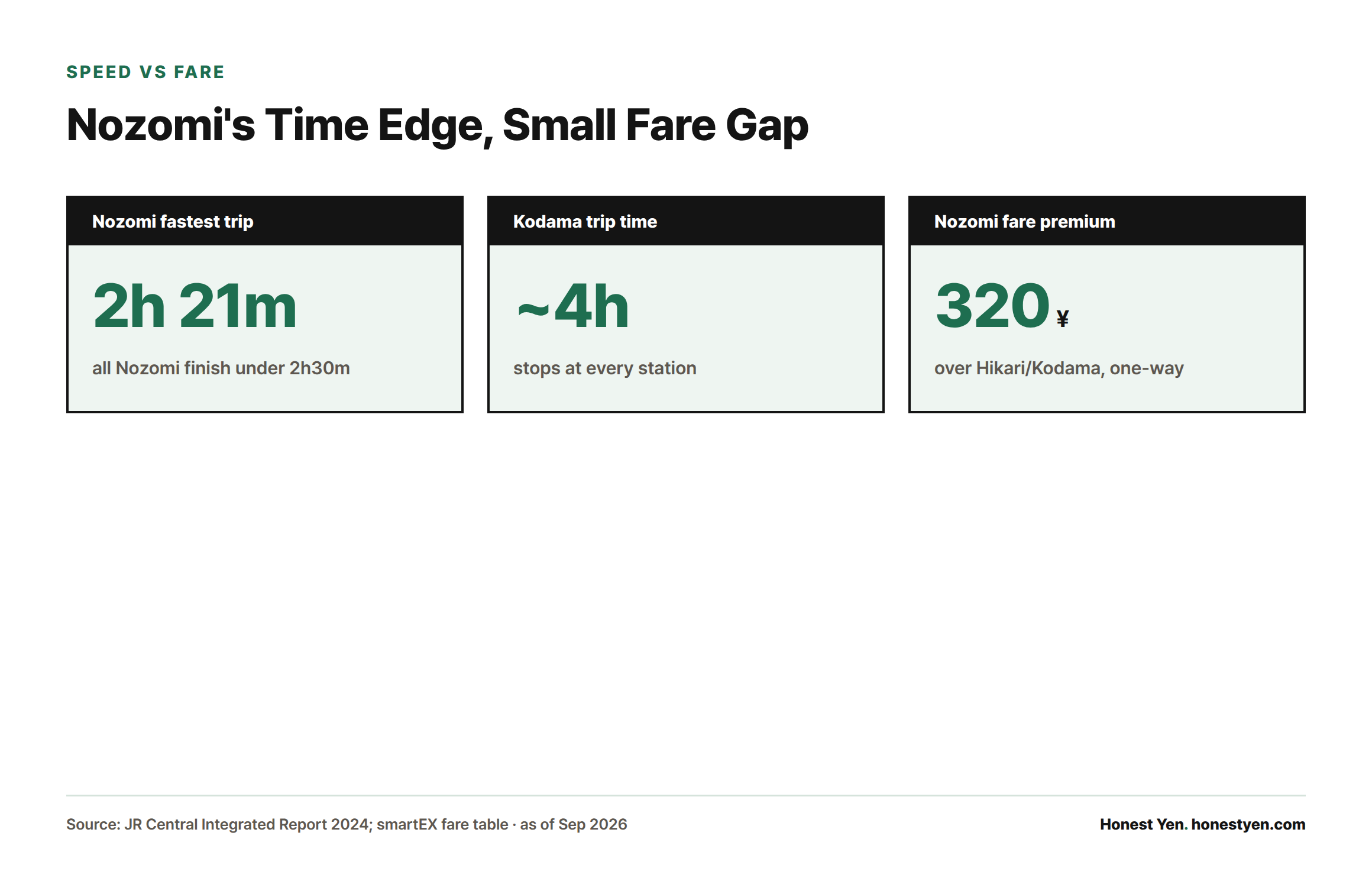
Nozomi’s fastest services cover Tokyo to Shin-Osaka in 2 hours 21 minutes, and every Nozomi finishes the run within 2 hours 30 minutes[10]. Kodama, stopping at every station, needs about 4 hours for the same trip[5].
That roughly 90-minute gap costs just ¥320 in reserved-seat fare: Nozomi’s ¥14,520 one-way fare sits only ¥320 above the shared ¥14,200 fare for Hikari and Kodama[7].
| Train | Tokyo/Shinagawa to Shin-Osaka fare | Approx. travel time | Covered by Japan Rail Pass |
|---|---|---|---|
| Nozomi | ¥14,520[7] | 2h21m fastest, under 2h30m all trains[10] | No, needs a separate supplement[1][4] |
| Hikari | ¥14,200[7] | Longer than Nozomi, stops at a few more stations[10] | Yes, free[1] |
| Kodama | ¥14,200[7] | About 4h, stops at every station[5] | Yes, free[1] |
What the Tokyo to Shin-Osaka run actually costs
SmartEX’s published reserved-seat fares below are listed as of April 2025[7]. The Puratto Kodama, Japan Rail Pass and supplement prices are current as of September 2026[5][2][4]. All fares are one adult, ordinary car, regular season, one-way unless marked round trip.
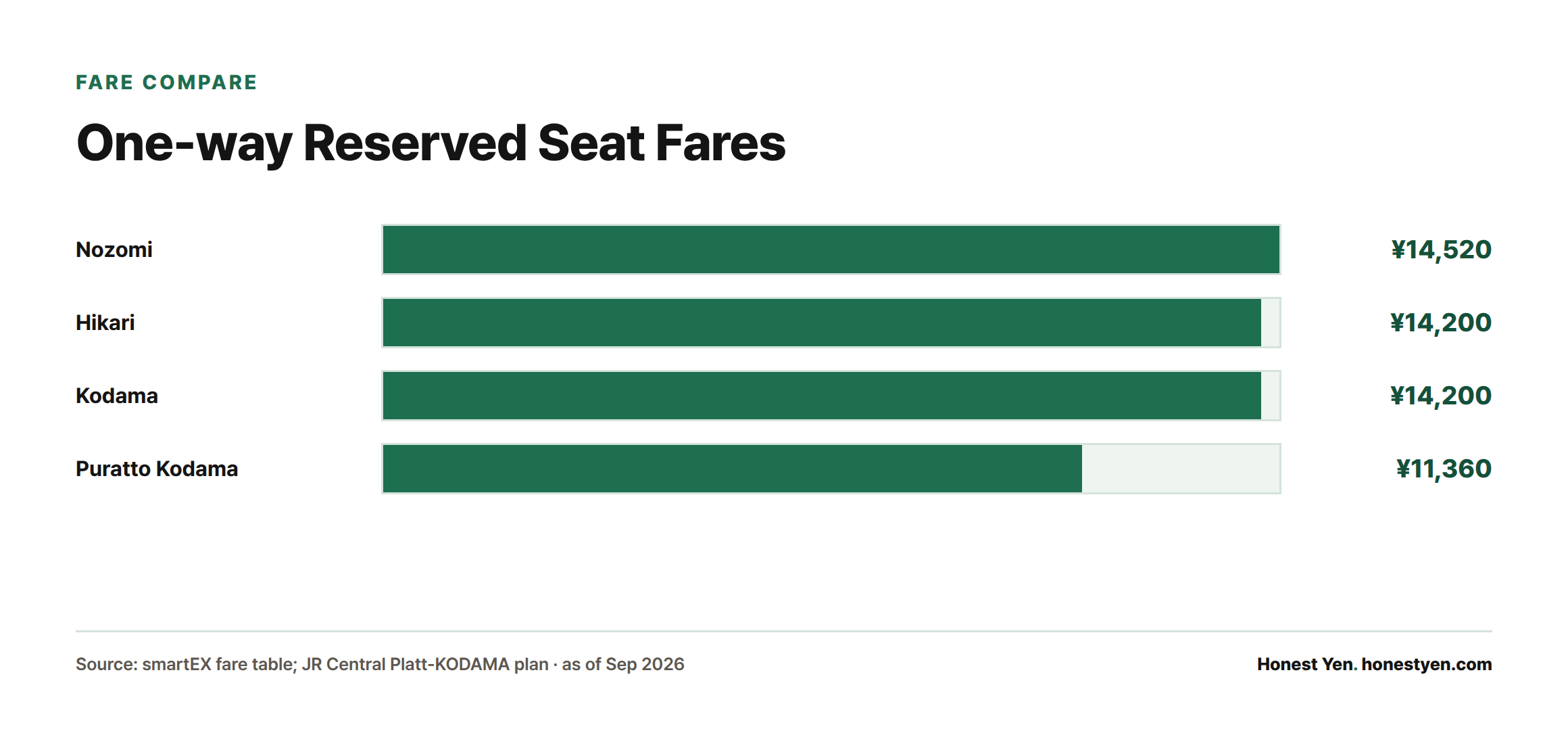
| Item | Nozomi, solo | Hikari, solo | Kodama, solo | Puratto Kodama, solo | 7-day Pass + Nozomi supplement, couple round trip to Kyoto | 7-day Pass + Hikari, couple round trip to Kyoto |
|---|---|---|---|---|---|---|
| Base fare or pass | ¥14,520[7] | ¥14,200[7] | ¥14,200[7] | ¥11,360[5] | ¥50,000 × 2[2] | ¥50,000 × 2[2] |
| Extra charge | – | – | – | 1 drink e-voucher[5] | ¥4,960 × 4 legs[4] | ¥0[1] |
| Total | ¥14,520 | ¥14,200 | ¥14,200 | ¥11,360 | ¥119,840 | ¥100,000 |
Puratto Kodama stays purchasable online until 11:30p.m. the day before departure[5].
Hikari pays off with a Japan Rail Pass
Hikari’s reserved-seat fare is identical to Kodama’s, ¥14,200 one-way[7], so paying full fare for Hikari buys nothing over Nozomi except a slower, cheaper-by-¥320 ride. What changes the calculation is the pass: a 7-day ordinary-car Japan Rail Pass costs ¥50,000 per adult online[2] and covers Hikari’s seat at no extra charge[1].
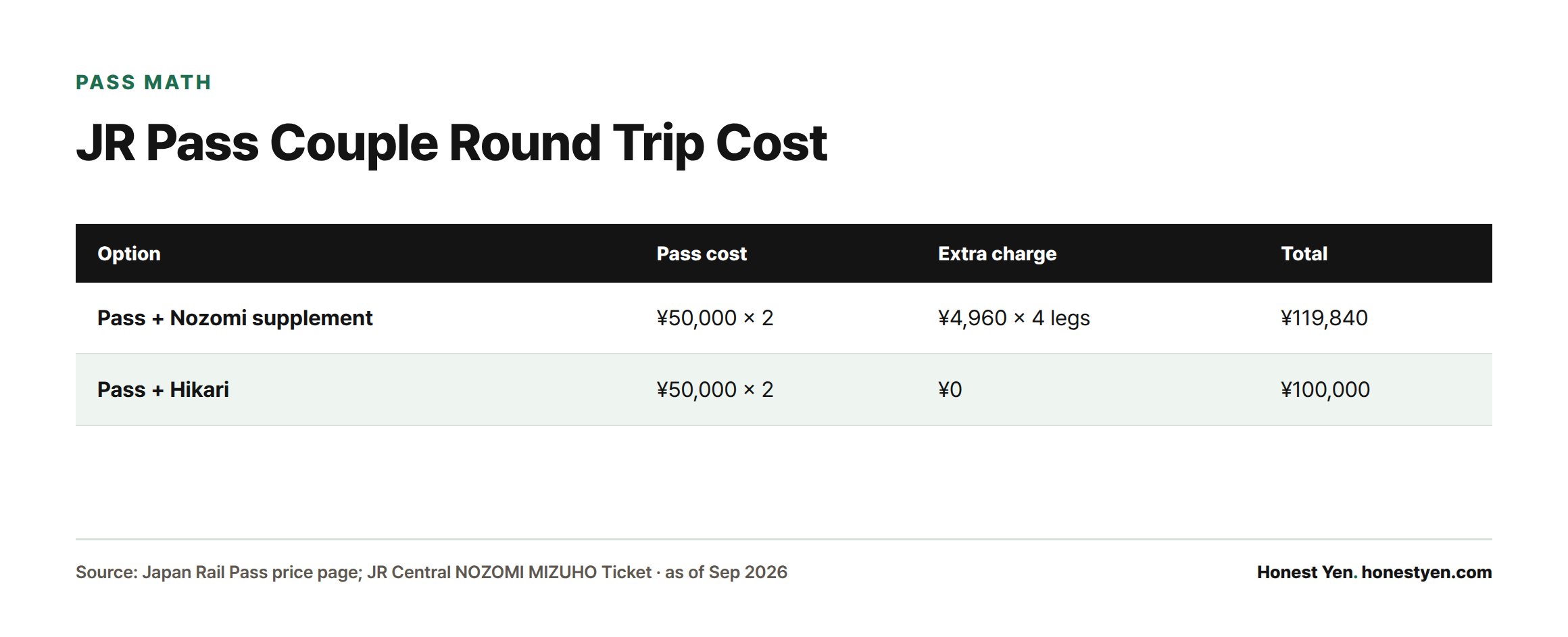
Anyone riding on a pass should default to Hikari rather than paying the Nozomi/Mizuho Ticket supplement, unless the time saved is worth ¥4,960 per leg[4] to them.
Kodama’s real discount is Puratto Kodama, not the base fare
Riding standard Kodama at its walk-up reserved fare saves nothing over Hikari, since both charge ¥14,200[7]. The actual saving comes from booking Puratto Kodama, a package fare of ¥11,360 in ordinary car or ¥12,550 in Green Car[5]. Each ticket is bundled with a drink e-voucher or Local Select Coupon[5].
For comfort over price, a Green Car seat on a faster train is the better comparison. Puratto Kodama is sold as its own travel product, bought instead of using a Japan Rail Pass for that leg. Registration for the free membership needed to buy it carries no annual fee[5].
Book Shinkansen tickets by train name
Smart EX and station ticket machines sell seats by train name, so you choose Nozomi, Hikari or Kodama specifically rather than just a Tokyo to Shin-Osaka ticket[6]. Once a Suica, ICOCA or other registered transport IC card is linked to a smartEX account, you touch it at the ticket gate and board[8]. No paper ticket or printed QR code is needed.
IC cards issued to foreign visitors, such as Welcome Suica or PASMO PASSPORT, are the exception. If the card has not already been used at a PASMO or Suica-area station, you cannot use it to board the Shinkansen[9].
Mistakes that cost first-time visitors time or money
- Assuming a Japan Rail Pass covers Nozomi outright, then paying full undiscounted fare at the gate instead of the ¥4,960 NOZOMI MIZUHO Ticket supplement[4].
- Stacking the Nozomi/Mizuho Ticket with another discount, when the ticket cannot be combined with other discounts[3].
- Treating Puratto Kodama as an add-on to a Japan Rail Pass rather than a standalone package bought in its place.
- Assuming a paper ticket is mandatory when a registered domestic IC card, or an already-activated tourist IC card, can tap straight through the gate[8].
Sources
- Japan Rail Pass, Scope of validity
- Japan Rail Pass, Price
- Japan Rail Pass, Use of NOZOMI/MIZUHO trains
- Central Japan Railway Company, NOZOMI MIZUHO Ticket for Japan Rail Pass holders
- Central Japan Railway Company, Platt-KODAMA plan
- smartEX, Fare overview
- smartEX, Ordinary Car reserved seat fare table (PDF)
- smartEX, Boarding with an IC card
- smartEX, FAQ on IC cards for foreign visitors
- Central Japan Railway Company, Integrated Report 2024 (PDF)