Hiroshima & Miyajima in One Day: The Hour-by-Hour Itinerary (2026)
This post may contain affiliate links. If you book or buy through them, we may earn a commission at no extra cost to you.
Miyajima is one of the few day trips in Japan where the schedule matters as much as the sights. Get the tide wrong and the famous floating torii gate is either stranded on mud or invisible under a puddle of tourists wading toward it. This guide is built around verified transport times, official ropeway and museum hours, and the tide table Miyajima’s own tourist association publishes — so you can plan the day in blocks of minutes, not vague “morning” and “afternoon” slots. Figures below are current as of August 2026; always recheck tide times for your actual travel date before you go.
Is one day really enough for Miyajima?
Yes, for the core loop: Itsukushima Shrine, the Great Torii, the Omotesando shopping street, and a return trip on the Mount Misen ropeway comfortably fit into 5–6 hours on the island. What doesn’t fit easily is adding Hiroshima’s Peace Memorial Park and Atomic Bomb Dome into the same relaxed day — you can do both, but it means an early start (before 8:00) and treating Miyajima as a half-day rather than a full leisurely one. If you’d rather not rush, split them: Miyajima as its own full day, Peace Memorial Park as a two-to-three-hour stop on the morning or evening you arrive in or leave Hiroshima.
Getting from Hiroshima to Miyajima: JR ferry vs. Hiroden vs. passes
There are two practical routes from central Hiroshima to the ferry terminal at Miyajimaguchi, plus a private ferry operator as a third option once you’re there.
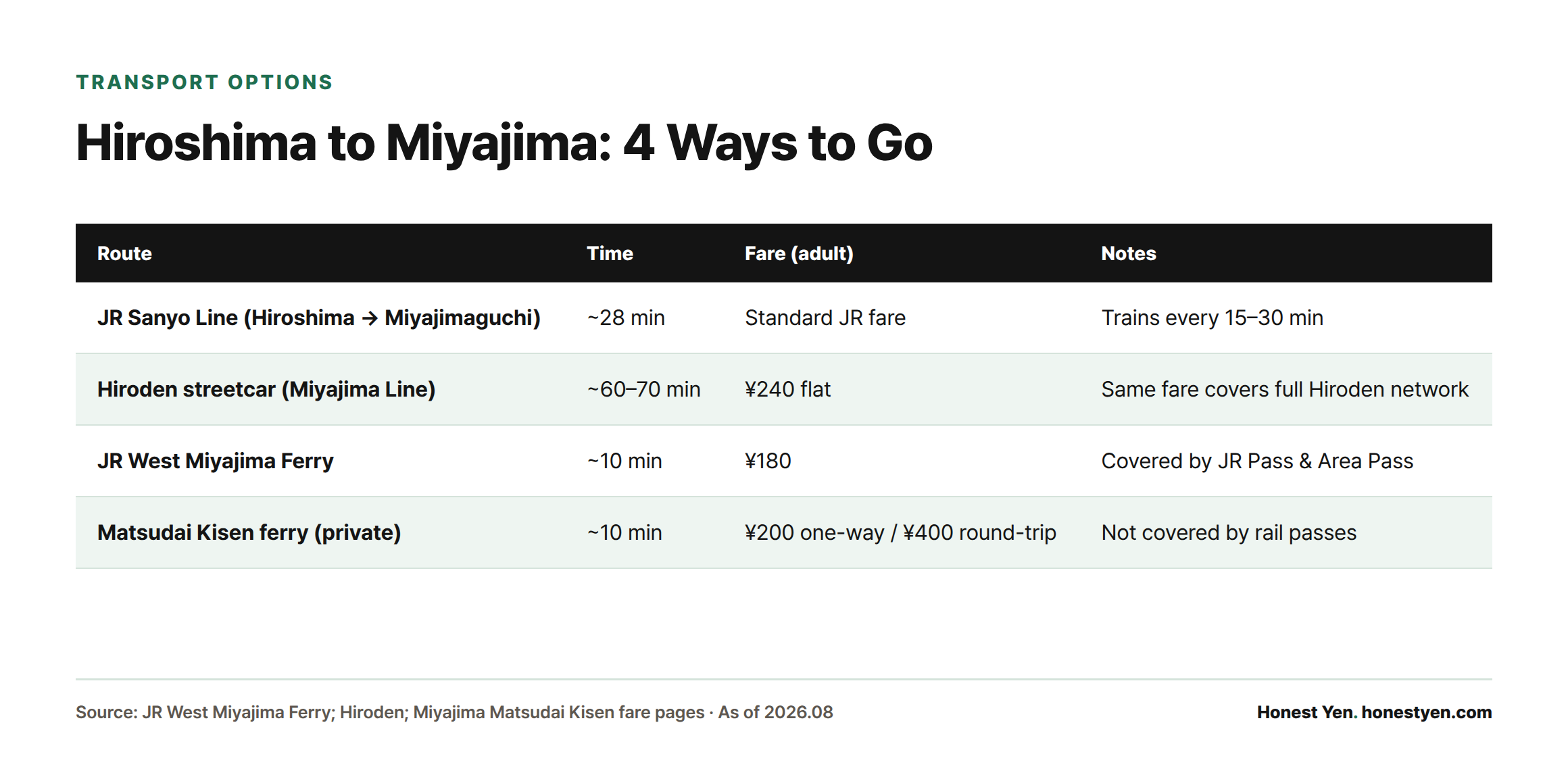
| Route | Time | Fare (one-way, adult) | Notes |
|---|---|---|---|
| JR Sanyo Line, Hiroshima Sta. → Miyajimaguchi Sta. | ~28 min[1] | Standard JR fare (IC or ticket) | Fastest option; trains run roughly every 15–30 minutes |
| Hiroden streetcar, Miyajima Line (from downtown) | ~60–70 min from Hiroshima Sta. | ¥240 flat fare[2] | Same flat fare covers the entire Hiroden network, including the tram to the Atomic Bomb Dome |
| JR West Miyajima Ferry, Miyajimaguchi → Miyajima | ~10 min[3] | ¥180[4] | Departs every 15 min in peak hours; covered by JR Pass and the Hiroshima-Yamaguchi Area Pass[5] |
| Miyajima Matsudai Kisen ferry (private operator) | ~10 min | ¥200 one-way / ¥400 round-trip[6] | Not covered by JR passes; useful if you’re already on a Hiroden-based itinerary |
If you’re carrying a Japan Rail Pass or the JR West Hiroshima-Yamaguchi Area Pass (¥15,000 adult / ¥7,500 child for 5 days), the JR ferry is included at no extra cost beyond the visitor tax[5]. If you’re using an IC card such as Suica or ICOCA for the rest of your trip, both the JR train and JR ferry accept it — worth knowing if you’re still deciding which card fits your itinerary, as covered in our Suica vs ICOCA comparison. The private Matsudai ferry does not accept rail passes, so if pass coverage matters, take the JR ferry.
Both ferries cross from the same general terminal area and land at the same Miyajima pier, so the choice mostly comes down to whether your rail pass already covers one of them.
Hour-by-hour itinerary: Hiroshima Station to Miyajima and back
This assumes a same-day return to Hiroshima and includes the Peace Memorial Park. If you’re skipping the park, add the freed-up hour to Mount Misen or lunch.
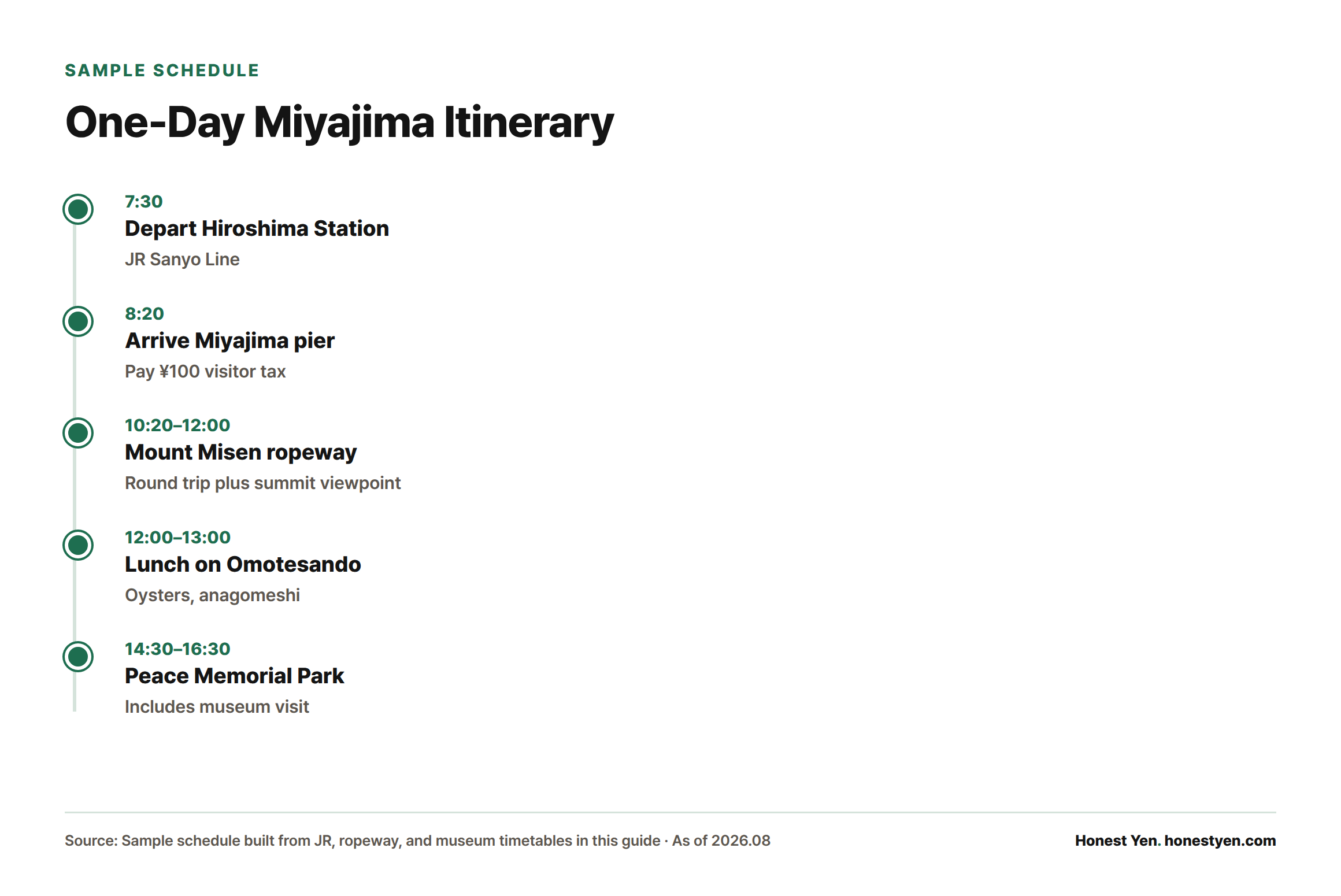
| Time | Activity |
|---|---|
| 7:30 | Depart Hiroshima Station on the JR Sanyo Line |
| 7:58 | Arrive Miyajimaguchi Station; walk 3–5 min to the ferry pier |
| 8:10 | Board JR ferry (10-minute crossing) |
| 8:20 | Arrive Miyajima pier; pay the ¥100 visitor tax if not already collected with your ferry ticket[7] |
| 8:20–9:00 | Walk the shoreline path to Itsukushima Shrine before the crowds build; photograph the torii against the morning tide |
| 9:00–10:00 | Enter and walk through Itsukushima Shrine’s covered boardwalk |
| 10:00–10:20 | Walk to the ropeway boarding shuttle stop near the pier area |
| 10:20–12:00 | Mount Misen ropeway round trip plus summit viewpoint |
| 12:00–13:00 | Lunch on Omotesando shopping street (oysters, anagomeshi) |
| 13:00–13:30 | Second look at the torii at a different tide stage, momiji manju shopping |
| 13:45 | Ferry back to Miyajimaguchi |
| 14:00 | JR train back toward Hiroshima; get off at Genbaku Dome-mae via a transfer, or continue to Hiroshima Station and take the tram |
| 14:30–16:30 | Peace Memorial Park and Peace Memorial Museum |
| 17:00 | Return to Hiroshima Station |
This is a template, not a fixed script — the one variable that should actually override this schedule is the tide, covered next.
Itsukushima Shrine and the Great Torii: why the tide is the whole game
Itsukushima Shrine and its offshore torii gate are built to sit directly over the water. At high tide, the shrine buildings and the gate appear to float — this is the postcard image most visitors are chasing. At low tide, the water recedes far enough that you can walk out across the sand to touch the base of the torii itself, which is a completely different (and for many visitors, more memorable) experience.
Miyajima’s official tourist association publishes an hourly tide table for exactly this purpose[8]. Look up your travel date before you leave home, note the times of high tide (満潮) and low tide (干潮), and build your visit around whichever effect you want to see — or plan two passes through the shrine area, once near each tide extreme, since the change between them typically plays out over five to six hours. Tide levels shift daily, so a generic “go in the morning” rule isn’t reliable; check the specific date.
Mount Misen ropeway vs. hiking
Mount Misen, the sacred mountain behind the shrine, has a summit viewpoint reachable either by ropeway or on foot via marked hiking trails (roughly 2–2.5 hours each way on the main routes). For a one-day itinerary that also covers the shrine and food, the ropeway is the realistic choice.
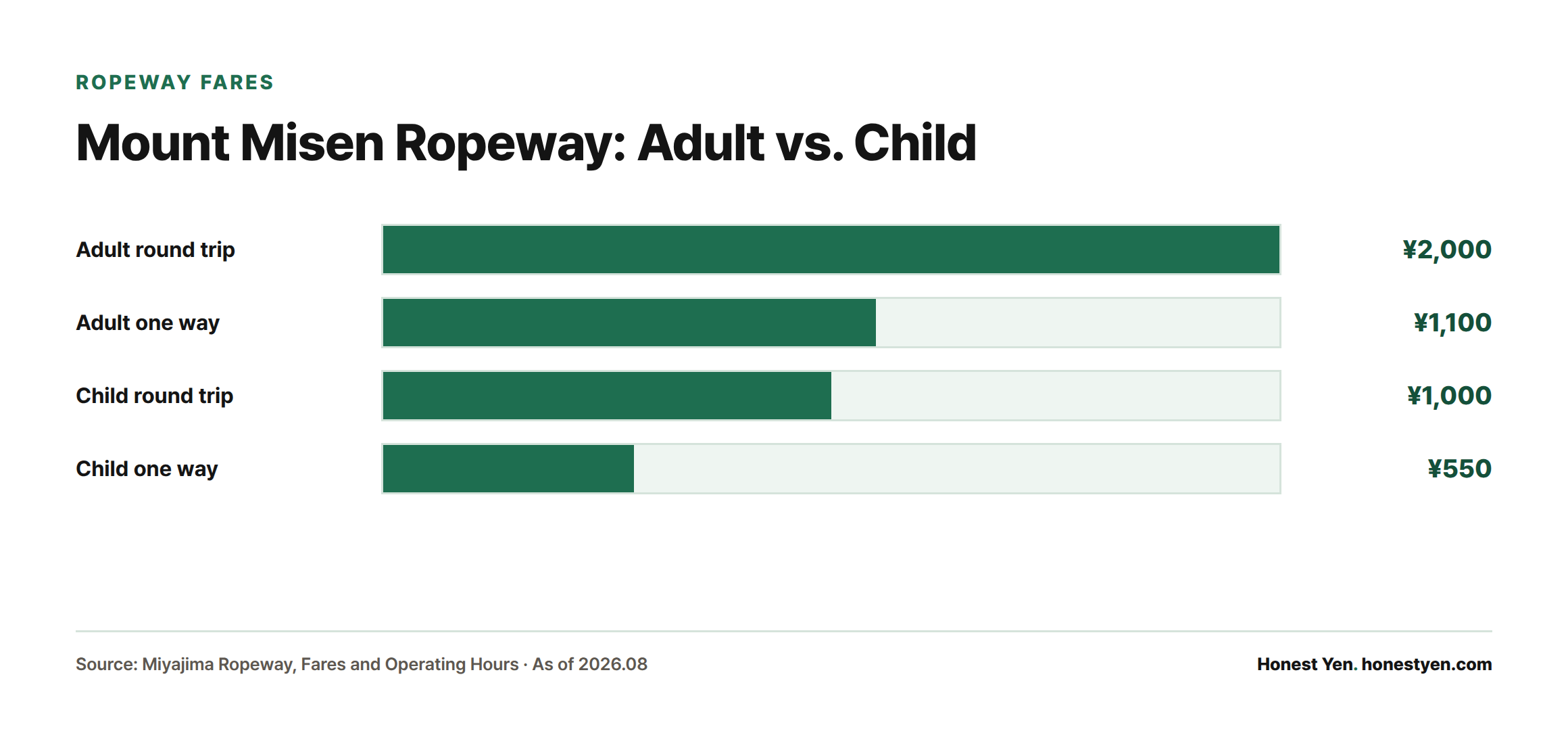
| Ropeway fare | Adult | Child (6–11) |
|---|---|---|
| Round trip | ¥2,000 | ¥1,000 |
| One way | ¥1,100 | ¥550 |
Operating hours run 9:00–16:00 for the ascent, with the last descent at 16:30[9]. The ropeway itself involves a transfer between two cable lines, and reaching the summit observation deck from the upper ropeway station adds a further 15–30 minute walk. Budget around 1.5–2 hours total for the round trip including the summit walk. If you’re an experienced hiker with more time and want to skip the ropeway fee, the trail is well-marked, but it removes any margin for the Peace Memorial Park add-on.
What to eat on Omotesando: oysters, anagomeshi, and momiji manju
The Omotesando shopping street running from the ferry pier toward the shrine is where most food stops happen, and it rewards knowing what you’re looking for rather than picking the first stall with a queue.
- Grilled oysters (kaki): Hiroshima Prefecture is Japan’s largest oyster-producing region, and Miyajima stalls grill them to order, often with a squeeze of ponzu or a shell half-shucked for easy eating. Fried oysters (kaki-fry) and oyster donburi are the other common formats.
- Anagomeshi: Conger eel (anago, a saltwater relative of unagi) simmered in a sweet soy glaze over rice. It’s Miyajima and Hiroshima’s signature rice bowl and is worth prioritizing over eel dishes elsewhere in Japan — this is where it’s a specialty rather than an import.
- Momiji manju: Small maple-leaf-shaped cakes, traditionally filled with sweet red bean paste, now also sold in chocolate, custard, and cheese variants. Several shops on Omotesando grill them fresh and let you sample a piece before buying a box.
Sit-down restaurants serving anagomeshi and oyster sets tend to have the longest queues around midday — arriving right when the shrine opens and eating lunch slightly before or after the 12:00–13:00 peak avoids most of the wait.
Combining Miyajima with the Atomic Bomb Dome and Peace Memorial Park
The two sites sit on opposite ends of a single Hiroshima day, connected by the same JR line and tram network you’re already using. The practical transfer point is Hiroshima Station: after returning from Miyajima on the JR train, either continue on the Hiroden tram (¥240 flat fare, roughly 15–20 minutes) to the Genbaku Dome-mae stop, or transfer at a connecting station depending on which JR/tram combination your IC card route suggests that day.
The Peace Memorial Museum’s hours vary by month — 7:30–19:00 in most of the year, extended to 20:00 in August, and shortened to 18:00 from December through February[10] — so check the current month’s closing time before planning your last entry, since admission stops 30 minutes before close. Adult admission is ¥200[10]. Walking the Peace Memorial Park itself (the Atomic Bomb Dome, the Children’s Peace Monument, the cenotaph) takes about 30–45 minutes without the museum, or 2–2.5 hours including a full museum visit.
Practical checklist
- Visitor tax: ¥100 per person, charged when boarding either ferry to Miyajima; preschool-age children are exempt[7]. It’s usually bundled into your ferry ticket automatically rather than collected separately.
- Deer: Miyajima’s sika deer roam freely near the pier and shrine and will approach food, paper maps, and open bags. Don’t feed them — it’s discouraged by local signage, and deer that associate humans with food become more aggressive toward the next visitor.
- Rain contingency: Itsukushima Shrine’s boardwalk and the covered sections of Omotesando are walkable in light rain; the ropeway typically suspends operation in high wind or heavy rain, so build in a shrine-and-food-only backup plan if the forecast looks rough.
- Autumn foliage season (mid-November): This is Miyajima’s peak crowd period, especially around Momijidani Park near the ropeway base. Arrive at the first ferry departure if visiting during this window, and expect ropeway queues to extend the 1.5–2 hour estimate above.
- Cash: Small food stalls on Omotesando are far more likely to be cash-only than sit-down restaurants. Carry yen in small denominations; card and IC acceptance is improving but not universal at street-food counters.
- Luggage: There’s no large coin-locker infrastructure on Miyajima itself — leave big suitcases at a locker in Hiroshima Station before heading out, since navigating the shrine boardwalk and ropeway queues with wheeled luggage is impractical.
Sources
- JR West Miyajima Ferry, Access Information
- Hiroshima Electric Railway (Hiroden), Fare and Usage Information
- JR West Miyajima Ferry, Timetable
- JR West Miyajima Ferry, Fare
- West Japan Railway Company, Hiroshima-Yamaguchi Area Pass Information
- Miyajima Matsudai Kisen, Fare Information
- Hatsukaichi City / Miyajima Visitor Tax Official Page
- Miyajima Tourist Association, Tide Table
- Miyajima Ropeway, Fares and Operating Hours
- Hiroshima Peace Memorial Museum, Official Site