Narita Airport to Tokyo: Skyliner vs N’EX vs Bus vs Taxi Compared (2026)
This post may contain affiliate links. If you book or buy through them, we may earn a commission at no extra cost to you.
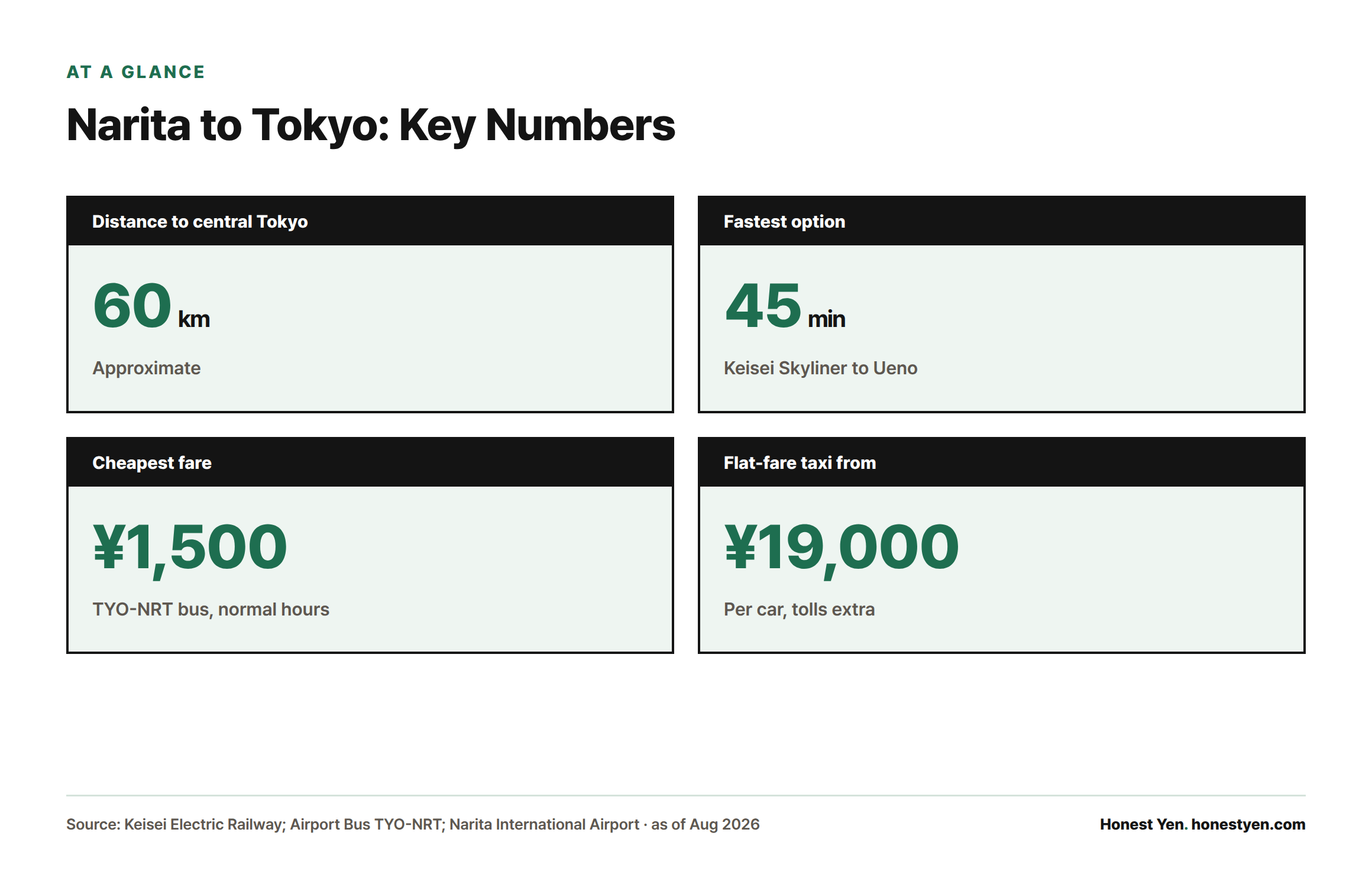
Narita Airport sits roughly 60 km from central Tokyo, so getting into the city is the first logistical decision every visitor makes. There is no single “best” option — the right choice depends on where you’re staying, how much luggage you’re hauling, and what time your flight lands. This guide compares every practical route as of August 2026, with verified fares and times from each operator.
Quick comparison: which one fits your trip
| Option | One-way fare (adult) | Travel time | Arrival point | Best for |
|---|---|---|---|---|
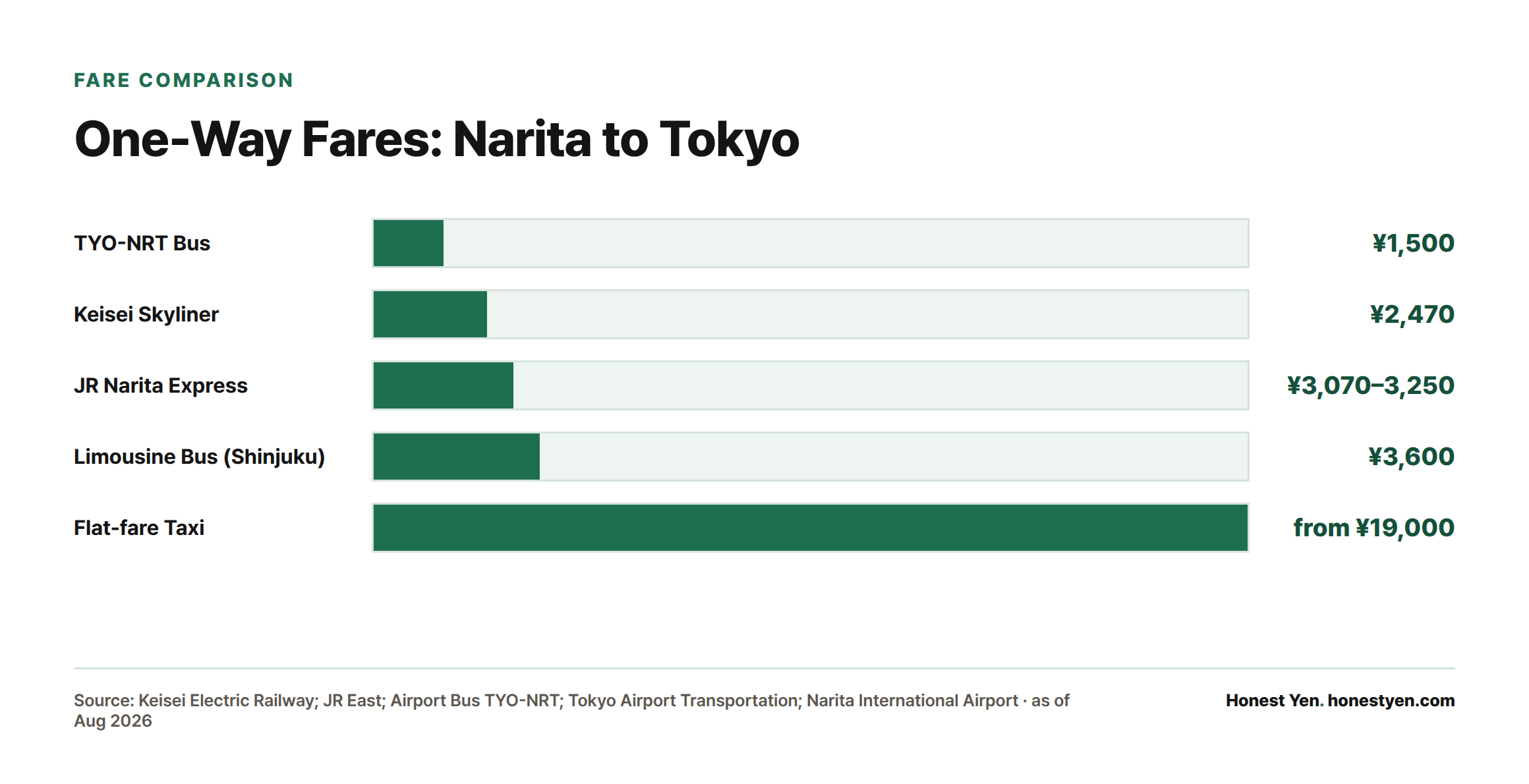
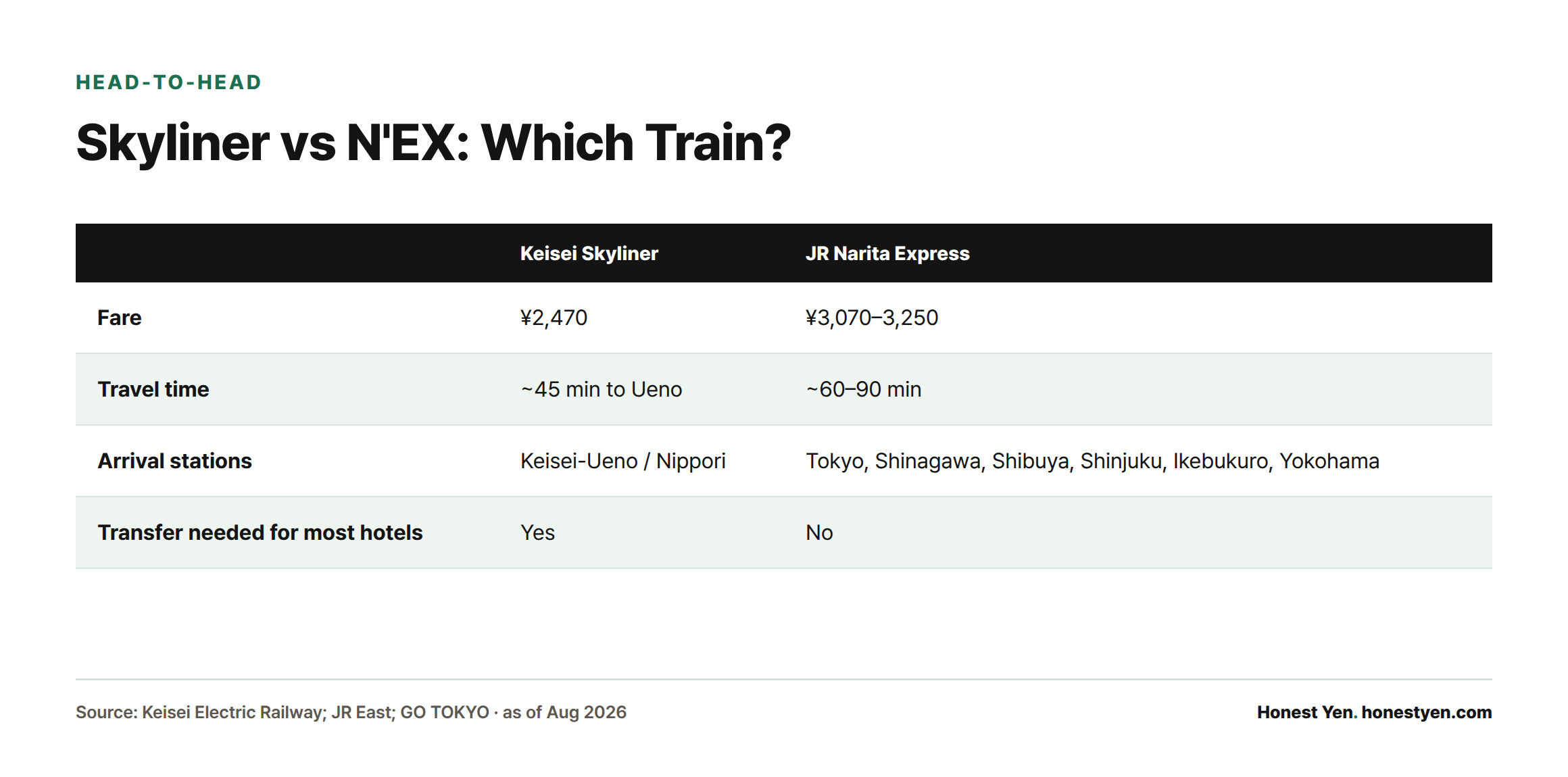
| Keisei Skyliner | ¥2,470[1] | ~45 min to Ueno[3] | Keisei-Ueno / Nippori | Fastest option; Ueno, Asakusa, Skytree side |
| JR Narita Express (N’EX) | ¥3,070–3,250[4] | ~60–90 min[3] | Tokyo, Shinagawa, Shibuya, Shinjuku, Ikebukuro, Yokohama | One-seat ride to major JR hubs; JR Pass holders |
| Low-cost bus (TYO-NRT) | ¥1,500 (¥3,000 late-night/early-morning)[3][5] | ~65–80 min[3] | Tokyo Station, Ginza | Budget travelers, light packers |
| Airport Limousine Bus | from ¥3,600 (Shinjuku)[7] | ~105 min[7] | Major hotels across Tokyo | Door-to-door near your hotel, heavy luggage |
| Taxi (flat-fare) | from ¥19,000[6] | ~60–90 min (traffic-dependent) | Any address | Groups of 3–4, very late arrivals |
| Rental car | Varies by company | ~60–90 min (traffic-dependent) | Any address | Onward road trips, not recommended for a Tokyo-only stay |
Keisei Skyliner — the fastest way into the city
The Skyliner is a reserved-seat limited express that runs non-stop from the airport into northeast Tokyo. The one-way fare is ¥2,470, dropping to ¥2,465 when you tap an IC card such as Suica or Pasmo at the gate instead of buying a paper ticket; a child’s fare is ¥1,240[1]. Journey time is about 45 minutes to Keisei-Ueno, with an intermediate stop at Nippori a few minutes earlier[3], and trains run roughly every 20 minutes through the day[2]. All seats are reserved, so buy your ticket (paper or via the Keisei app/e-ticket) before boarding — walk-up purchase at the airport counter is normal and does not cost more than booking ahead. Note that the Skyliner terminates at Keisei-Ueno and Nippori only; if your hotel is elsewhere, you’ll need to change to the JR Yamanote Line at either station, which both share the same station building as their JR counterparts.
JR Narita Express (N’EX) — direct to Tokyo, Shinjuku or Shibuya
The Narita Express is JR East’s reserved-seat airport train and the only rail option that reaches central Tokyo without a transfer. A one-way ordinary-car ticket costs ¥3,070 to Tokyo Station, and ¥3,250 to Shinagawa, Shibuya or Shinjuku (Green Car adds roughly ¥770)[4]. Travel time is about 60 minutes to Tokyo Station and around 90 minutes to Shinjuku[3]. Overseas visitors can buy the N’EX Tokyo Round Trip Ticket for ¥5,200, valid 14 days, which saves ¥1,460 versus two one-way fares to Shinagawa, Shibuya or Shinjuku[4]. If you’re carrying a Japan Rail Pass, N’EX rides are included at no extra cost — you still need to claim a free seat reservation at a JR ticket counter or machine before boarding, since all seats are reserved[4]. The JR ticket office at Narita Airport also handles Rail Pass exchange, so first-time pass holders can activate their pass and reserve their N’EX seat in the same stop.
Low-cost bus (Airport Bus TYO-NRT) — the budget option
TYO-NRT (the merged successor to the former Tokyo Shuttle and The Access Narita) runs frequent highway coaches between the airport and central Tokyo for ¥1,500 one-way during normal hours, rising to ¥3,000 for designated late-night and early-morning departures (child fare ¥1,500 on those runs)[5]. It takes about 65 minutes to Tokyo Station and around 80 minutes to Ginza[3], roughly the same door-to-seat time as N’EX once you account for walking and waiting, at less than half the price. The tradeoff is fewer drop-off points — Tokyo Station and Ginza only — and less luggage space than the Limousine Bus, so this suits travelers with one or two bags rather than a family with a full set of check-in luggage. Reservations are recommended in peak season since seats can sell out, though same-day tickets are usually available outside holiday weeks.
Airport Limousine Bus — direct to your hotel
Operated by Tokyo Airport Transportation, the Limousine Bus network stops at dozens of major hotels and stations across the city, so it’s the only option that can drop you within walking distance of your actual accommodation rather than a station. The Narita–Shinjuku route costs ¥3,600 for an adult (¥1,800 for a child) and takes about 105 minutes[7]; fares and journey times vary by destination, so check the route for your specific hotel or stop on the operator’s site before booking. Large under-bus luggage storage makes this the most comfortable choice for families or anyone traveling with oversized bags, at the cost of a longer, traffic-dependent ride.
Taxi and flat-fare services — for groups and late-night arrivals
A metered taxi from Narita to central Tokyo typically runs into the tens of thousands of yen once expressway tolls are added, so most travelers who choose this route use a flat-fare (teigaku) taxi instead. Flat fares to Tokyo’s 23 wards start from ¥19,000 per car, with expressway tolls charged separately and a late-night/early-morning surcharge applied between 22:00 and 5:00[6]. No reservation is required — simply ask the driver at the taxi stand to confirm the flat-fare zone for your destination before you get in. Split three or four ways, this can undercut individual N’EX or Limousine Bus tickets, and it’s the only option that runs door-to-door at any hour, including the middle of the night.
Rental car — only if you’re driving beyond Tokyo
Nippon Rent-A-Car and Toyota Rent a Car both operate counters at Terminal 1 and Terminal 2, generally open from around 07:00–08:00 to 20:00; the rental office itself is off-site, reached by a free shuttle that takes about 15–30 minutes from the terminal[8]. Cars picked up at Narita cannot be returned there after a one-way Tokyo trip, and the last pickup slot is 20:00[8], which rules this out for late arrivals. Driving in central Tokyo means dealing with left-hand traffic, expensive expressway tolls, and scarce, costly parking, so a rental car makes sense mainly if you’re heading straight out of the city — to Hakone, Nikko, or a road trip — rather than as a way to reach a Tokyo hotel.
Best transport by hotel area
| Staying near | Recommended | Why |
|---|---|---|
| Shinjuku or Shibuya | N’EX, or Limousine Bus if you have heavy luggage | N’EX runs direct with no transfer; Limousine Bus stops at hotel doors nearby |
| Ueno or Asakusa | Skyliner | Direct, fastest, and cheapest rail option to this side of the city |
| Tokyo Station / Ginza / Nihonbashi | N’EX or TYO-NRT bus | Both go direct; the bus is far cheaper for the same rough travel time |
| Anywhere, with 3+ people or heavy bags | Flat-fare taxi | Split among a group, it can beat individual train or bus fares while going door-to-door |
Booking tips and FAQ
Skyliner or N’EX — which is better?
Skyliner is faster and cheaper, but only serves Ueno and Nippori. N’EX is slower and pricier but reaches Tokyo, Shinagawa, Shibuya, Shinjuku, Ikebukuro and Yokohama without a transfer[3][4]. Choose based on where you’re actually staying rather than speed alone — a fast train to the wrong station just adds a transfer.
Is booking in advance cheaper than buying at the airport?
For Skyliner and N’EX, the walk-up counter price equals the advance-booking price — there is no discount for booking early. The reason to book ahead is seat availability: during Golden Week, Obon, New Year and other peak periods, N’EX and Skyliner reserved seats — and TYO-NRT bus seats — can sell out, so reserve a few days ahead if you’re traveling in those windows.
What if I land very late at night or very early in the morning?
Skyliner and N’EX do not run 24 hours and stop for the night, resuming the next morning. TYO-NRT runs designated late-night and early-morning departures for a higher ¥3,000 fare[5], which is the cheapest option outside normal train hours. A flat-fare or metered taxi is the only choice that runs at any hour, with a late-night surcharge applied between 22:00 and 5:00[6].
Can Japan Rail Pass holders ride N’EX for free?
Yes. N’EX travel is included with a valid Japan Rail Pass at no extra fare, but you must still pick up a free reserved-seat ticket at a JR ticket counter or machine before boarding, since every seat on the train is reserved[4].
What happens if a typhoon or heavy snow disrupts service?
Narita’s surface access shares the same expressways and rail lines, so trains and expressway buses can be suspended at the same time during severe weather. Check the airport’s live rail and road operation-status pages before you travel on a day with a typhoon or heavy snow warning, and build in extra buffer time — or a same-day flexible itinerary — during typhoon season (roughly August–October).
Sources
- Keisei Electric Railway, Skyliner Fares
- Keisei Electric Railway, Skyliner Guide (Narita Airport Access)
- GO TOKYO (Tokyo Convention & Visitors Bureau), Narita Airport Access Guide
- JR East, N’EX (Narita Express) Tickets
- Airport Bus TYO-NRT, Official Site
- Narita International Airport, Taxi
- Tokyo Airport Transportation, Limousine Bus: Narita–Shinjuku Route
- Narita International Airport, Rental Car