Kyoto Subway & Bus 1-Day Pass: Is It Worth It? (August 2026 Prices + Real Route)
This post may contain affiliate links. If you book or buy through them, we may earn a commission at no extra cost to you.
The Short Answer
The Kyoto Subway & Bus 1-Day Pass costs ¥1,100 for adults and ¥550 for children as of August 2026[1][2]. It pays for itself once you take roughly five rides in a day — four if some of those rides are on the subway rather than the flat-fare bus. If your day is built around three or four spread-out sights (the classic Kinkaku-ji, Nijo Castle, Kiyomizu-dera loop, for example), you’ll usually land right at or just past that break-even point, so the pass is worth buying more often than not — but it isn’t automatic, and this guide shows you the actual math instead of just telling you to buy it.
What the Pass Covers (as of August 2026)
| Adult | Child (elementary school) | |
|---|---|---|
| Price | ¥1,100 | ¥550 |
It covers unlimited rides on both Kyoto Municipal Subway lines (Karasuma Line and Tozai Line), every Kyoto City Bus route, and select routes of Kyoto Bus, Keihan Bus, and West Japan JR Bus within the city[2]. A late-night bus surcharge applies on the last runs of certain lines and is not covered[2].
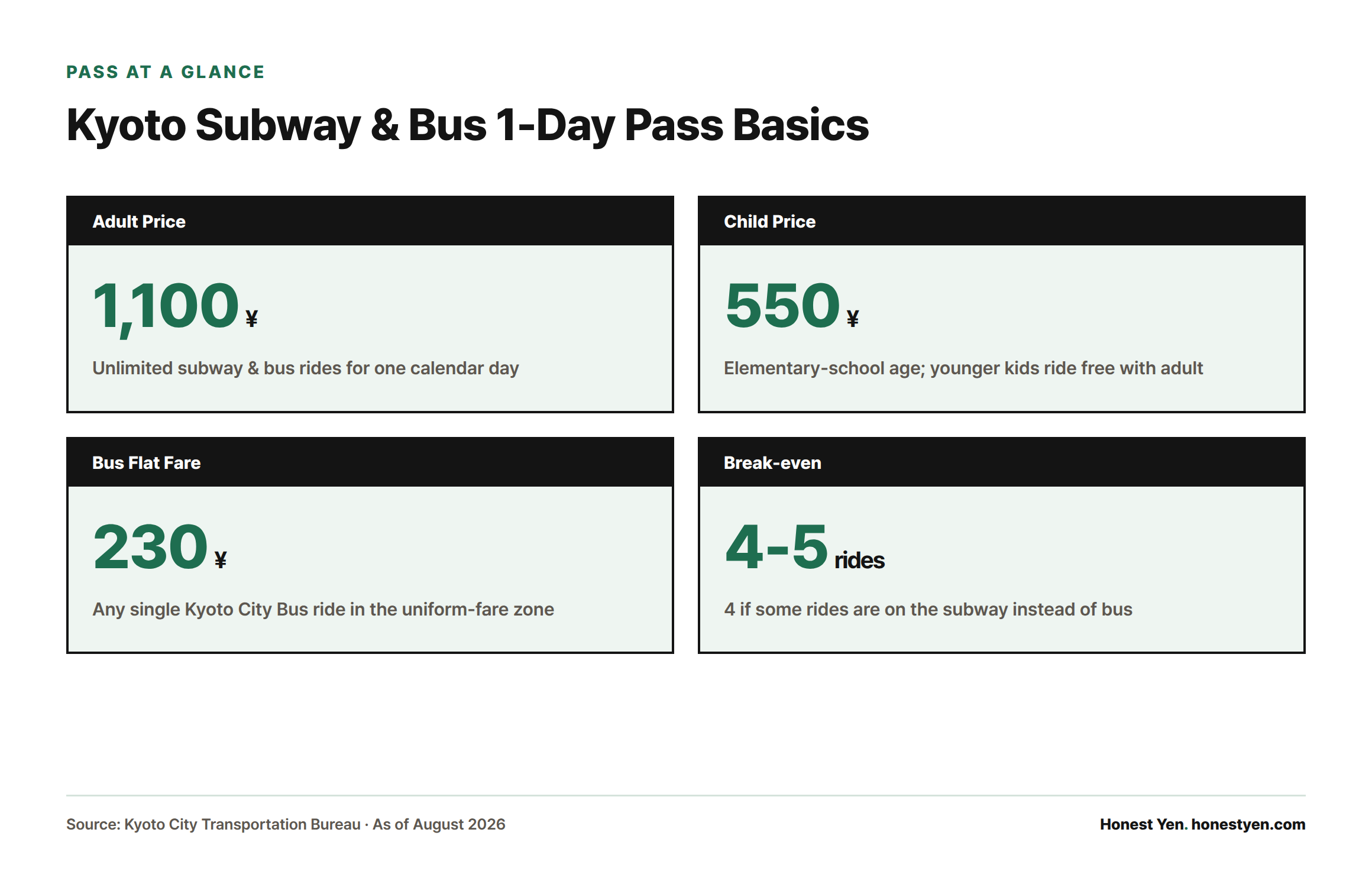
Crucially, this is not a 24-hour pass. It’s valid only on the calendar date you activate it, from first use until that day’s service ends — a 6 a.m. train and an 11 p.m. bus both count as the same “day,” but a ride at 12:30 a.m. does not[1][2]. You can buy the physical card in advance and activate it whenever you first use it.
This is a city-only pass and has nothing to do with the nationwide Japan Rail Pass — it won’t get you on JR trains, including the JR lines that also run through Kyoto Station.
Do the Math: When Does It Pay Off?
Kyoto City Bus rides cost a flat ¥230 for adults (¥120 for children) anywhere within the uniform-fare zone that covers almost all tourist areas[3]. Subway fares are distance-based, starting at ¥220 for 0–3 km and rising to ¥260 (3–7 km), ¥290 (7–11 km), ¥330 (11–15 km), and ¥360 beyond that[4].
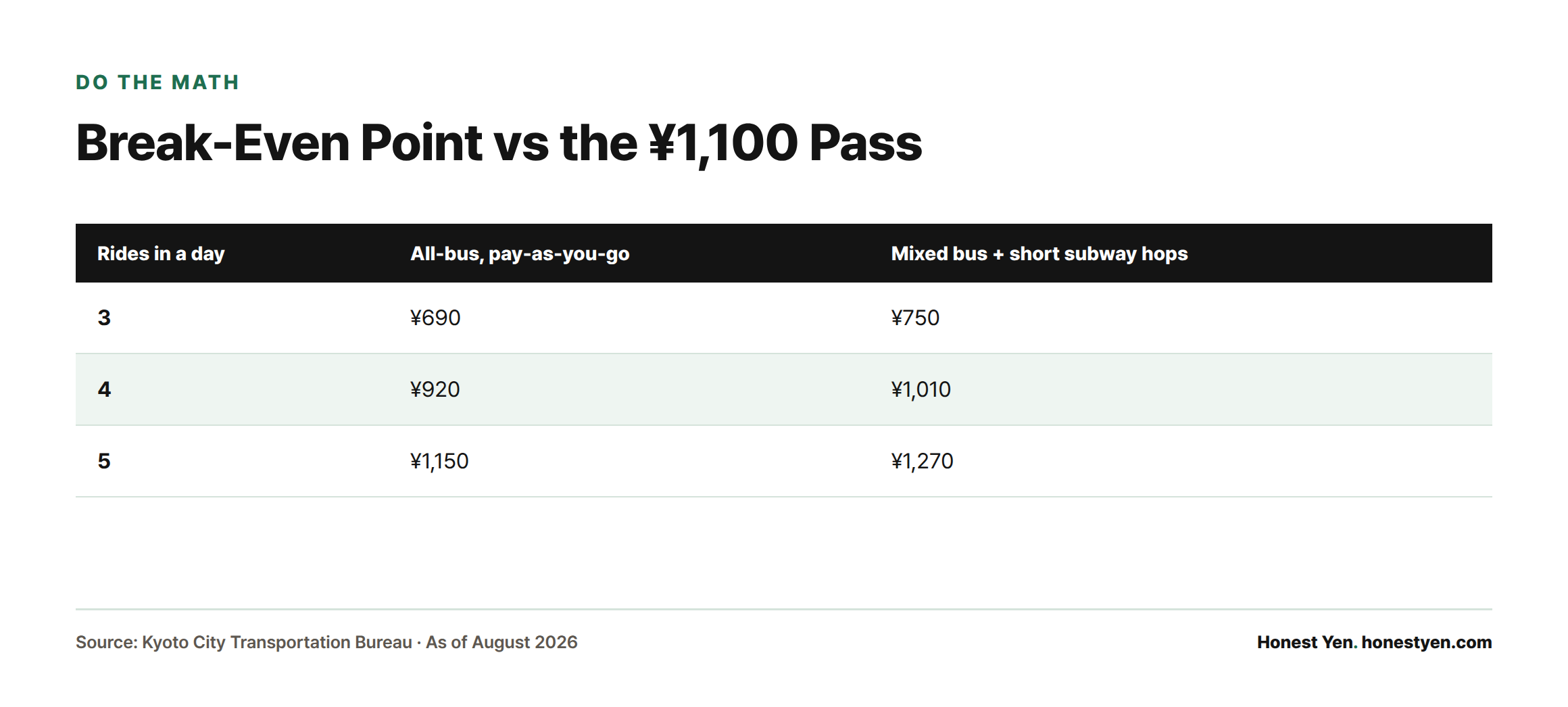
| Rides in a day | All-bus, pay-as-you-go | Mixed bus + short subway hops |
|---|---|---|
| 3 | ¥690 | ¥750 |
| 4 | ¥920 | ¥1,010 |
| 5 | ¥1,150 | ¥1,270 |
Against the ¥1,100 pass, four bus-only rides still costs less out of pocket (¥920); the fifth ride is what tips it in the pass’s favor. If even one or two of those rides are on the subway rather than the bus, you often break even at the fourth ride instead. Kids break even faster relative to the ¥550 child pass, since child fares are exactly half the adult flat-fare rate[3].
Where to Buy It: In Person vs Online
Physical passes are sold at subway station counters (most run roughly 5:30 a.m.–11:30 p.m.), the Kyoto Station bus information counter, Kotochika Kyoto (near the subway’s central ticket gates at Kyoto Station), Kitaoji bus terminal, Karasuma-Oike Station, several bus service offices, and the Kyoto Tourist Information Center (Kyo-Navi) inside Kyoto Station[5]. You can buy it on board some buses too, but availability is limited, so the transportation bureau recommends buying beforehand at one of the fixed locations[5].
There’s also an official digital route: KANSAI MaaS sells a purchasable coupon by credit card, from one month before your travel date up to 7 p.m. on the day itself, which you then exchange for the physical pass at the Kyoto Station Front Information Center or Kotochika Kyoto — both open 7:30 a.m.–7:30 p.m.[7]. It doesn’t skip the counter entirely, but it locks in the ticket and payment ahead of time, which can matter on a first-morning rush at Kyoto Station. If you’re flying into Kansai Airport first, that’s also where most travelers pick up an ICOCA card — see our Kansai Airport transport guide for the pickup counters.
Pass vs. Just Tapping an IC Card
ICOCA and Suica fares are identical to cash fares on Kyoto’s buses and subway — there’s no automatic tourist discount for tapping in[8]. A registered points scheme (もえポっ!) exists for ICOCA and PiTaPa holders, but it requires advance sign-up and monthly ride thresholds, so it’s built for commuters, not a one-day visitor[8].
| 1-Day Pass | ICOCA / Suica | |
|---|---|---|
| Cost logic | Flat ¥1,100, unlimited rides | Pay per ride, no cap |
| Best for | 5+ rides in a day, or a bus/subway-heavy loop | 1–3 rides, or mostly walking with occasional hops |
| Convenience | No balance to track; same card doubles as souvenir | Also works in shops, vending machines, other cities |
If your day involves just a train in and a train back, or you’re mostly walking between close-together sights (Gion, Kiyomizu-dera, and Yasaka Shrine, for instance, are all walkable from each other), an IC card will almost always be cheaper. The pass earns its keep on days with real cross-town movement.
A Real Route: Kinkaku-ji, Nijo Castle, Kiyomizu-dera
This is the classic first-timer’s day, and it happens to sit right at the pass’s break-even line:
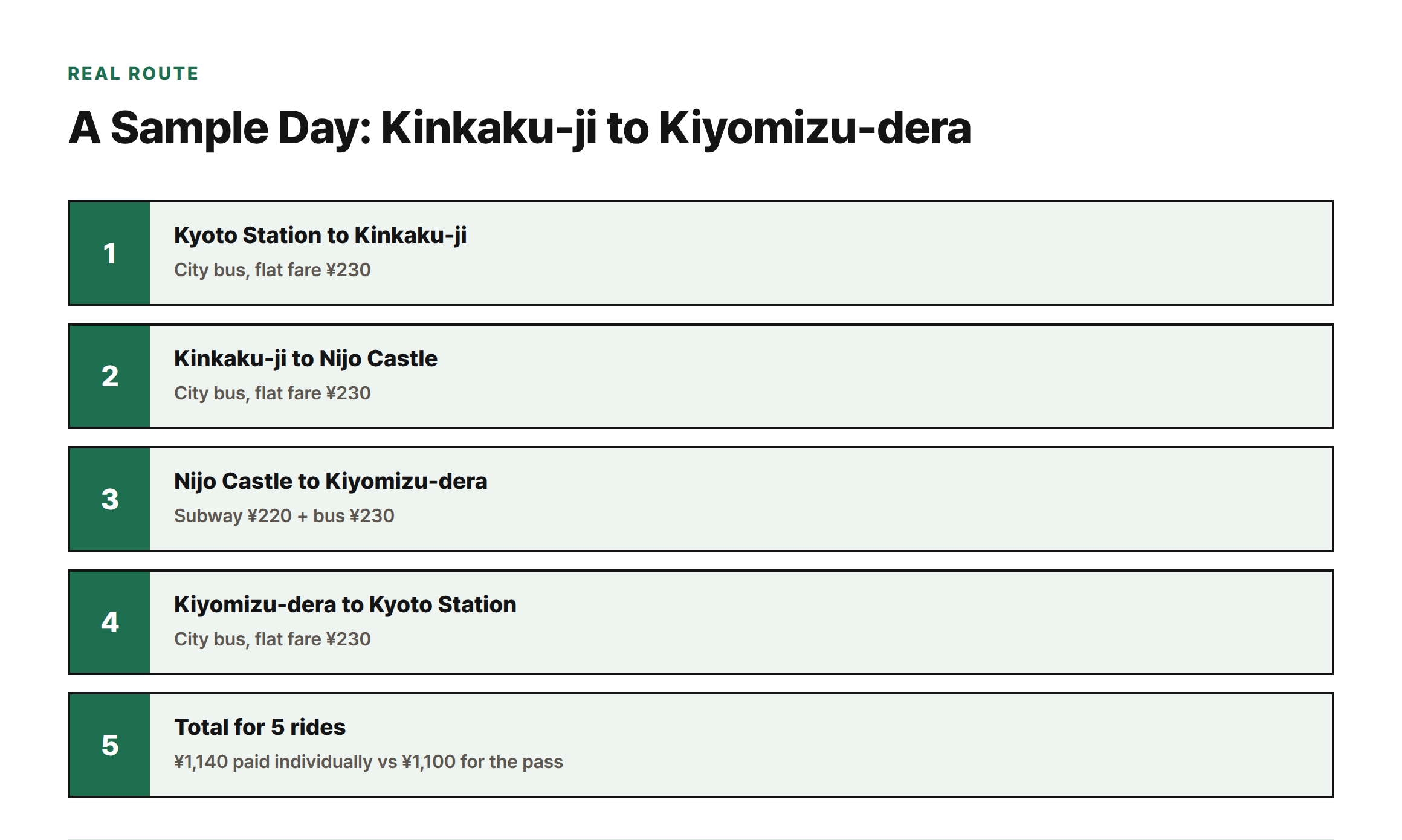
- Kyoto Station → Kinkaku-ji: City bus (routes signed for Kinkakuji-michi depart from the Kyoto Station bus pool). Flat fare ¥230.
- Kinkaku-ji → Nijo Castle: Bus back toward central Kyoto to the Nijojo-mae stop. Flat fare ¥230.
- Nijo Castle → Kiyomizu-dera: Subway Tozai Line from Nijojo-mae to Sanjo-Keihan (¥220, 0–3 km band), then a bus toward Kiyomizu-michi and a short uphill walk. Subway + bus, ¥220 + ¥230.
- Kiyomizu-dera → Kyoto Station: Bus back to Kyoto Station. Flat fare ¥230.
Paid individually, that’s five rides totaling ¥1,140 — already ¥40 more than the pass, before counting any extra hop to Gion, Fushimi Inari, or Nishiki Market later in the day. For exact departure times and current routing, check the transportation bureau’s live bus/subway search rather than relying on a fixed schedule, since routes are periodically revised.
How to Actually Board
Subway
Insert the pass into the slot at the automatic ticket gate before going to the platform, and don’t forget to pick it back up on the other side[6].
Bus
Board through the rear door and exit through the front, near the driver[6]. On your very first ride, insert the pass into the farebox slot by the driver when you get off — this prints the date on the card. After that, just show the dated side to the driver as you exit[6]. If your first ride happens to be on a Keihan Bus or West Japan JR Bus route, you may need to write the date on the pass by hand instead[6].
Good to Know
- Not 24 hours: the pass expires at the end of service on its activation date, not exactly 24 hours after first use[1][2].
- Child fare: ¥550 applies to elementary-school-age children; younger children ride free when accompanied by a fare-paying adult[1][3].
- Lost or damaged passes: the transportation bureau explicitly does not compensate for a pass that’s lost, damaged, or demagnetized after purchase, so treat it like cash[1].
- Late-night buses: some late-night routes charge an extra fare on top of the pass[2].
Sources
- Kyoto City Transportation Bureau, Subway & Bus 1-Day Pass (Korean)
- Kyoto City Transportation Bureau, Subway & Bus 1-Day Pass (English)
- Kyoto City Transportation Bureau, City Bus regular fares
- Kyoto City Transportation Bureau, Subway fare guide (English)
- Kyoto City Transportation Bureau, 1-Day Pass — Where to Buy
- Kyoto City Transportation Bureau, 1-Day Pass — How to Use
- KANSAI MaaS, Kyoto Subway & Bus 1-Day Pass digital coupon
- Kyoto City Transportation Bureau, IC Card services on City Bus & Subway