Kyoto Bus & Subway Pass Guide (2026): Which One-Day Ticket Actually Pays Off
This post may contain affiliate links. If you book or buy through them, we may earn a commission at no extra cost to you.
Kyoto’s transit passes changed in a way a lot of English-language guides still haven’t caught up with: the cheap 700-yen bus-only pass is gone. This guide is current as of September 2026 and covers every pass still on sale, what each one actually covers, and the ride count where a pass beats paying per trip on an IC card.
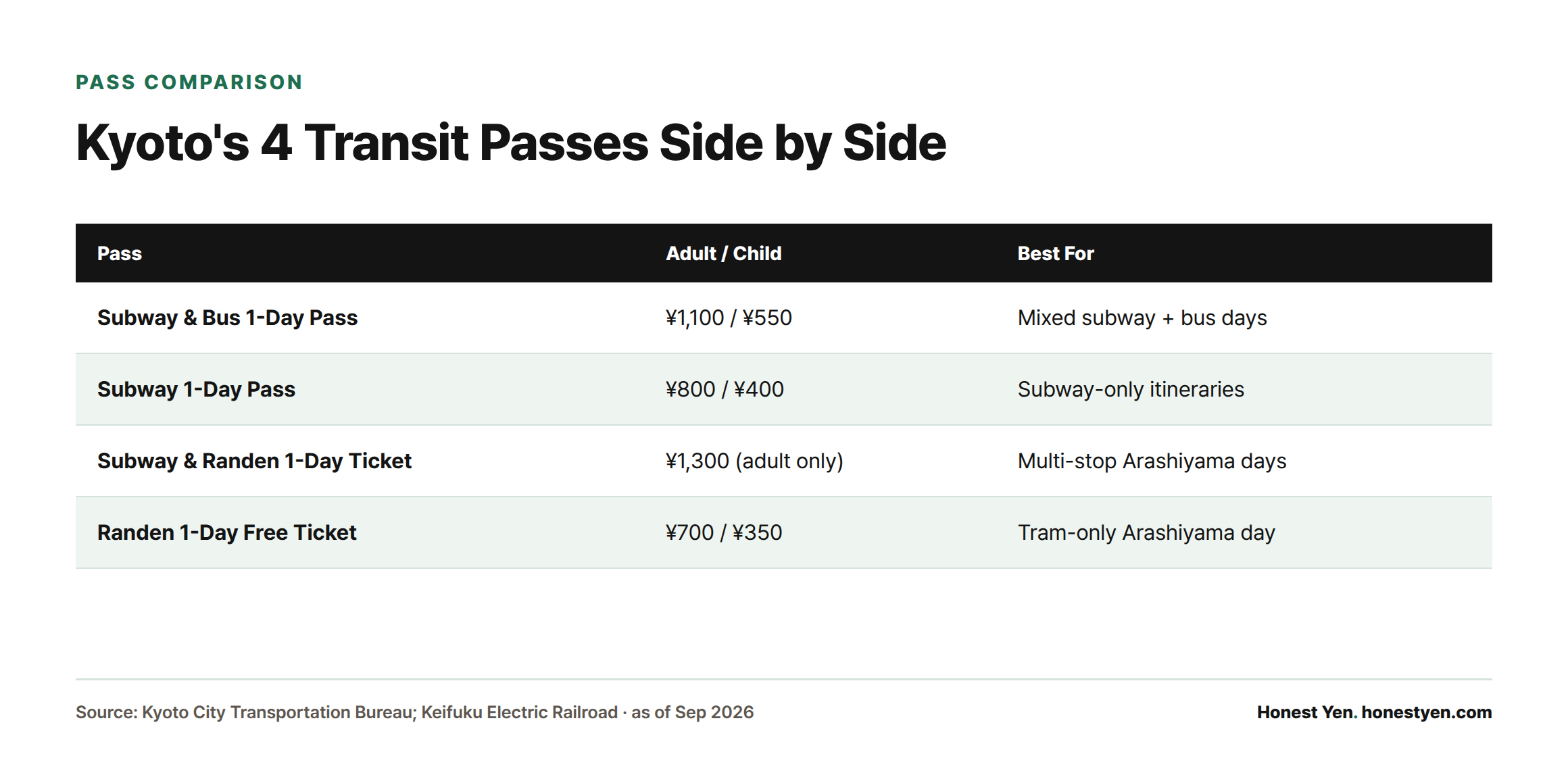
At a Glance: Kyoto Transit Passes Compared
| Pass | Adult / Child | Covers | Best for |
|---|---|---|---|
| Subway & Bus 1-Day Pass | ¥1,100 / ¥550 | Both subway lines + city buses + parts of Kyoto Bus, Keihan Bus, JR Bus | Most first-time visitors doing a mixed day |
| Subway 1-Day Pass | ¥800 / ¥400 | Karasuma & Tozai subway lines only | Days spent mostly along the subway (Nijo Castle, downtown, Fushimi via transfer) |
| Subway & Randen 1-Day Ticket | ¥1,300 (adult only) | Both subway lines + Randen tram, no city buses | Multi-stop Arashiyama-area days |
| Randen 1-Day Free Ticket | ¥700 / ¥350 | Randen tram only | A pure Arashiyama/Ninna-ji/Kitano Tenmangu tram-hopping day |
Prices and coverage below are drawn from the Kyoto City Transportation Bureau’s official English and Japanese ticket pages[1][2][3] and the Keifuku (Randen) fare page[7].
Subway & Bus 1-Day Pass (¥1,100) — The Default Choice
This is the pass most visitors should default to. It costs ¥1,100 for adults and ¥550 for children and covers both subway lines (Karasuma and Tozai), every Kyoto City Bus route, and select routes of Kyoto Bus (Ohara, Iwakura, Daikaku-ji, Kiyotaki, Kokedera areas), Keihan Bus (Yamashina, Daigo, central Kyoto), and the West Japan JR Bus Takao–Keihoku line[1][2].
It does not cover seasonal/limited routes such as the Route 51 Hieizan line, Routes 90 and 95 (Arashiyama–Takao, Ohara–Kurama), highway buses, airport limousine buses, or Keihan’s premium sightseeing buses[1][2]. It also doesn’t cover Randen or JR trains.
One detail that trips people up: this is a calendar-day pass, not a 24-hour pass. It activates on first use and is valid only until service ends that same day — not for a rolling 24 hours from purchase[1][2]. It can be bought in advance and simply isn’t stamped active until first tapped through a gate or shown to a driver.
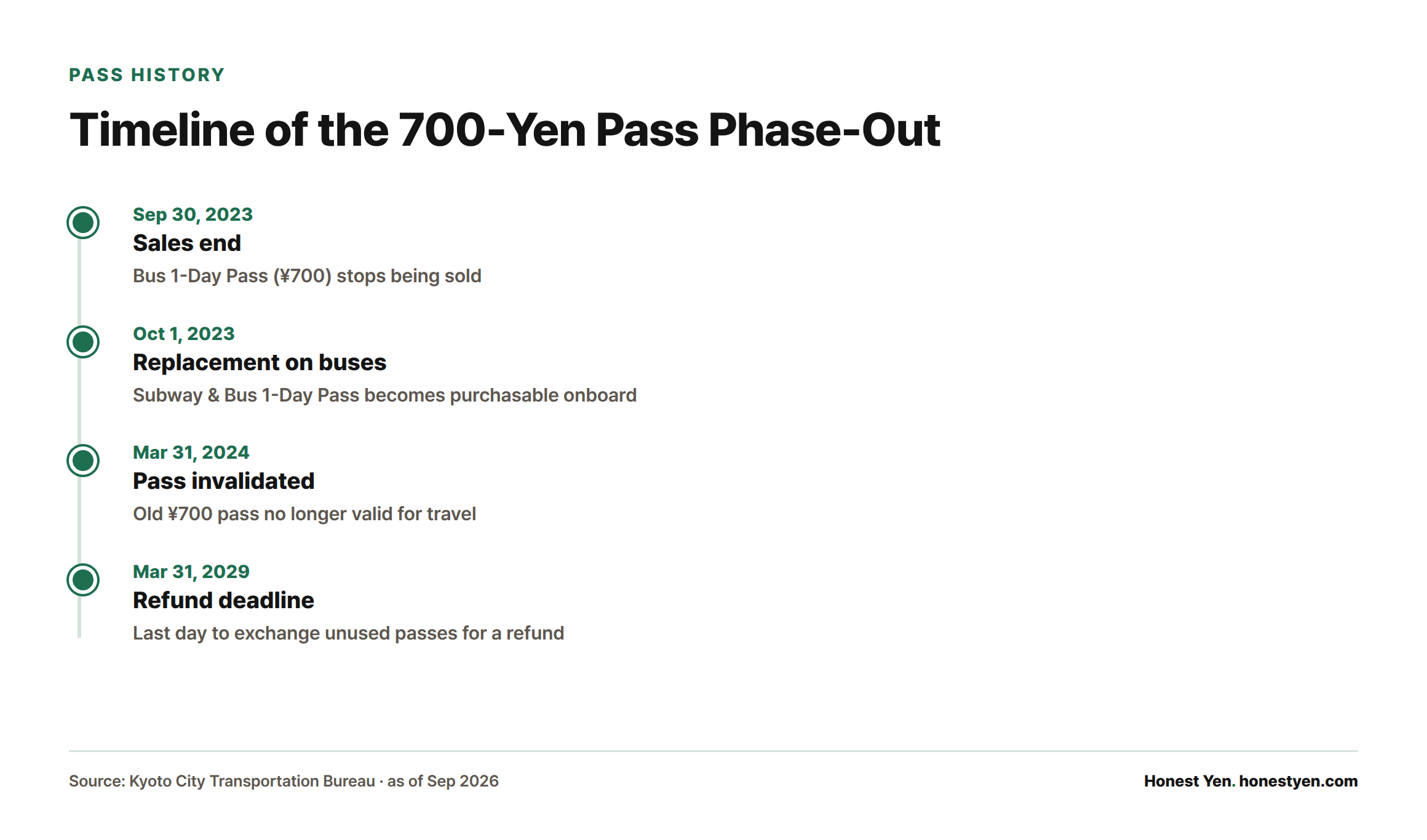
What Happened to the 700-Yen Bus-Only Pass?
It’s discontinued. Sales of the old Bus 1-Day Pass (¥700, city buses only) ended September 30, 2023, and the pass stopped being valid for travel on March 31, 2024[6]. The Transportation Bureau’s stated reason was overcrowding: in cherry blossom and autumn-leaf season, buses were getting so full that bus-only pass holders were crowding out other riders, so the city pushed everyone toward the Subway & Bus 1-Day Pass to spread demand onto the subway[6]. As a direct replacement, the Subway & Bus 1-Day Pass became purchasable on board city buses starting October 1, 2023[6]. If you still have an old unused 700-yen pass, it’s exchangeable for a refund at designated stations through March 31, 2029[6]. Bottom line: there is no bus-only day pass anymore — the ¥1,100 combined pass is the closest equivalent, and it’s a better deal anyway since it also unlocks the subway.
Subway-Only Pass vs. the Combined Pass: Which One?
Buy the Subway 1-Day Pass (¥800 adult / ¥400 child) only if your entire day genuinely stays near subway stations — for example Nijo Castle, downtown Kawaramachi/Karasuma, or Kyoto Station itself plus a Tozai Line hop toward Yamashina. It covers both subway lines and nothing else[3].
For most itineraries — which mix a temple reachable only by bus (Kiyomizu-dera, Ginkaku-ji) with a subway stretch — the ¥1,100 Subway & Bus Pass is the safer buy, since the ¥300 gap over the subway-only pass is covered by a single bus ride.
Subway vs. Subway & Randen Pass: Only Worth It for Multi-Stop Arashiyama Days
Randen (the Keifuku tram line to Arashiyama) is a separate private operator — none of the city passes above include it. A single Randen ride costs ¥250 for adults and ¥120 for children, flat, regardless of distance[7].
The Subway & Randen 1-Day Ticket (¥1,300, adult fare only — no child discount is offered) covers both subway lines and the entire Randen network[5], but not city buses. It only pays for itself if you’re actually hopping on and off the tram multiple times — say, subway to a Randen connection point, tram to Arashiyama, tram onward to Ninna-ji or Kitano Tenmangu, and a subway ride elsewhere later. For a simple there-and-back Arashiyama trip, two single Randen tickets (¥500 round trip) plus a subway fare will almost always be cheaper than the ¥1,300 combo. There’s also a Randen-only 1-Day Free Ticket at ¥700 (¥350 child) if your day is tram-only and doesn’t touch the subway at all[5].
Do the Math: How Many Rides Before a Pass Pays Off
Single-ride fares: city buses are a flat ¥230 for adults (¥120 child) regardless of distance[4]; subway fares are distance-based, ranging from ¥220 to ¥360 for adults (¥110–¥180 child) depending on how far you travel[3].
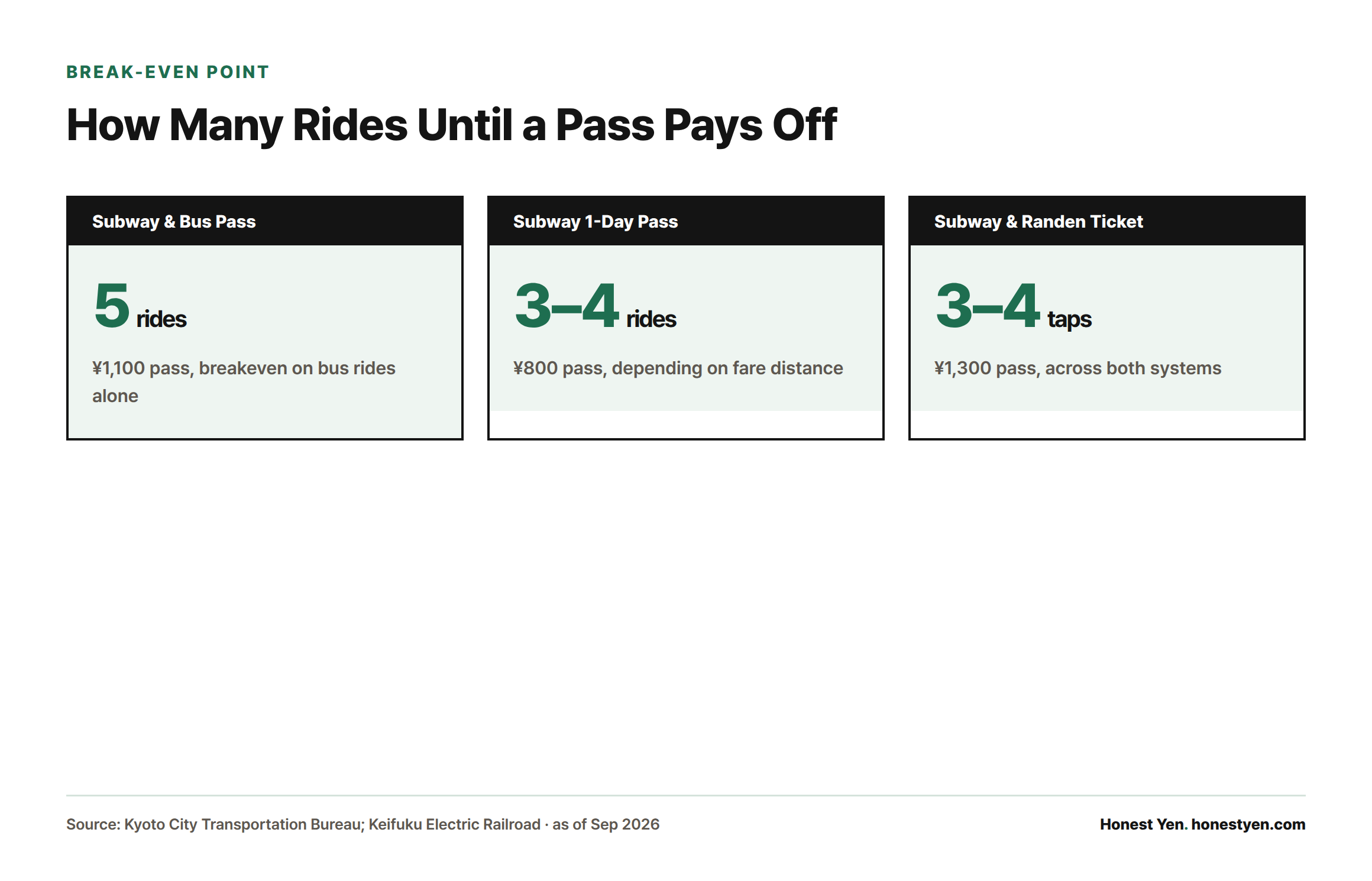
- Subway & Bus Pass (¥1,100): on bus rides alone (¥230 each), you break even at the 5th ride (5 × ¥230 = ¥1,150). Mixing in subway trips gets you there faster — two bus rides plus two mid-distance subway rides (roughly ¥230×2 + ¥290×2 ≈ ¥1,040) is close to breakeven, and a third tap of either kind puts the pass ahead.
- Subway 1-Day Pass (¥800): at the shortest subway fare (¥220), you need 4 rides to profit; at a typical mid-range fare (¥260–¥290), it’s still around 3–4 rides.
- Subway & Randen Ticket (¥1,300): a round-trip subway leg (~¥440–¥520) plus a Randen round trip (¥500) alone doesn’t clear ¥1,300 — you generally need a third or fourth tap across the two systems (e.g., an extra Randen stop) before it beats paying cash.
Practical takeaway: if your day includes fewer than 3–4 total rides, an IC card like ICOCA tapped per ride is usually cheaper than any pass. Once you’re doing a temple-hopping day with 4+ boardings, the relevant day pass starts winning.
Where to Buy: Local vs. Pre-Booking
The Subway & Bus 1-Day Pass and Subway 1-Day Pass are sold at Bus & Subway Information Centers, subway station ticket windows, commuter pass counters, on board city buses, and at some convenience stores, tourist information counters, and hotels within Kyoto[1][2]; the official Kyoto Tourist Information Center “Kyo Navi” inside Kyoto Station also stocks several of these tickets[8]. None of the official pages list Kansai Airport (KIX) as a sales point for these city passes, so plan to buy after you reach Kyoto — at Kyoto Station, on your first bus, or at your hotel front desk — rather than at the airport.
Booking platforms like Klook also list some Kyoto transit tickets as e-vouchers, which you exchange for the physical pass at a designated counter rather than using directly at the gate. That extra redemption step can mean a queue, and availability of specific products changes, so for a same-day pass most travelers will find it simpler and just as cheap to buy directly at a subway station or convenience store once they’re in Kyoto — pre-booking mainly helps if you want to lock in a multi-day Kansai-wide pass before arrival rather than one of the single-day city passes covered here.
Which Pass Matches Which Sight
- Kiyomizu-dera: bus-only access from Kyoto Station area (Routes 100/206 and similar) — get the Subway & Bus Pass or, if starting near a subway stop, just pay the flat ¥230 bus fare if it’s your only stop.
- Fushimi Inari Taisha: reachable by JR (not covered by any of these passes) or by city bus — if bus, the Subway & Bus Pass applies; if JR, none of these passes help and a plain IC card tap is simplest.
- Arashiyama (bamboo grove, Tenryu-ji, Randen stops): use the Randen 1-Day Free Ticket for a tram-only day, or the Subway & Randen Ticket if you’re also using the subway elsewhere that day. City bus routes reach Arashiyama too, but the Subway & Bus Pass doesn’t include Randen.
- Ginkaku-ji: bus-only (Route 5 and others) — the Subway & Bus Pass or a single ¥230 bus fare.
FAQ
Is the ¥700 bus-only pass still sold?
No. It stopped selling in September 2023 and stopped being valid for rides in March 2024[6]. The Subway & Bus 1-Day Pass (¥1,100) replaced it.
Subway pass or the combined bus/subway pass — which is better?
If your day is subway-only, the ¥800 subway pass. If you’ll ride even one bus, the ¥1,100 combined pass usually wins once you account for the ¥230 flat bus fare.
How much is the child fare?
Subway & Bus Pass: ¥550. Subway-only pass: ¥400. Randen single ride: ¥120. The Subway & Randen combo ticket has no child discount — it’s ¥1,300 flat[1][3][5][7].
How many rides justify buying a pass over an IC card?
Roughly 4–5 taps in a day for the Subway & Bus Pass, 3–4 subway rides for the subway-only pass. Fewer than that, pay per ride on ICOCA or Suica.
Pre-book online (Klook etc.) or buy locally?
For single-day city passes, buying locally at a subway station, convenience store, or on the bus is simplest — no redemption counter, no queue. Pre-booking mainly makes sense for multi-day regional passes bought before you land.
What do I need for Arashiyama?
Neither the Subway & Bus Pass nor the subway-only pass covers Randen. For a tram-hopping Arashiyama day, buy the Randen 1-Day Free Ticket (¥700) or, if combining with subway travel, the Subway & Randen 1-Day Ticket (¥1,300).
One more thing worth knowing before you land: passes are calendar-day, not 24-hour, and late-night buses carry an extra surcharge not covered by any of these passes[1][2] — factor that into a very early or very late itinerary. For getting into Kyoto in the first place, or comparing IC card options more broadly, see our Suica vs ICOCA comparison.
Sources
- Kyoto City Transportation Bureau, Subway & Bus 1-Day Pass (Korean)
- Kyoto City Transportation Bureau, Subway & Bus 1-Day Pass (English)
- Kyoto City Transportation Bureau, Subway 1-Day Pass
- Kyoto City Transportation Bureau, City Bus Fares
- Kyoto City Transportation Bureau, Subway & Randen 1-Day Ticket
- Kyoto City Transportation Bureau, notice on discontinuation of the Bus 1-Day Pass
- Keifuku Electric Railroad, Randen fares and tickets
- Kyoto City Official Travel Guide, Transportation Tickets & Passes