Japan Rail Pass After the October 2026 Price Hike: A Break-Even Buying Guide
This post may contain affiliate links. If you book or buy through them, we may earn a commission at no extra cost to you.
As of August 2026, the nationwide Japan Rail Pass is about to get more expensive again. JR Group has confirmed a second price increase, effective October 1, 2026, on top of the steep 2023 hike that already reshaped how the pass is used[1][2]. This guide gives you a concrete formula and worked route examples so you can check your own itinerary instead of relying on generic advice.
Bottom line: who should still buy it
| Traveler profile | Verdict |
|---|---|
| Multi-region trip in one window (e.g. Tokyo → Kansai → Hiroshima/Kyushu, or Tokyo → Tohoku → Hokkaido) | Usually worth it |
| Single round trip only (e.g. Tokyo–Osaka) | Not worth it — buy point-to-point tickets |
| Trip confined to Kansai (Osaka/Kyoto/Kobe/Himeji/Okayama) | A regional pass is cheaper |
| Trip confined to Hokkaido only | Hokkaido Rail Pass is cheaper |
| Traveling in peak season (Golden Week, Obon, New Year) with tight reservations | Pass still useful for reserved-seat flexibility |
Price hike timeline: 2023 → 2026
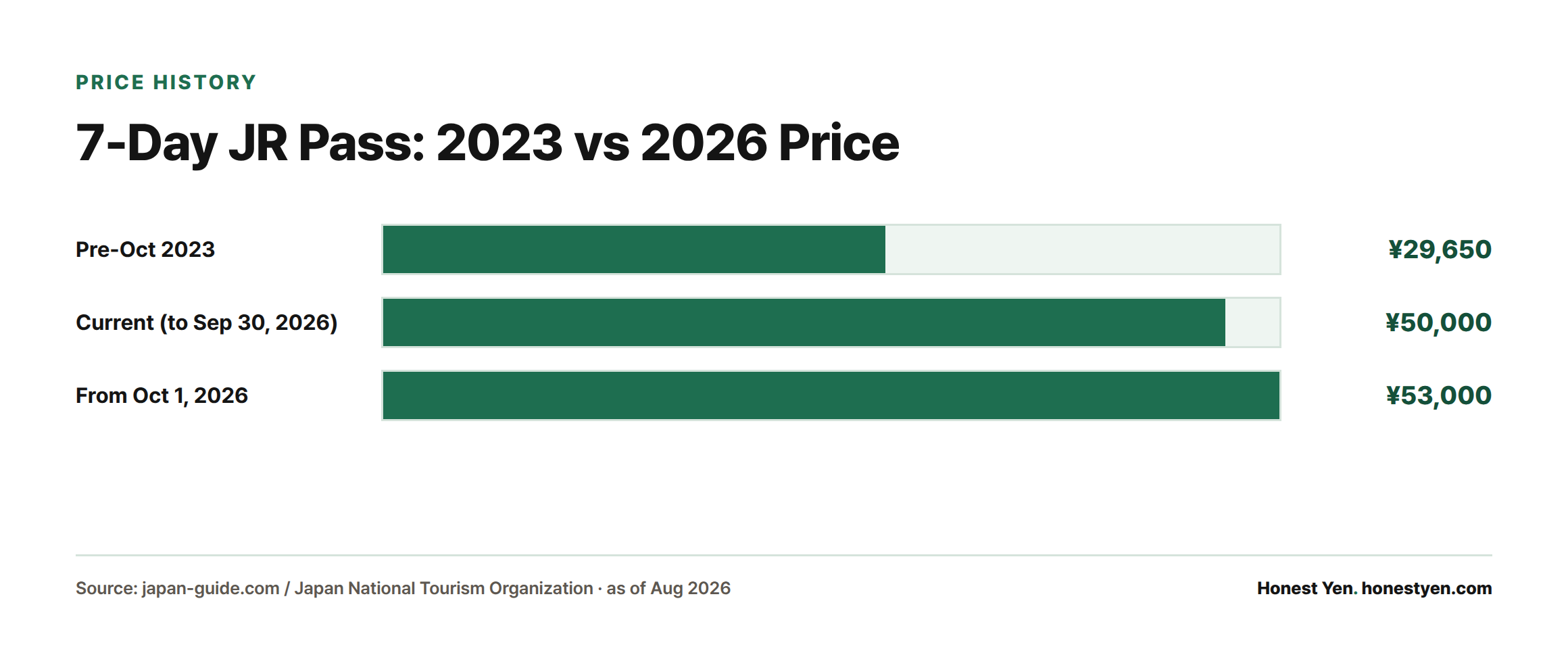
Before October 2023, a 7-day Ordinary pass cost ¥29,650. It jumped roughly 70% to ¥50,000 that October[1]. A second, smaller revision takes effect October 1, 2026[2][3].
| Duration | Ordinary (pre-Oct 2023) | Ordinary (current, to Sep 30 2026) | Ordinary (from Oct 1 2026) |
|---|---|---|---|
| 7 days | ¥29,650 | ¥50,000 | ¥53,000 |
| 14 days | ¥47,250 | ¥80,000 | ¥84,000 |
| 21 days | ¥60,450 | ¥100,000 | ¥105,000 |
| Duration | Green Car (current) | Green Car (from Oct 1 2026) |
|---|---|---|
| 7 days | ¥70,000 | ¥74,000 |
| 14 days | ¥110,000 | ¥116,000 |
| 21 days | ¥140,000 | ¥147,000 |
That is a 5–6% increase this round[2], far milder than 2023’s roughly 70%, but from pre-2023 levels the 7-day pass is now about 79% more expensive overall. The increase follows broader JR fare adjustments, including JR East’s 7.1% fare revision in March 2026, its first in decades[2]. Passes bought through the official website before the changeover can keep the pre-October price for a limited window after October 1; agency-bought passes convert to new pricing from that date[3].
Break-even formula
List every long-distance JR segment you plan to ride (one-way), look up the standard reserved-seat fare for each, and sum them:
- Add up standard reserved-seat fares for every planned long-distance leg.
- Divide that total by the pass price matching your trip length.
- Ratio ≥ 0.9: the pass wins, especially once you add local JR lines, airport trains, and ferries it also covers for free.
- Ratio 0.7–0.9: a close call — tally in local transport (Yamanote Line, Narita Express, JR ferries) before deciding.
- Ratio < 0.7: buy individual tickets or a regional pass instead.
Worked examples
Standard reserved-seat fares below are for the Nozomi/Mizuho service most independent travelers book[6]; pass holders ride the slightly slower Hikari/Kodama for the same distance at no extra cost, or pay a small supplement to also use Nozomi/Mizuho (see next section).
| Route (one-way) | Standard fare |
|---|---|
| Tokyo–Kyoto | ¥14,170 |
| Tokyo–Shin-Osaka | ¥14,720 |
| Tokyo–Hiroshima | ¥19,440 |
| Tokyo–Hakata (Fukuoka) | ¥23,390 |
| Shin-Osaka–Hiroshima | ¥7,900[8] |
| Hiroshima–Hakata | ¥6,300[8] |
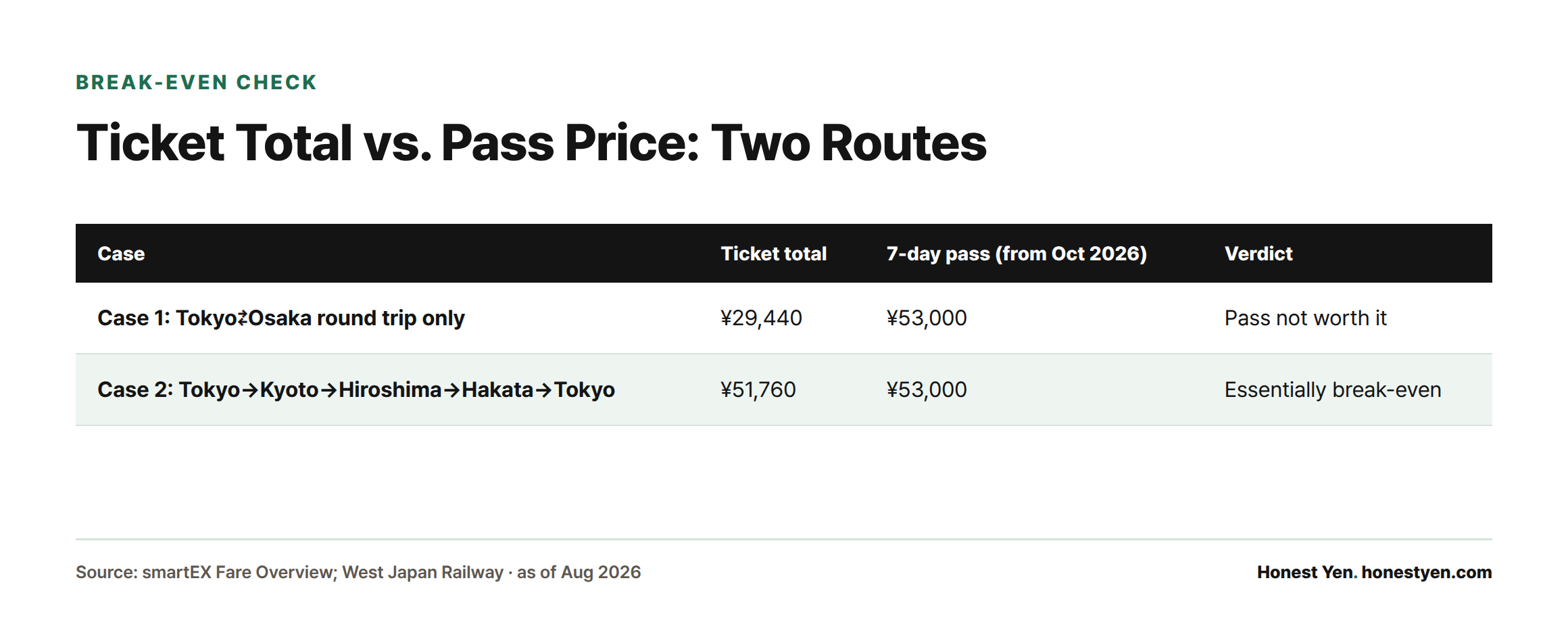
Case 1 — Tokyo⇄Osaka round trip only: ¥14,720 × 2 = ¥29,440, versus ¥53,000 for a 7-day pass. The pass costs ¥23,560 more — not worth it for this alone.
Case 2 — Tokyo → Kyoto → Hiroshima → Hakata → Tokyo (the classic “Golden Route + Kyushu” loop): ¥14,170 + ¥7,900 + ¥6,300 + ¥23,390 = ¥51,760, versus ¥53,000 for the new 7-day pass — essentially break-even. Under pre-October pricing (¥50,000), tickets clearly beat the pass on this route; after the hike it’s a coin flip that tips toward the pass as soon as you add any local JR rides (Yamanote Line, a Nara day trip, the JR ferry to Miyajima, Narita Express to the airport).
Regional passes instead of the nationwide pass
| Pass | Price (adult) | Coverage |
|---|---|---|
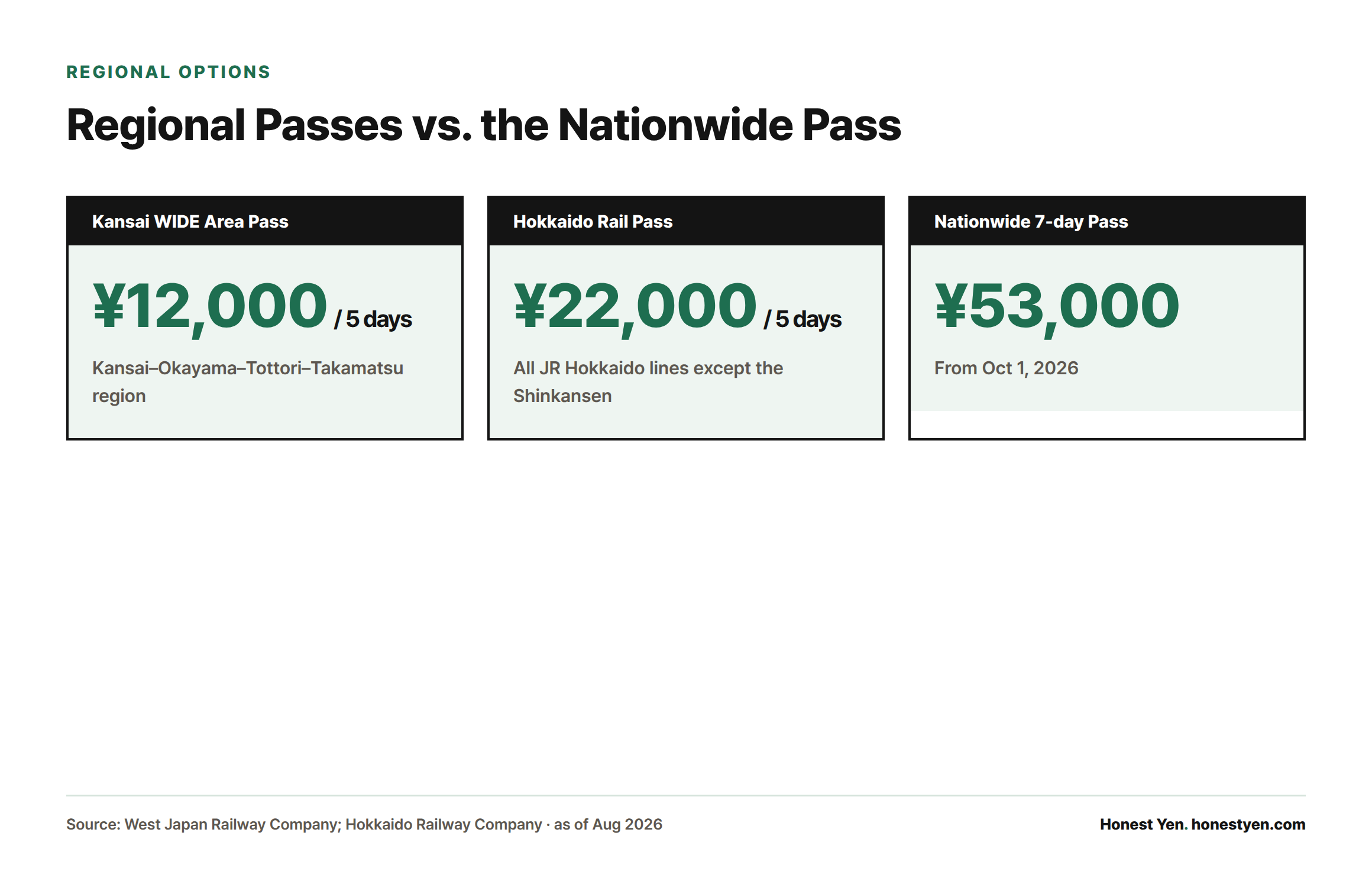
| Kansai WIDE Area Pass | ¥12,000 / 5 days[7] | Sanyo Shinkansen Shin-Osaka–Okayama, limited express, JR West/Shikoku local lines, Kansai–Okayama–Tottori–Takamatsu–Tsuruga |
| Hokkaido Rail Pass | ¥22,000 / 5 days (pre-purchase)[9] | All JR Hokkaido lines except the Hokkaido Shinkansen |
If your trip never leaves one of these zones, the regional pass is dramatically cheaper than the nationwide pass.
Nozomi/Mizuho and Green Car checkpoints
Since the 2023 overhaul, pass holders can ride the fastest Nozomi and Mizuho Shinkansen by buying a separate flat-rate supplement ticket instead of being locked out entirely[1][4]. Sample supplements: Tokyo–Nagoya ¥4,180, Tokyo–Kyoto/Shin-Osaka ¥4,960, Tokyo–Hiroshima ¥6,500, Shin-Osaka–Hakata ¥4,960[4]. Add these to your break-even total only for legs where saving 15–30 minutes matters to your schedule.
For Green Car, the pass premium over Ordinary is ¥21,000 for 7 days from October 2026. Before upgrading, check the Green Car surcharge you would pay per ride on an Ordinary pass at any JR ticket machine; if your itinerary has enough long rides that those surcharges alone would exceed ¥21,000, the Green pass pays for itself.
Where to buy: official site vs. travel agency
| Official website (japanrailpass.net) | Overseas travel agency (Exchange Order) | |
|---|---|---|
| Price after Oct 1, 2026 | Pre-hike price for a limited window[3] | New, higher price from Oct 1[3] |
| Refund fee | Flat ¥560 per pass, must cancel before the start date, original credit card required[5] | 10% of the sales price, applied at the exchange office, before use begins[5] |
For lowest cancellation risk, the official website is the cheaper option to unwind if your plans change.
FAQ
How much has the JR Pass gone up? About 70% in October 2023, then a further 5–6% from October 2026 — roughly 79% higher overall than pre-2023 pricing for a 7-day pass[1][2].
Will it rise again after October 2026? No further increase is scheduled beyond the announced October 1, 2026 revision as of this writing[2][3].
Is it still worth buying? Only if your route total (Case 2 above) approaches or exceeds the pass price — a single city pair rarely clears that bar anymore.
Does a Tokyo–Osaka round trip alone break even? No — it comes in well under the pass price (see Case 1).
Can I ride Nozomi/Mizuho? Yes, with a separate supplement ticket since the 2023 revision[1][4].
Is a regional pass like Kansai WIDE better? Yes, if your trip stays inside that region — it costs a fraction of the nationwide pass[7].
Where is cheapest to buy with easiest refunds? The official website, both for price-lock timing and its flat ¥560 refund fee versus a 10% fee through agency Exchange Orders[3][5].
Sources
- japan-guide.com, “Japan Rail Pass Cost Increase”
- Travel And Tour World, “Japan Rail Network JR Pass Price Big Increase From October 2026”
- Japan National Tourism Organization, “Price Increases are Coming to the Nationwide Japan Rail Pass (2026)”
- JAPAN RAIL PASS official site, “Use of NOZOMI/MIZUHO trains”
- JAPAN RAIL PASS official site, “Conditions for use” (refund policy)
- smartEX (Tokaido/Sanyo/Kyushu Shinkansen official reservation service), “Fare Overview”
- West Japan Railway Company, “Kansai WIDE Area Pass Information”
- West Japan Railway Company, “SANYO-SHINKANSEN One-way Ticket Information”
- Hokkaido Railway Company, “Hokkaido Rail Pass”