Hakone vs. Kusatsu: Which Tokyo-Area Onsen Town Should You Actually Visit?
This post may contain affiliate links. If you book or buy through them, we may earn a commission at no extra cost to you.
Both towns get called “the best hot spring trip near Tokyo,” and both show up in the same searches, but they solve different problems. Hakone is a day-trippable national park with a Romancecar straight from Shinjuku. Kusatsu is a mountain onsen village three to four hours out, built around a genuinely different mineral spring. This guide compares them head-to-head — transport cost and time, water quality, ryokan pricing, seasons, and sights — so you can pick based on what you actually want out of the trip. Figures below are current as of August 2026 and cited to official operators and tourism boards; where only booking-platform data exists, that is stated explicitly.
Hakone vs. Kusatsu at a Glance
| Hakone | Kusatsu | |
|---|---|---|
| Distance from Tokyo | ~80 min one-way (Romancecar)[1] | ~3 hrs (train+bus) to ~4 hrs (direct bus)[3][4] |
| Day trip feasible? | Yes, comfortably | Technically yes, not recommended |
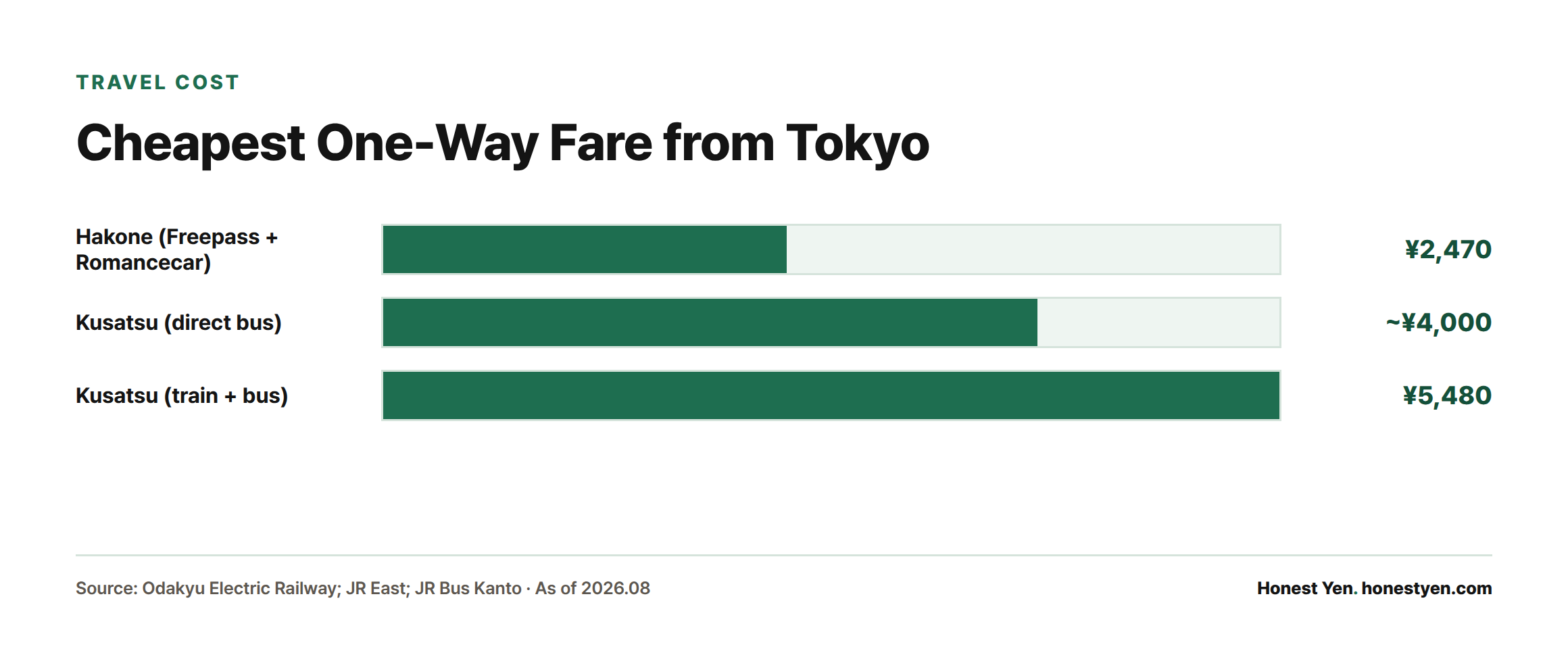
| One-way cost (cheapest) | From ¥2,470 (Freepass + Romancecar surcharge)[1] | From ~¥4,000 (direct bus)[4] |
| Water character | 17 spring areas, ~17–20 mineral types[2] | Japan’s largest natural spring flow, single strongly acidic source[5] |
| Best for | First-timers, couples, families, tight schedules | Dedicated onsen soak, winter snow baths, slower pace |
Getting There from Tokyo
Hakone’s biggest structural advantage is the Odakyu Romancecar, a limited express that runs directly from Shinjuku to Hakone-Yumoto in about 80 minutes[1]. No transfers, reserved seats, and it’s covered by the Odakyu network the Hakone Freepass runs on. The Freepass itself costs ¥7,100 (adult, 2-day) or ¥1,600 (child) from Shinjuku, and includes unlimited rides on eight local transport modes — the Hakone Tozan train, ropeway, Lake Ashi cruise, and local buses[1]. The Romancecar itself isn’t included; the reserved-seat surcharge is an extra ¥1,200 (adult) or ¥600 (child) each way from Shinjuku[1].
Kusatsu has no rail line to the town itself. The two realistic options are a direct highway bus or a train-plus-bus combination:
- Direct bus: JR Bus Kanto’s Joshu Yumeguri service runs from Busta Shinjuku straight to the Kusatsu Onsen bus terminal, no transfer, in about 4 hours 5 minutes, with fares around ¥4,000 one-way (fares vary by day and season; this figure comes from bus-booking platforms since JR Bus Kanto’s own fare page wasn’t accessible at time of writing)[4].
- Train + bus: The Limited Express Kusatsu·Shima runs from Ueno to Naganohara-Kusatsuguchi Station, the closest rail stop, for a combined base fare and reserved-seat charge of ¥5,480 (seasonal ±¥200–400)[3]. From there it’s a roughly 25-minute local bus into town. Total door-to-door time runs close to 3 hours[3].
So the honest answer to “which is more accessible”: Hakone, by a wide margin. It’s roughly half the travel time of even Kusatsu’s faster route, with a single direct train and no bus transfer required.
Water Quality: Variety vs. Concentration
These two towns represent different philosophies of what makes a great onsen. Hakone is spread across what’s known as the “Hakone Juushichiyu” — seventeen distinct hot spring districts, each with its own source and mineral profile, totaling roughly 17 to 20 identifiable spring types across the region[2]. Hakone-Yumoto’s water is alkaline and sodium-chloride based, good for skin and fatigue recovery; Gora and Sengokuhara run calcium-sulfate and sulfur; Lake Ashi’s springs are simple and sulfurous[2]. The practical upshot: which ryokan you book actually changes what kind of bath you get.
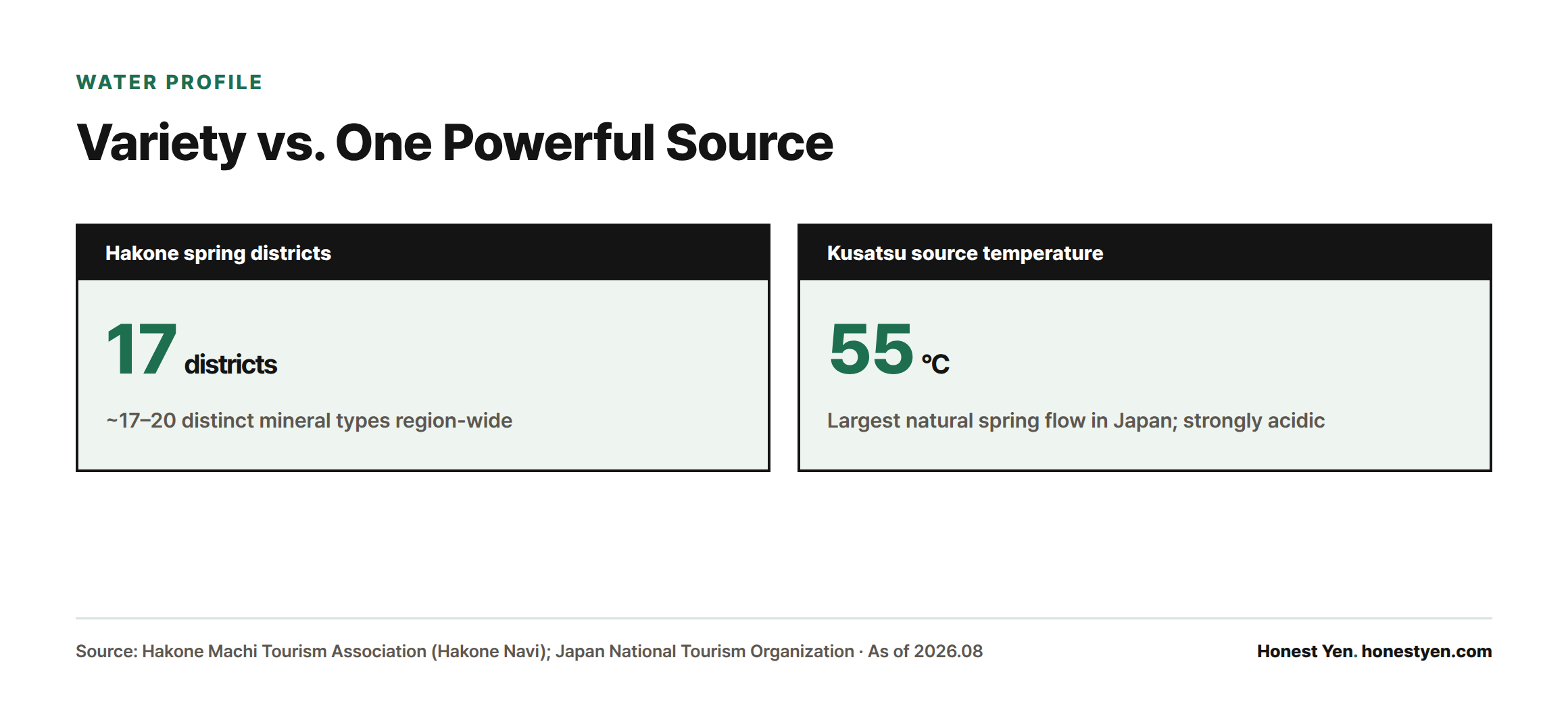
Kusatsu is the opposite approach — one famous, powerful source. It has the largest volume of naturally flowing hot spring water of any onsen town in Japan, emerging at around 55°C and known for its strong acidity[5]. That water is piped through the town’s central Yubatake (“hot water field”), the wooden channel structure that is Kusatsu’s visual landmark[5]. If you want one iconic, high-volume, high-mineral soak, Kusatsu wins; if you want to sample different water types across a single trip, Hakone does.
Can You Day-Trip Kusatsu? Why One Night Is Recommended
Technically yes — round-trip travel on the direct bus is about 8 hours, leaving a workable window in town. But almost nobody who has made the trip recommends it as a day trip, for three practical reasons: the travel time itself eats most of a day, Kusatsu’s own attractions (the Yumomi cooling-water show, the evening-lit Yubatake, the open-air baths) are built around a slower, overnight pace, and ryokan half-board pricing means you’re paying for the trip either way. Hakone, by contrast, is genuinely built for day trips — the Freepass, the Romancecar timing, and the cluster of sights around Owakudani and Lake Ashi are all designed to be done between a Tokyo morning departure and evening return.
Ryokan Pricing and Style
Neither town publishes official average room rates, so the ranges below come from major booking platforms rather than a tourism board, and should be read as indicative rather than exact.
- Hakone: Two-person, one-night half-board (dinner and breakfast included) rooms commonly list from roughly ¥9,900 at the budget end up to ¥150,000+ per couple at higher-end ryokan with private open-air baths (rotenburo), with a large mid-tier cluster in the ¥25,000–¥100,000 range per couple. Hakone’s proximity to Tokyo and volume of ryokan means booking 2–4 weeks out is often workable outside peak weekends.
- Kusatsu: Room-only stays start from roughly ¥2,500 per person; half-board plans commonly run ¥10,000–¥20,000 per person on weekdays, rising to ¥20,000–¥30,000+ during Golden Week, summer holidays, and peak autumn-color weekends. Weekend and holiday dates are recommended to book one to two months ahead.
Net effect: Kusatsu is not meaningfully cheaper than Hakone at the budget end, but Hakone has a wider luxury tier (multiple ryokan with private rotenburo per room) simply because of its size and Tokyo-commuter clientele.
Best Season for Each
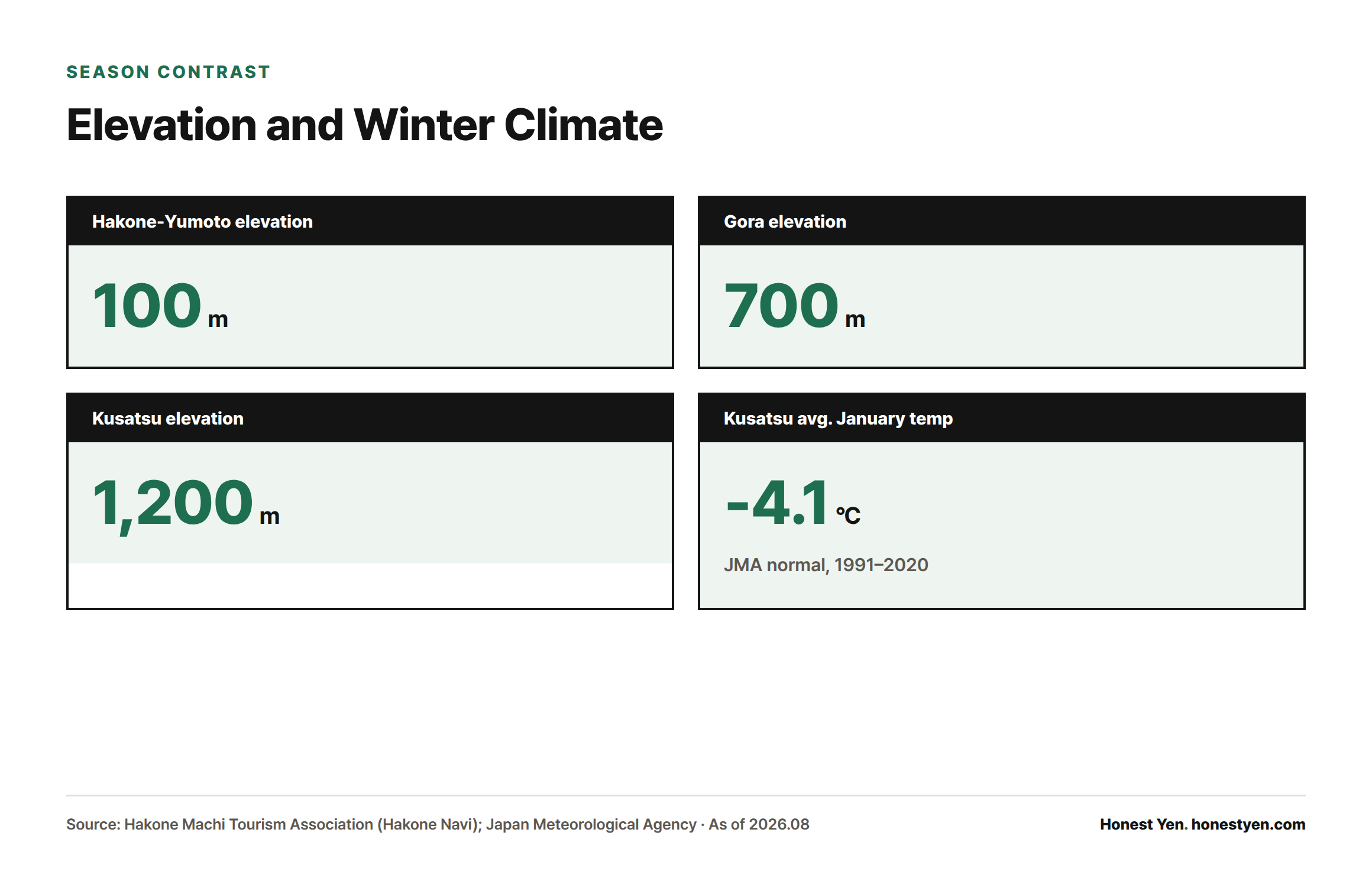
Hakone sits at relatively low elevation (Hakone-Yumoto is around 100m, Gora around 700m[2]) and is popular in spring for cherry blossoms and especially in autumn, when the Owakudani and Lake Ashi area draws heavy foliage crowds. Kusatsu sits much higher, around 1,200m, and its winters are genuinely cold and snowy: the town’s average January temperature is about −4.1°C, with meaningful snow accumulation through January and February[6]. That’s exactly why it’s a winter draw — soaking in an open-air bath while snow falls is Kusatsu’s signature experience, something Hakone’s milder, lower-elevation climate doesn’t replicate in the same way. In short: go to Hakone for blossom and foliage season scenery, go to Kusatsu specifically for a snow-season soak.
What to See and Do
Hakone’s sightseeing is a loop, and the Freepass is built around it: the Hakone Ropeway carries you toward Owakudani, the volcanic valley with sulfur vents, then connects directly to the Lake Ashi sightseeing cruise from Togendai port, with the ropeway and cruise terminals integrated for an easy transfer[7]. It’s a half-day circuit that combines a volcanic landscape with a lake view of Mt. Fuji on clear days.
Kusatsu’s sightseeing centers on the town itself. The Yubatake is the visual and social hub, lit up at night and surrounded by footbaths and shops[5]. At Netsunoyu hall, the traditional Yumomi show — where staff stir and cool the naturally hot spring water with long wooden paddles to a folk song — runs several times daily, adult admission ¥700, elementary-school children ¥350, with a hands-on Yumomi experience (¥300) offered on Sundays and Mondays[8]. If you’re deciding on bath etiquette for either town, the same rules of thumb apply — see our practical guide to visiting a Japanese onsen with tattoos before you book.
FAQ
Which is easier to reach from Tokyo, Hakone or Kusatsu?
Hakone. The direct Romancecar from Shinjuku takes about 80 minutes[1], versus roughly 3 hours by the fastest train-plus-bus route to Kusatsu, or about 4 hours by direct bus[3][4].
Is Kusatsu doable as a day trip?
Physically yes, but it isn’t recommended. Round-trip travel alone takes most of a day, and Kusatsu’s appeal — the evening Yubatake, the slower onsen town pace, half-board ryokan dining — is built around an overnight stay rather than a quick visit.
How different is the water?
Hakone spreads across 17 hot spring districts with roughly 17–20 distinct mineral types, so the water changes depending on which part of town you bathe in[2]. Kusatsu is a single, highly concentrated, strongly acidic source — the largest-volume natural spring flow in Japan, at around 55°C[5].
Which is more expensive to stay in?
They’re broadly comparable at the budget end (both have room-only or half-board options starting around ¥2,500–¥10,000 per person), but Hakone has a deeper luxury tier with more ryokan offering private in-room open-air baths, reflecting its larger size and proximity to Tokyo.
Which season favors which town?
Spring and autumn favor Hakone, for cherry blossoms and foliage around Lake Ashi and Owakudani. Winter favors Kusatsu, where average January temperatures around −4°C and heavy snowfall make an open-air soak in falling snow the signature experience[6].
What about IC cards, luggage, and kids?
Suica and PASMO work throughout the Odakyu network and on Hakone’s local buses and trains; if you’re unsure which IC card fits your trip, see our Suica vs. ICOCA comparison. For Kusatsu, the connecting local bus from Naganohara-Kusatsuguchi Station also accepts IC cards. Neither town is stroller-hostile, but Hakone’s shorter travel time and cluster of family-friendly attractions (ropeway, cruise, pirate-ship boats) make it the easier choice with young children; Kusatsu suits families more comfortable with a longer transit day in exchange for the snow-season bath experience.
Sources
- Odakyu Electric Railway, “Hakone Freepass: A Convenient Ticket for Your Trip from Shinjuku”
- Hakone Machi Tourism Association (Hakone Navi), “Onsen: The Appeal of Hakone”
- JR East, “Kusatsu/Shima: Train & Routes”
- JR Bus Kanto, “Joshu Yumeguri-go / Tokyo Yumeguri-go Fare and Cancellation Fee Revision Notice”
- Japan National Tourism Organization, “Kusatsu Onsen”
- Japan Meteorological Agency, Kusatsu AMeDAS Normal Values (1991–2020)
- Hakone Machi Tourism Association (Hakone Navi), “Hakone Sightseeing Cruise”
- Kusatsu Town Official Site, “Yumomi and Dance at Netsunoyu”