Okinawa Rental Car Guide: Booking, Insurance, and Driving Rules for Foreign Tourists (2026)
This post may contain affiliate links. If you book or buy through them, we may earn a commission at no extra cost to you.
Okinawa is one of the only regions in Japan where a rental car is genuinely the best way to see the island — trains barely exist outside the Naha monorail, and the best beaches and dive spots are strung along coast roads that buses skip. But it’s also a place where a Western visitor stacks up several unfamiliar risks at once: left-hand traffic, a rental system built around a Japan-specific insurance product, and a couple of local hazards that don’t show up in general “driving in Japan” advice. This guide covers what to prepare before you book, what to do on the road, and exactly what happens if something goes wrong. Figures below are current as of August 2026 — always confirm exact rates with your rental company at booking.
When to book your Okinawa rental car
Japan’s two heaviest domestic travel surges are Golden Week (roughly the last week of April into the first days of May) and Obon (mid-August), followed by the New Year holidays. Okinawa’s rental fleets are smaller than mainland cities, so cars — especially minivans and anything with a child seat fitted — sell out for these windows weeks before the dates themselves. If your trip touches any of those periods, book as early as your travel dates are fixed rather than waiting for a “good deal.” Outside peak season, booking one to two weeks ahead is usually enough to get your preferred car class.
What you must bring: license and ID
Japan only recognizes driving permits issued under the 1949 Geneva Convention on Road Traffic. Permits based on other frameworks, including the 1968 Vienna Convention used in much of continental Europe, are not valid here — check this before you assume your home country’s IDP will work.[1]
There are three legal ways to drive in Okinawa:
- International Driving Permit (IDP) + passport. You must get the IDP in your home country before departure — Japan does not issue them to visitors, and you cannot apply for one after arrival. It is valid for one year from its issue date, and the rental date must fall inside that window.[2]
- Foreign license + official Japanese translation + passport. This route exists only for license holders from Taiwan, Switzerland, Germany, France, Monaco, and Belgium. The translation must come from the Japan Automobile Federation (JAF) or your country’s embassy/consulate in Japan — a translation printed on the back of the license itself is not accepted.[2]
- A Japanese driver’s license, for residents.
In every case, rental counters require the original documents — photocopies or phone photos are refused — and the name on your IDP must match your passport exactly. Bring both your IDP and your original home license; the IDP alone is not valid without it.[2]
Insurance: why CDW and NOC are not optional
Every legitimate Okinawa rental company includes basic liability coverage, but that coverage comes with a deductible — you are on the hook for repair costs up to that amount even with insurance in place. As an example, one of Okinawa’s largest operators sets its standard deductible at ¥100,000 for damage to the rental car, with unlimited, zero-deductible coverage for damage to other people’s property. Paying a Collision Damage Waiver (CDW) fee of around ¥1,650 per 24 hours reduces that ¥100,000 exposure to close to zero.[3]
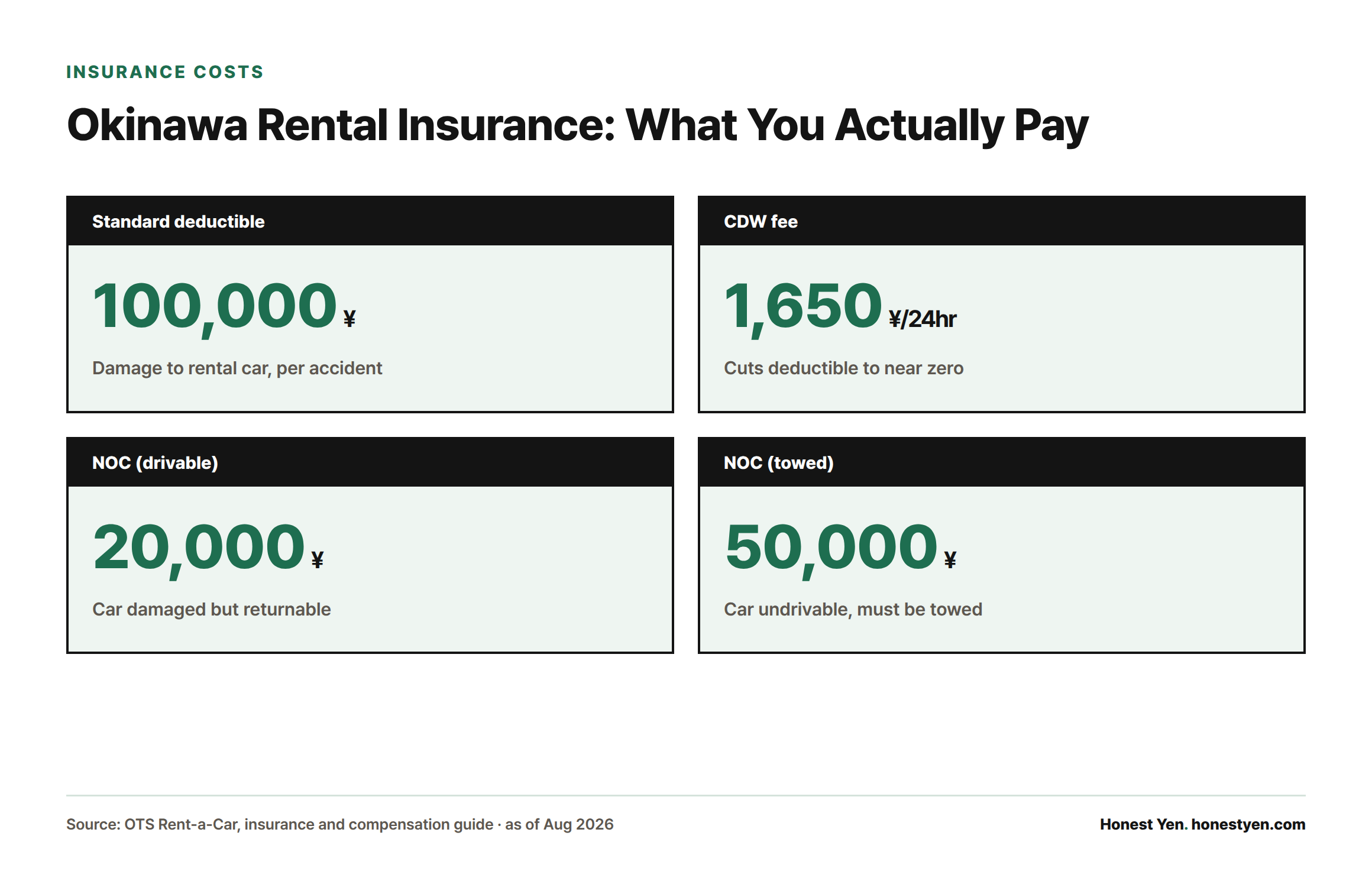
Separately from CDW, Japanese rental contracts include a Non-Operation Charge (NOC) — compensation for the revenue the company loses while your damaged car is out of service for repairs, regardless of who was at fault. This is billed on top of any deductible and is not automatically waived by CDW. At the same operator, NOC runs around ¥20,000 if the car is still drivable and can be returned to a rental location, or around ¥50,000 if it cannot be driven and must be towed.[3] Rates vary by company and vehicle class, so confirm both numbers — the deductible and the NOC — at the counter before you sign.
Adjusting to left-hand traffic
Japan drives on the left, with the driver’s seat on the right side of the car. If you’re used to right-hand traffic, the two mistakes that catch people out repeatedly are turning into the wrong lane after a turn (muscle memory pulls you into the right-hand lane) and reaching for the wrong side of the dashboard — indicator and wiper stalks are mirrored, so the first few times you signal you’ll likely turn on the wipers instead. Give yourself a few minutes in the rental lot before pulling out to find the indicator, and default to following the car ahead through your first few intersections rather than trusting instinct.
Okinawa adds a distinct, and rarely mentioned, hazard: much of the prefecture’s asphalt is mixed with local coral limestone aggregate rather than the harder stone used on mainland roads. Japan’s Cabinet Office Okinawa General Bureau, which manages the prefecture’s roads, states plainly that this surface becomes slippery once wet and that vehicles “cannot avoid slipping” under those conditions — its guidance is to slow down well before curves and drive with extra caution in the rain.[4] Municipal roads use the highest proportion of this coral aggregate, prefectural and national roads less so, and the expressway is paved with standard mainland stone — so the ordinary town roads you’ll use to reach beaches and dive shops are exactly where this matters most. Treat the first rain after a dry spell as effectively black-ice conditions and increase following distance accordingly.
One more Okinawa-specific hazard worth knowing: the forested Yanbaru region in the north is home to the Okinawa rail (yanbaru kuina), an endangered, mostly flightless bird found nowhere else on Earth, along with other protected species. Japan’s Ministry of Environment records roughly a quarter of the year’s vehicle strikes in May alone, when breeding-season activity coincides with Golden Week traffic, and identifies Prefectural Routes 2 and 70 through Kunigami and Higashi villages as the worst-affected stretches. Its advice for drivers on these roads is simple: slow down on curves so you can see and stop for animals crossing.[5] If you’re driving up to Cape Hedo or the Yanbaru forest, treat this the same as a mainland deer-crossing warning.
Fuel and ETC tolls
Okinawa’s rental cars run on one of two fuels, and getting it wrong is a real risk: regular gasoline (レギュラー, “regular”) for most standard cars, or diesel (軽油, “keiyu”) for some vans and trucks. Putting diesel into a gasoline engine or vice versa can disable the car entirely — Japan’s national motoring body, JAF, receives hundreds of misfueling callouts a year. If you’re unsure which your rental takes, ask staff explicitly at pickup and check the fuel cap or manual; if you realize you’ve misfueled, do not start or move the car, and call the rental company or JAF immediately rather than trying to drive it.[6] Rentals are issued full and must be returned full — keep your final gas station receipt, since staff will ask for it at drop-off if the tank looks anything less than topped up.
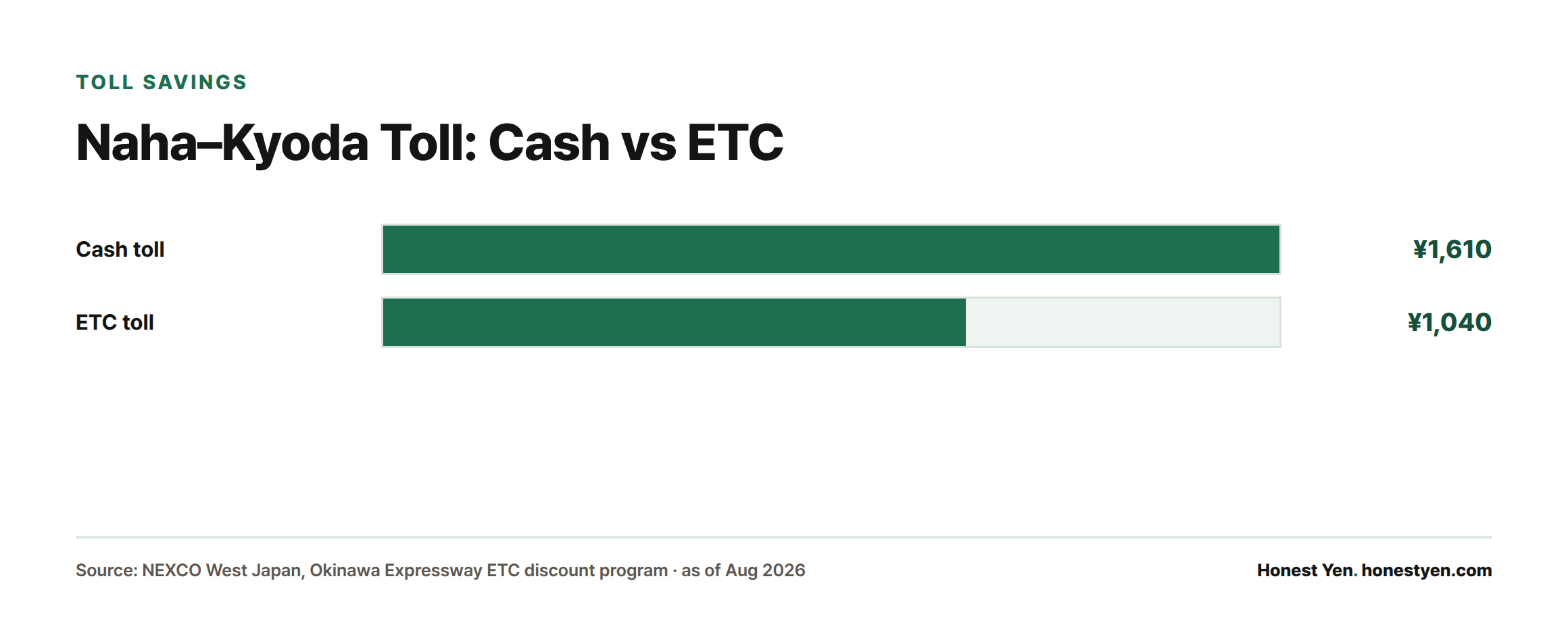
The Okinawa Expressway (E58), the only stretch of true highway on the island, connects Naha to Nago in the north. Most rental cars come pre-fitted with an ETC card reader for automatic toll payment through dedicated ETC lanes — ask at pickup whether a card is loaded, since without one you’ll need to stop at a manned cash booth. ETC pays off here: NEXCO West Japan’s special Okinawa Expressway discount cuts tolls by 35.5% versus cash, meaning the full Naha–Kyoda run costs ¥1,610 in cash but only ¥1,040 with ETC, a discount currently scheduled to run through March 2027.[7] Parking in central Naha and near major beaches is mostly metered coin-operated lots (paid on exit via a machine) rather than the barrier-gate garages common in mainland cities — read the posted per-hour and daily maximum rates before you park, as they vary block by block.
Two more logistics questions come up constantly for first-time Japan road-trippers, even outside Okinawa: how to actually book the long-distance transport you’ll use before or after your rental car — see our guide to booking the Shinkansen and choosing seats — and how to stay connected for navigation apps once you land, covered in our SIM, eSIM, and pocket WiFi comparison.
If you have an accident: the legal steps
Japanese law does not leave this to judgment calls. Article 72 of the Road Traffic Act requires anyone involved in a traffic accident — driver or passenger, at fault or not, injury or no injury — to immediately stop, aid anyone injured, take steps to prevent further danger, and then report the accident to the police: to an officer at the scene if one is present, or to the nearest police station if not. The report must include when and where the accident happened, the number of injured and how seriously, and what property was damaged. Failing to report carries a criminal penalty of up to three months’ imprisonment or a ¥50,000 fine — this applies even to minor fender-benders with no injuries.[8]
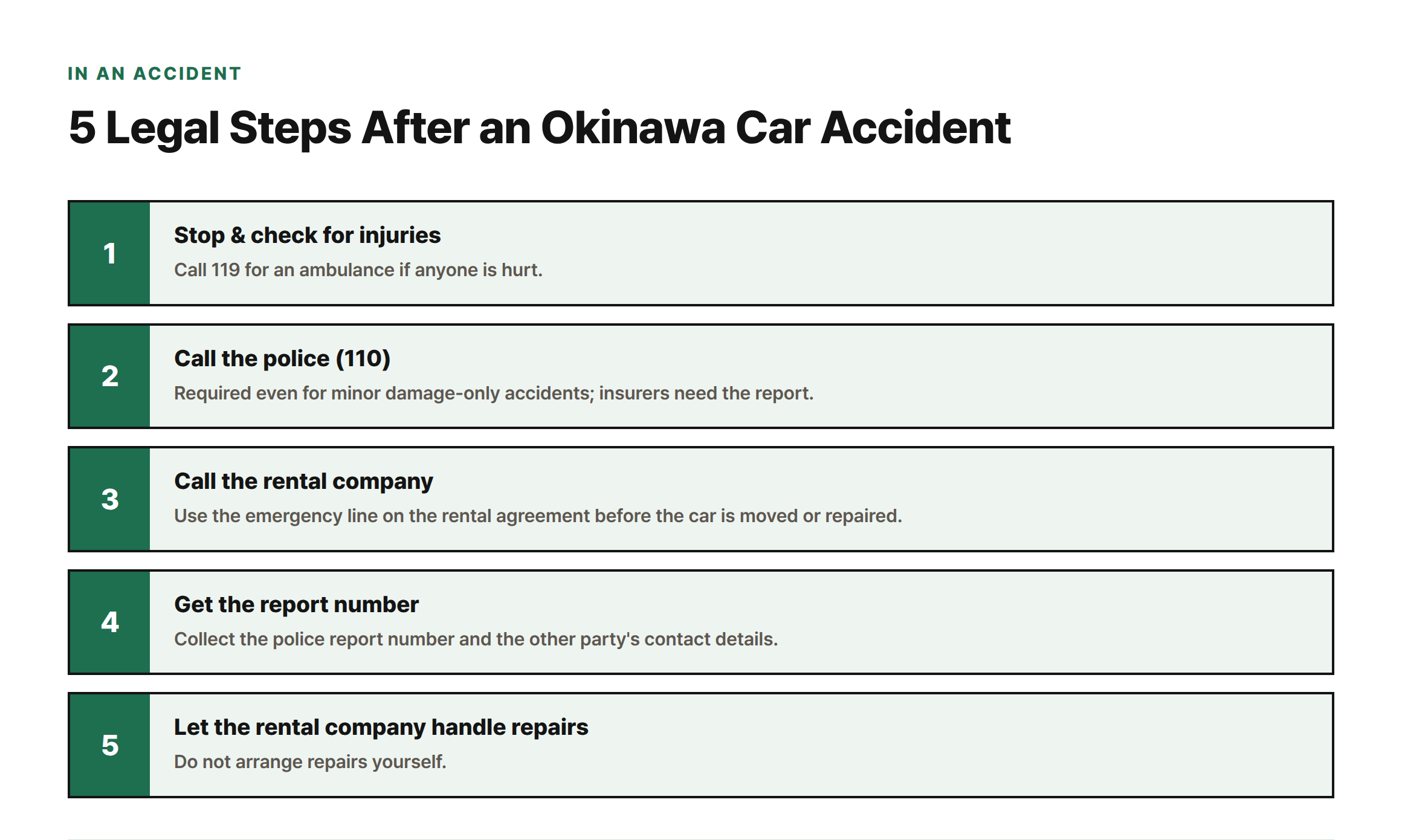
In practice, the sequence is:
- Stop the car and check for injuries; call 119 for an ambulance if anyone is hurt.
- Call the police (110) — do this even for minor damage-only accidents, since it is a legal obligation, not a courtesy, and your rental insurance will not pay out without a police accident report.
- Call your rental company’s emergency line, printed on the rental agreement and usually posted on a sticker inside the car, before the car is moved or repaired.
- Get the police report number and, if possible, the other party’s name and contact details.
- Let the rental company coordinate repairs and file the insurance claim — do not arrange repairs yourself.
Skipping the police call because “it’s just a scratch” is the single most common mistake — without an official accident report, insurers in Japan routinely deny the claim, leaving you liable for the full deductible or more.
Before you return the car
Avoid late fees and disputed damage charges with a quick pre-return check:
- Full tank. Refuel at a station near the return point and keep the receipt.
- Walk the exterior. Photograph all four sides, plus the roof and undercarriage edges if accessible, timestamped — this is your evidence against a disputed damage claim at drop-off.
- Check for personal items in door pockets, the trunk, and any child seat you had installed.
- Return on time. Okinawa’s roads back up badly near Naha Airport in late afternoon; build in 30–45 minutes of buffer before your flight-mandated drop-off time, since a late return typically triggers an extra day’s charge.
- Match the return branch to what you booked — one-way returns to a different office usually carry a separate fee if not arranged in advance.
FAQ
Do I need a child seat, and can I rent one?
Yes. Article 71-3 of the Road Traffic Act requires a child restraint seat for any child under six, with narrow exceptions for medical conditions.[9] Japan’s National Police Agency notes this is a legal requirement, not a recommendation, though it also flags that a large share of seats in use are installed or positioned incorrectly — so ask rental staff to check the fit before you drive off.[10] Most Okinawa operators rent infant, child, and junior seats sized roughly for newborn–1, 6 months–4 years, and 4–6 years, bookable alongside the car; reserve one in advance during peak season, since fitted-seat inventory sells out before plain cars do.
Is there an age limit or minimum driving experience required?
Requirements vary by company, so confirm at booking, but Japanese rental firms generally require a valid, non-provisional license; some accept drivers who passed their test less than a year ago (identifiable by Japan’s beginner-driver “shoshinsha mark”) as long as they carry the standard documentation, while a provisional or learner’s permit is not accepted for a rental agreement.
What if the other driver has no insurance or leaves the scene?
This is exactly why the police report matters — it’s the paper trail your rental company’s insurer needs to process a claim regardless of the other party’s status. Do not attempt to negotiate a cash settlement at the scene instead of calling the police; doing so removes your legal protection and can itself be treated as a failure to report under Article 72.
Does travel insurance cover the CDW/NOC gap?
Some credit cards and travel insurance policies cover collision damage, but Japan’s NOC charge is a distinct line item that many overseas policies exclude entirely. Confirm with your card issuer or insurer specifically whether NOC is covered before declining the rental company’s own coverage.
Sources
- Tokyo Metropolitan Police Department, “Valid International Driving Permits in Japan”
- OTS Rent-a-Car, “Must Check Before Visiting Japan! Driving in Japan”
- OTS Rent-a-Car, insurance and compensation guide (deductible/NOC rates)
- Okinawa General Bureau, Cabinet Office of Japan, on coral-limestone road pavement
- Ministry of the Environment, Kyushu Regional Environment Office, “May is Yanbaru Kuina STOP! Roadkill Month”
- JAF (Japan Automobile Federation), guidance on misfueling
- NEXCO West Japan, Okinawa Expressway ETC discount program
- e-Gov Japan, Road Traffic Act, Article 72 (accident measures and reporting duty)
- e-Gov Japan, Road Traffic Act, Article 71-3 (child restraint device requirement)
- National Police Agency, child car seat safety information