Tax-Free at Japan’s Convenience Stores: 7-Eleven vs. Lawson vs. FamilyMart, by Payment Method (2026)
Yes — but only at specific branches, and the payment method you use can change how the discount is applied. As of September 2026, 7-Eleven, Lawson, FamilyMart, and Ministop all operate tax-free counters at select locations, but none of them run tax-free service at every store, and the four chains don’t process the exemption the same way. Here’s what actually happens at the register, chain by chain, and what changes when Japan’s refund system switches over on November 1, 2026.
Who Actually Qualifies
Tax-free purchases are limited to non-resident foreign travelers holding a “temporary visitor” (short-term stay), diplomatic, or official status, who have been in Japan for less than six months since their most recent entry[1]. Japanese nationals who have lived abroad continuously for two or more years can also qualify if they can prove it with a residence certificate[7]. In every case you need your passport in hand at the register — the Visit Japan Web QR code alone is not accepted as proof[4]. People working in Japan, US military personnel stationed here, and anyone who has overstayed six months do not qualify, regardless of nationality[5].
The ¥5,000 Minimum, and How It’s Counted
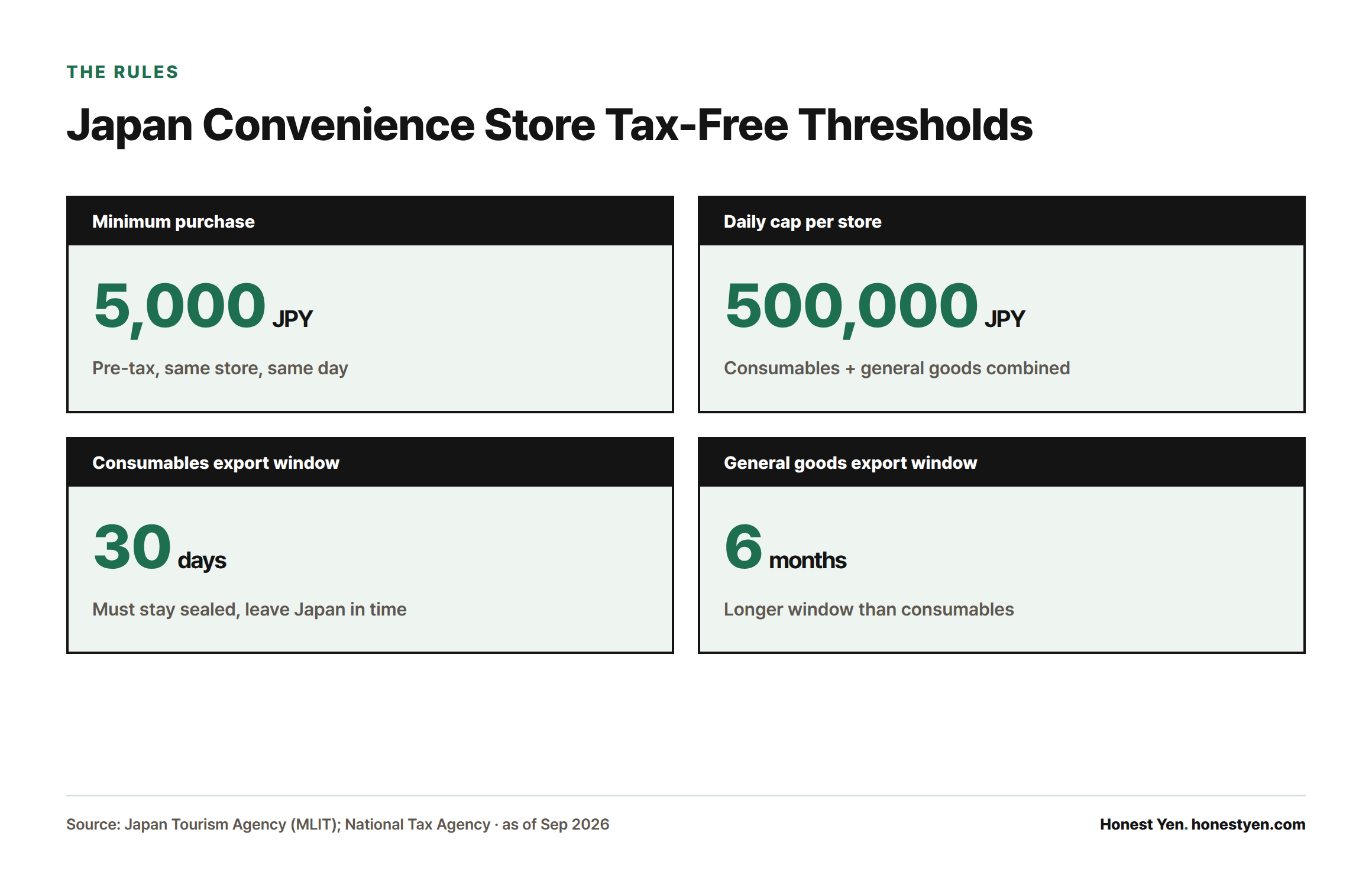
The current threshold is a same-day, same-store, pre-tax total of ¥5,000, combining general merchandise (electronics, clothing) and consumables (food, drinks, cosmetics) if needed to clear the line[1][4]. Consumables and general goods together are capped at ¥500,000 before tax per day per store[1][5]. Consumables must leave Japan within 30 days of purchase and stay in their sealed, tax-free packaging the whole time; general goods have six months[1]. This is a national rule set by Japan’s tax-free shop program, not something individual convenience store chains can adjust[2].
7-Eleven vs. Lawson vs. FamilyMart vs. Ministop
This is the part most guides skip: the four major chains don’t use the same mechanism to apply the discount, and it changes what you should expect at the counter.
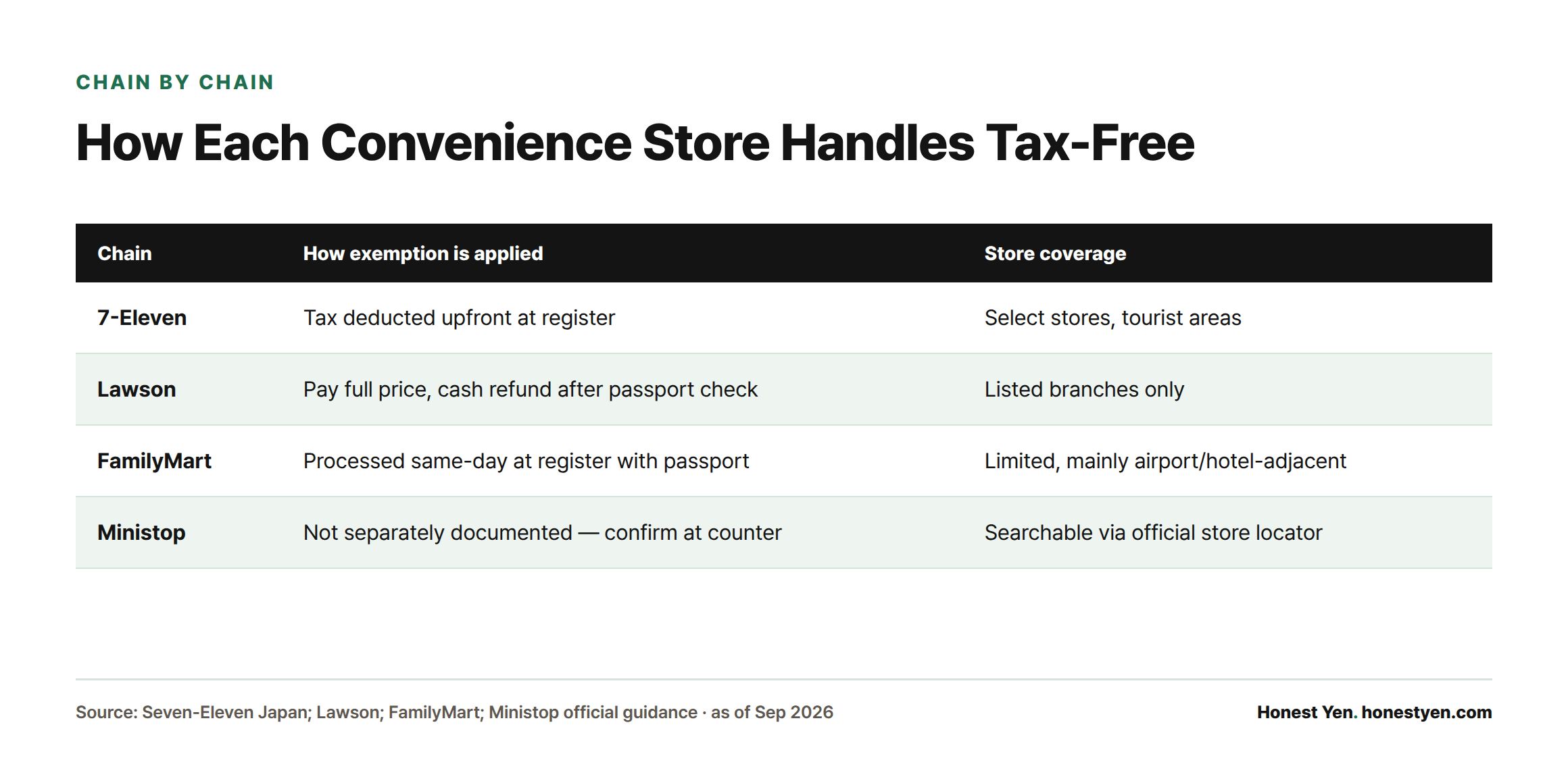
| Chain | How the exemption is applied | Store coverage |
|---|---|---|
| 7-Eleven | Tax deducted upfront — you pay the pre-tax price directly at the register[1] | Select stores only, concentrated in tourist areas |
| Lawson | You pay the full tax-included price first, then receive the consumption-tax portion back in cash after passport verification at the same counter[5] | Listed branches only — Lawson’s own guidance states other stores do not offer tax-free sales[5] |
| FamilyMart | Processed same-day at the register with passport shown; availability can vary by time of day[4] | Limited locations, mainly airport and hotel-adjacent stores |
| Ministop | Not separately documented — confirm at the counter | Searchable via Ministop’s own store locator using the “Tax-free Shop” filter[6] |
In practice, 7-Eleven’s model is the one most Western travelers expect from a duty-free counter: the discount comes off before you pay. Lawson’s is different — you front the full amount, then get cash back once staff confirm your passport and print the paperwork. If you’re paying by card at Lawson, budget for the full sticker price to leave your account; the refund itself only comes as cash[5].
Does Your Payment Method Matter?
It does, and this is where the chains diverge most.
| Payment method | 7-Eleven | Lawson |
|---|---|---|
| Cash (yen) | Accepted for the tax-deducted price[1] | Accepted for purchase; refund itself is cash-only[5] |
| Credit card | Accepted[1] | Accepted for purchase[5] |
| QR/barcode pay (PayPay, etc.) | Not listed as accepted for the tax-free price[1] | Accepted for purchase[5] |
| Transit IC card (Suica, Pasmo, ICOCA) | Not addressed in official guidance | Not addressed in official guidance |
Neither chain’s own tax-free documentation mentions transit IC cards, so treat that as unconfirmed and ask staff before tapping in with your Suica if the exemption matters to you. If you want a payment method that works everywhere without a conversation, cash or a credit card is the safe default at both chains.
What Changes on November 1, 2026
Japan’s tax-free system is switching from point-of-sale deduction to a refund model nationwide, and convenience stores are not exempt from this[2][3]. From that date, tax-free shops — including any convenience store branch running the service — must sell items at the full, tax-included price. The consumption-tax portion is only refunded after Japanese customs confirms, at your departure airport or port, that the goods are actually leaving the country[2]. If even one item in a transaction isn’t confirmed for export, the entire purchase can lose its tax-exempt status[2]. Mailing purchases home instead of carrying them out yourself no longer qualifies either way — that option was discontinued in March 2025[2]. For readers who want the line-by-line math on how this changes the price you actually pay versus what you get back, our breakdown of Japan’s refund system launch works through worked examples using a large retailer, and the same customs-confirmation step applies to a convenience store receipt.
Practically, this makes every convenience store’s process converge toward something closer to Lawson’s current pay-then-refund pattern, except the refund now happens at the airport rather than back at the store.
What You Can’t Buy Tax-Free, and Why You Shouldn’t Open the Bag
Excluded items commonly cited by the chains include gift cards, stamps, frozen food, and other items that can’t be put into the required sealed packaging[5]. Consumables are packaged specifically so they can’t be opened or consumed inside Japan[1][4]; break the seal before departure and customs can assess the tax retroactively at the airport, which is a slower and more annoying process than just leaving the bag alone. If you’re stocking up on snacks or cosmetics at a convenience store and also plan to hit a bigger retailer for electronics or cosmetics in bulk, keep the tax-free receipts and sealed bags together — customs checks the whole batch as a set.
Step-by-Step Checklist
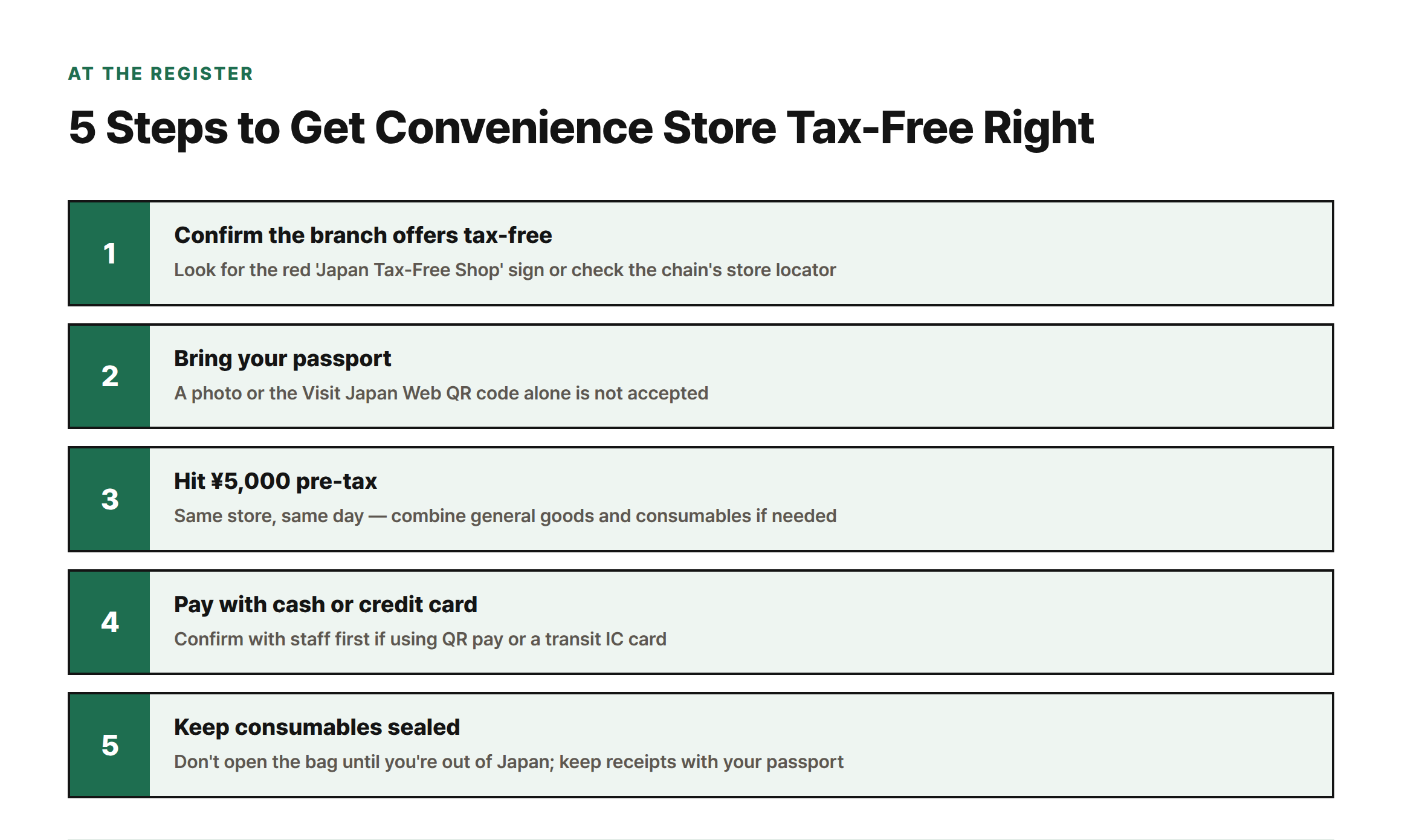
- Check that the specific branch offers tax-free service — look for the red “Japan Tax-Free Shop” sign, or use the chain’s store locator (Ministop’s has a dedicated filter[6]).
- Bring your passport to the register or a designated tax-free counter — not a photo of it, not the Visit Japan Web QR code alone[4].
- Hit ¥5,000 pre-tax in that store, that day — combine general goods and consumables if you need to.
- Pay with cash or a credit card if you want the exemption to apply cleanly; confirm with staff before using QR pay or a transit IC card.
- Leave sealed consumables unopened until you’re out of Japan, and keep receipts attached to your passport for departure.
FAQ
Is convenience store tax-free real, or is it only department stores and drugstores?
It’s real, but narrower: only specific branches of 7-Eleven, Lawson, FamilyMart, and Ministop run the service, mostly in airport terminals, station areas, and dense tourist districts[4][5][6].
Which of the four chains actually does tax-free?
All four have official tax-free procedures, but coverage is store-by-store, not chain-wide[1][4][5][6].
Can I use a card or QR pay and still get the discount?
At 7-Eleven, only cash or credit card is documented for the tax-deducted price[1]. At Lawson, cash, credit card, and barcode/QR pay all work for the purchase itself, but the tax refund comes back in cash only[5].
How does the November 2026 change affect convenience store tax-free?
You’ll pay the full tax-included price at the register everywhere, then get the tax refunded only after customs confirms export at your departure point — the point-of-sale discount goes away[2][3].
What’s the minimum purchase amount?
¥5,000 before tax, per store, per day, combinable across general goods and consumables up to ¥500,000[1][5].
Can I open my tax-free snacks or cosmetics inside the store?
No — consumables are sealed specifically so they can’t be opened in Japan, and doing so risks the tax being reassessed at departure[1][4].
Sources
- Seven-Eleven Japan, Tax-Free Shopping Guide
- Japan Tourism Agency (MLIT), Consumption Tax-Free Shop Site
- Japan National Tourism Organization, Japan’s Tax Exemption
- FamilyMart, Tax-Free Shop Service
- Lawson, Welcome to Japan (Tax-Free Guidance)
- Ministop, Official Store Locator (Tax-free Shop filter)
- National Tax Agency, No.6559 Eligible Purchasers for Foreign Tourist Tax Exemption