Don Quijote Tax-Free Shopping: A Step-by-Step Guide (2026, Before the November Rule Change)
Don Quijote — the discount chain with the loud yellow-and-black signage in nearly every Japanese city — is one of the easiest places for a tourist to get tax-free shopping right, and one of the easiest to get wrong if you show up without your passport or open a sealed bag on the train home. This guide walks through the exact eligibility rules, the counter procedure, the ¥500,000 consumable cap, and the system overhaul that takes effect on November 1, 2026. Figures below are current as of August 2026.
Don Quijote Tax-Free Rules at a Glance
| Rule | Detail |
|---|---|
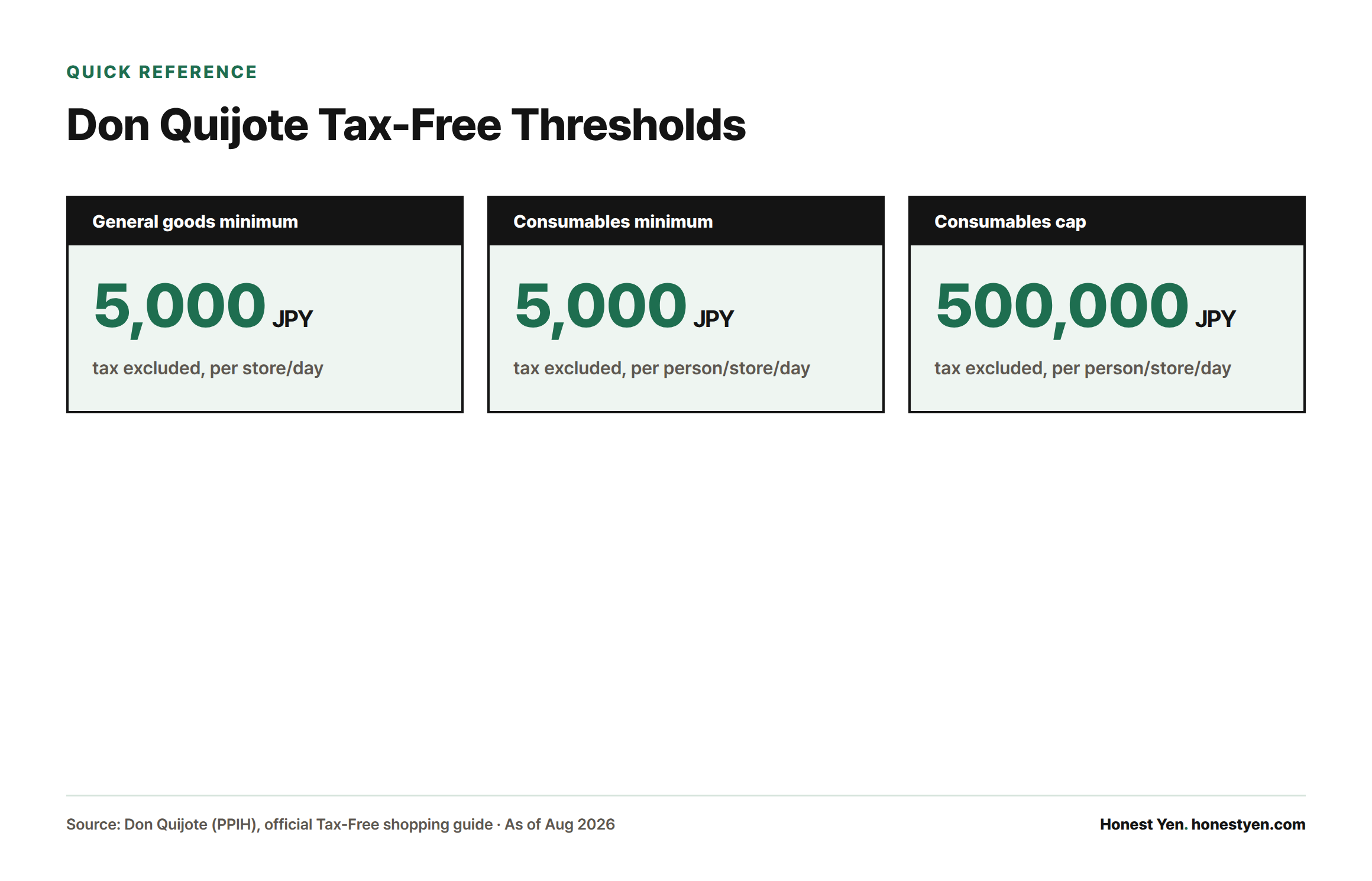
| Minimum purchase (general goods) | ¥5,000 or more, tax excluded[1] |
| Minimum purchase (consumables) | ¥5,000–¥500,000, tax excluded, per person per store per day[1] |
| ID required | Original passport or landing permit — no copies, no photos[1] |
| Where to process | Dedicated Tax-Free Counter, same day and same store as purchase[1] |
| Packaging | Consumables are sealed; do not open before leaving Japan[1] |
| System change | From November 1, 2026, exemption moves to a pay-tax-then-refund model[2] |
Who Qualifies, and What You Need to Bring
Tax exemption applies to non-residents staying in Japan on a Temporary Visitor status (ordinary tourists), plus certain diplomatic and official statuses, provided they have been in the country fewer than six months[3]. Japanese nationals can qualify too, but only with proof of two or more years of continuous residence abroad and a matching entry stamp — a narrow case that doesn’t apply to most readers of this guide.
The one document that actually matters at the register is your passport, and it must be the original. Don Quijote’s own policy is explicit: photocopies, PDF scans, and photos on your phone are not accepted[1]. If you’ve locked your passport in a hotel safe “for safekeeping,” bring it with you on shopping days — there is no workaround.
If you’re paying by credit card, UnionPay, a mobile wallet, or Don Quijote’s own majica card, the name on the card must match the name in the passport[4]. In practice this rules out using a travel companion’s card to pay for your tax-free basket, or vice versa — the cardholder and the passport holder need to be the same person for that transaction. Cash purchases don’t have this constraint, since there’s no name to check.
The 5-Step Tax-Free Procedure
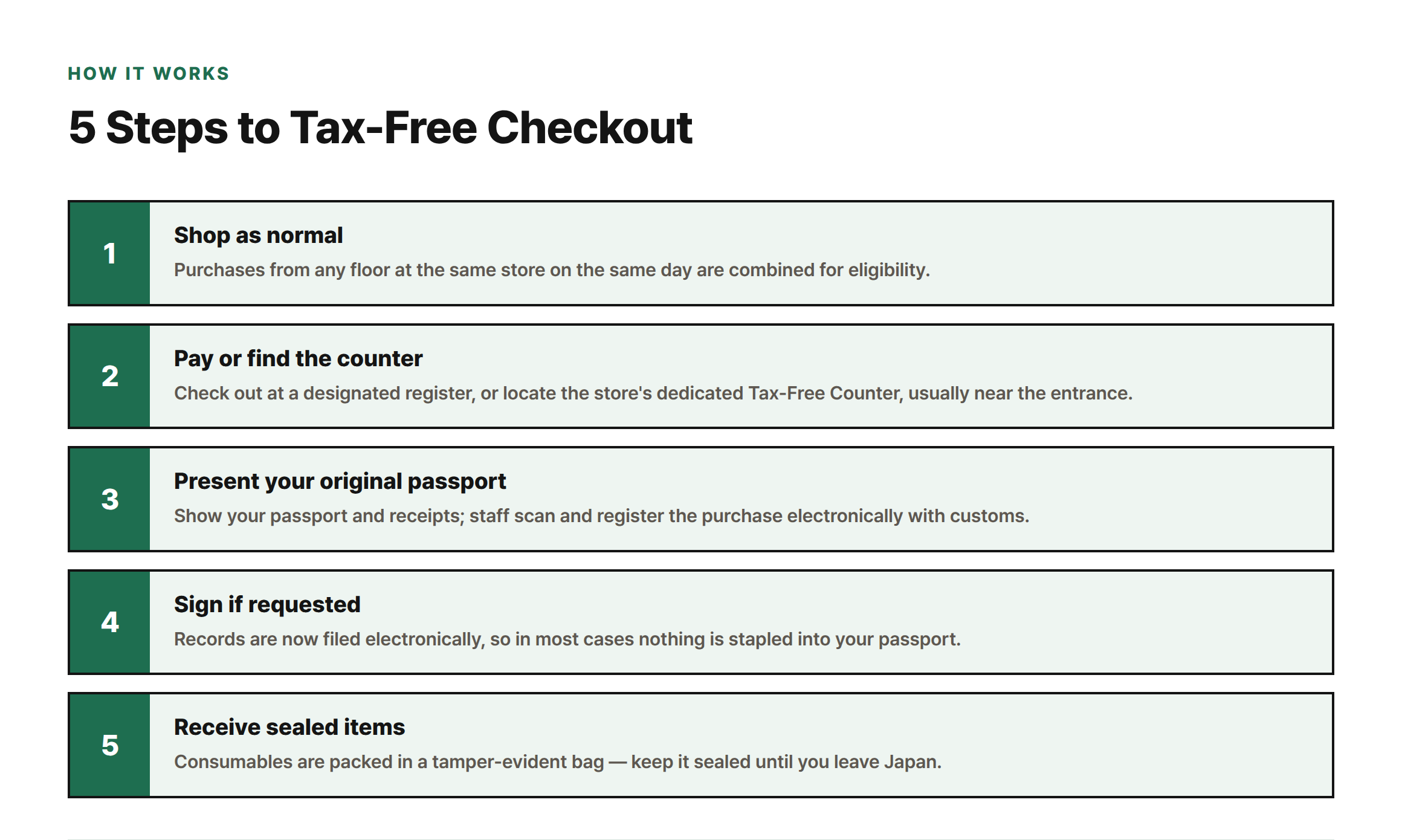
- Shop as normal. Pick up items from any floor or department — Don Quijote stores are usually multi-floor, and tax-free counters combine purchases made at the same store on the same day, not per floor or per register[1].
- Pay at the regular checkout first, or ask staff to direct you. Some locations run an immediate tax-free process right at a designated register; larger stores route everyone through a separate Tax-Free Counter, usually near the entrance or a dedicated floor. Look for signage or ask any staff member for “tax-free counter.”
- Present your original passport along with your receipt(s). Staff scan the passport and register the purchase electronically with Japanese customs[1].
- Sign the purchase record if requested — this used to involve a paper slip stapled into your passport; Japan has since moved to an electronic record, so in most cases nothing goes into the passport itself anymore.
- Receive your sealed items. Consumables (food, drinks, cosmetics, medicine) are packed in a tamper-evident bag. Keep it sealed until you’ve left Japan.
Consumables vs. General Goods: Where the ¥500,000 Cap Applies
Japan’s tax exemption splits everything into two buckets[3]:
- General goods — electronics, clothing, bags, toys, souvenirs you’ll actually use in daily life. Minimum ¥5,000 (tax excluded) per store per day. No upper limit.
- Consumables — food, drinks, cosmetics, medicine, and similar items meant to be consumed. Minimum ¥5,000, and capped at ¥500,000 (tax excluded) per person per store per day[1].
The cap exists to stop bulk resale disguised as personal shopping. If your snack-and-cosmetics haul at one Don Quijote branch exceeds ¥500,000 before tax in a single day, the excess simply isn’t eligible — split the trip across days or stores if you’re buying at that scale. General goods and consumables can be combined to clear the ¥5,000 floor (e.g., ¥3,000 of snacks plus ¥3,000 of a phone case), but once combined, the whole basket is treated under the stricter consumables packaging rule[1].
The November 2026 Reform: From Instant Exemption to Refund-After-Export
This is the change every tourist shopping at Don Quijote after November 1, 2026 needs to understand before their trip. Japan’s National Tax Agency is retiring the current point-of-sale exemption in favor of a “refund method” (リファンド方式)[2][5].
What changes
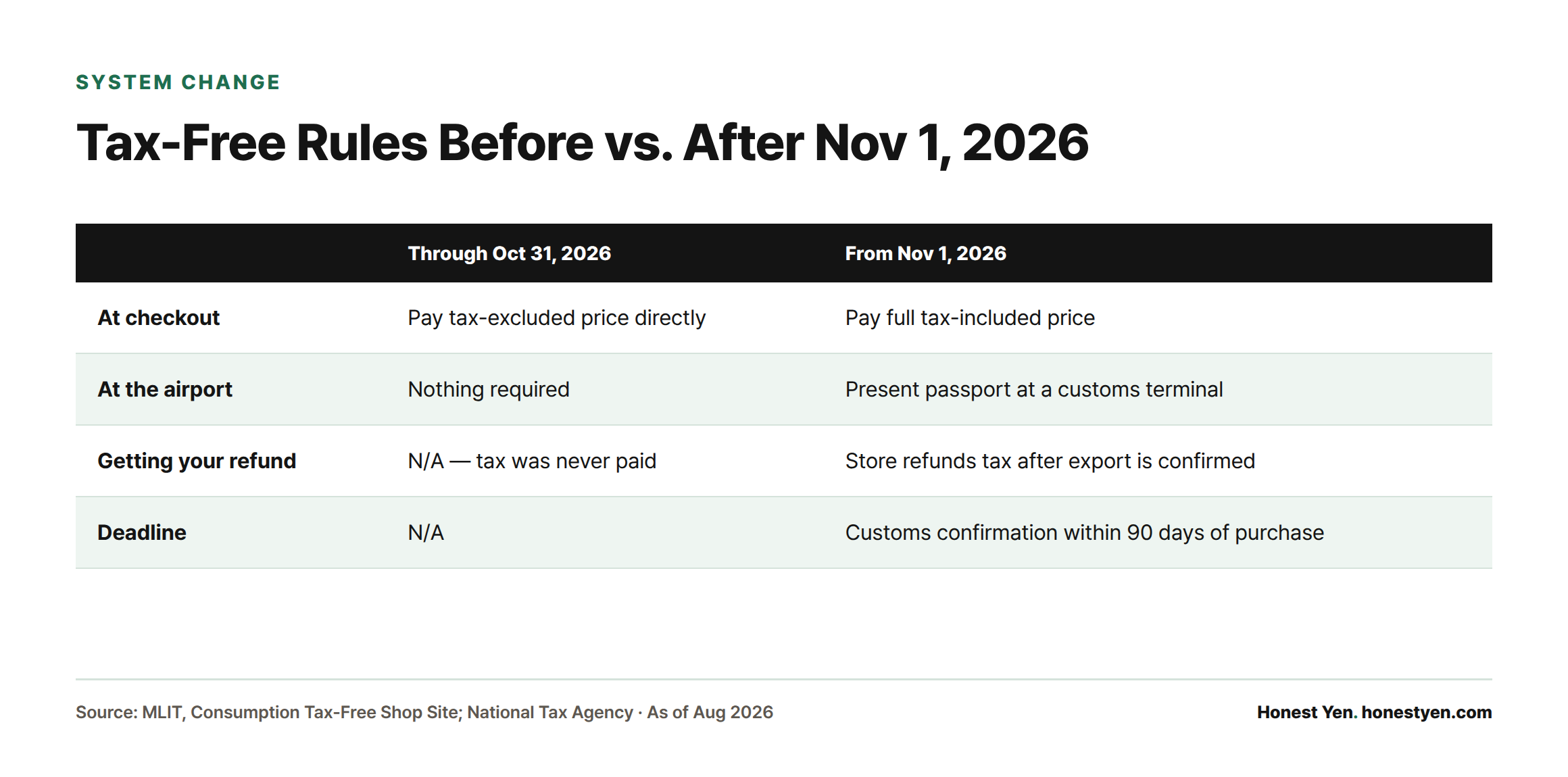
| Through October 31, 2026 | From November 1, 2026 | |
|---|---|---|
| At checkout | Pay the tax-excluded price directly | Pay the full tax-included price |
| At the airport | Nothing required (electronic record already filed) | Present passport at a customs terminal to confirm export |
| Getting your money back | N/A — you never paid the tax | Refund issued by the store after customs confirms export |
| Deadline | N/A | Customs confirmation must happen within 90 days of the purchase date[5] |
Under the new system, every tax-free item you buy at Don Quijote will show the regular, tax-included price on your receipt. Before checking your bags at the airport, you’ll need to visit a self-service terminal in the departure area, scan your passport, and have the system (and possibly a customs officer) confirm you’re carrying the goods out of the country. Only after that confirmation does the store — or a third-party refund agent it works with — return the tax portion to you, by the method the retailer offers: bank transfer, card refund, app payment, or cash at the airport[5]. If you skip this step or the 90-day window lapses, you keep the goods but lose the refund, and in principle you become liable for the tax you were exempted from[5].
Practically, this means budgeting the full sticker price when you shop at Don Quijote from November onward, and building in extra time at the airport before check-in to process the refund terminal — don’t check your tax-free bags without doing this first, since you’ll need the physical items on hand if a customs officer asks to see them[5].
Coupons and the majica App
Tax exemption and store discounts stack, but not all discount instruments are eligible at the tax-free counter. Don Quijote’s own tax-free terms state that regional shopping coupons, premium gift certificates, and prepaid cards cannot be applied to a tax-free transaction[1]. Digital tourist coupons distributed through Don Quijote’s official channels are generally fine to combine with tax exemption; check the specific coupon’s terms before you shop, since eligibility can vary by campaign and by store. The company’s own majica loyalty app is the most reliable source for current promotions, since third-party coupon pages come and go.
Common Mistakes and What to Watch For
- Opening the sealed bag early. Consumables leave the store in tamper-evident packaging that is not meant to be opened inside Japan. If customs or airline staff find it broken before departure, you can be asked to pay the exempted tax on the spot. If you genuinely need to open or use something before you fly, Don Quijote’s policy is to bring the item and your receipt back to the store that sold it so staff can re-process the sale as a taxed purchase[1].
- Assuming each floor needs its own ¥5,000 minimum. It doesn’t — Don Quijote combines everything bought at the same store on the same day. Keep all your receipts together and bring them all to the tax-free counter in one visit rather than processing floor by floor.
- Paying with someone else’s card. If the name on your payment card doesn’t match your passport, staff can refuse the tax-free process for that transaction[4]. Traveling as a couple or family, plan on paying separately if you want each purchase properly attributed.
- Processing on a different day. Tax-free procedures are only valid on the day of purchase, at the store where you bought the items[1]. There’s no next-day fix if you forget to stop at the counter.
- Losing track of the passport itself. Since immediate tax exemption depends on the physical document, keep it accessible — not buried at the bottom of a suitcase — on any day you plan to shop.
If you’re weighing how much cash to carry for a shopping-heavy day, it’s worth pairing this with how you’ll actually pay in Japan more broadly — see this comparison of travel money cards for Japan for how card fees and cash withdrawals stack up against carrying yen.
FAQ
How much do I need to spend to get tax-free at Don Quijote?
¥5,000 or more before tax, in a single store on a single day. That threshold applies separately to general goods and to consumables, though the two categories can be combined to reach it[1].
Can I use a passport copy or a photo on my phone?
No. Only the original physical passport (or landing permit) is accepted; copies and photos are explicitly rejected[1].
Does my payment card need to match the name on my passport?
Yes, for card, UnionPay, mobile-pay, and majica payments — the cardholder name must match the passport presented for the tax-free transaction[4]. Cash purchases avoid this issue entirely.
The store has multiple floors with separate checkouts — how does tax-free combine everything?
Don Quijote’s tax exemption is based on total purchases at the same store on the same day, not per floor or per register[1]. Keep every receipt from that day and bring them together to the Tax-Free Counter.
What happens if I open the tax-free packaging?
You’re not supposed to use or open sealed consumables before leaving Japan. If you need to, the correct process is to return the item and receipt to the original store so staff can re-sell it as a taxed purchase[1].
What actually changes on November 1, 2026?
You’ll pay the full tax-included price at checkout instead of an already-discounted price. To get the tax back, you present your passport at a customs terminal at the airport or seaport before departure, within 90 days of the purchase date, and the store refunds the tax afterward[2][5].
Sources
- Don Quijote (PPIH), official Tax-Free shopping guide
- Ministry of Land, Infrastructure, Transport and Tourism, Consumption Tax-Free Shop Site — Refund Method notice
- Japan Customs, “Exemption for Purchase of Consumer Goods for Non-Residents”
- Don Quijote, Tax-Free procedure and eligibility terms (Japanese)
- National Tax Agency, Review of the Export Goods Sales Site System — Shift to the Refund Method