Do You Need a Foreign Passport for That Japan Discount?

This post may contain affiliate links. If you book or buy through them, we may earn a commission at no extra cost to you.
Four Japan travel products check a physical passport before they sell you a discount. The table below shows which ones, what they check, and what each currently costs.
| Discount | Passport check | Price, September 2026 | Who is excluded |
|---|---|---|---|
| Japan Rail Pass, 7-day Ordinary | Temporary Visitor stamp required[1] | ¥50,000 before Oct 1; ¥53,000 on or after[2] | Residents and most long-term visa holders[1] |
| Tokyo Subway Ticket, 72-hour | Overseas tourist status required[3] | ¥1,500 adult[3] | Residents of Tokyo and six neighboring prefectures[3] |
| N’EX Tokyo Round Trip Ticket | Passport inspected at purchase[3] | ¥5,000 adult[3] | Japan residents |
| Tax-free shopping | Entry record within 6 months[7] | 10% or 8% exemption[10], ¥5,000 minimum[7] | Residents without a tourist entry record[7] |
| Hakone Freepass | No restriction on the operator’s page[8] | ¥7,100, 2-day, from Shinjuku[8] | Nobody |
| Kansai Railway Pass Lite | Not stated as passport-gated[6] | ¥5,200, 2-day[5] | Sold as a digital e-ticket[5] |
A Temporary Visitor stamp unlocks four of these six products
Japanese immigration law grants “Temporary Visitor” entry status for stays of 15 or 90 days for sightseeing[1]. Officers stamp or sticker the passport with that status on arrival, once you say you are visiting to sightsee. The Japan Rail Pass can be exchanged and used only by someone holding that exact stamp[1].
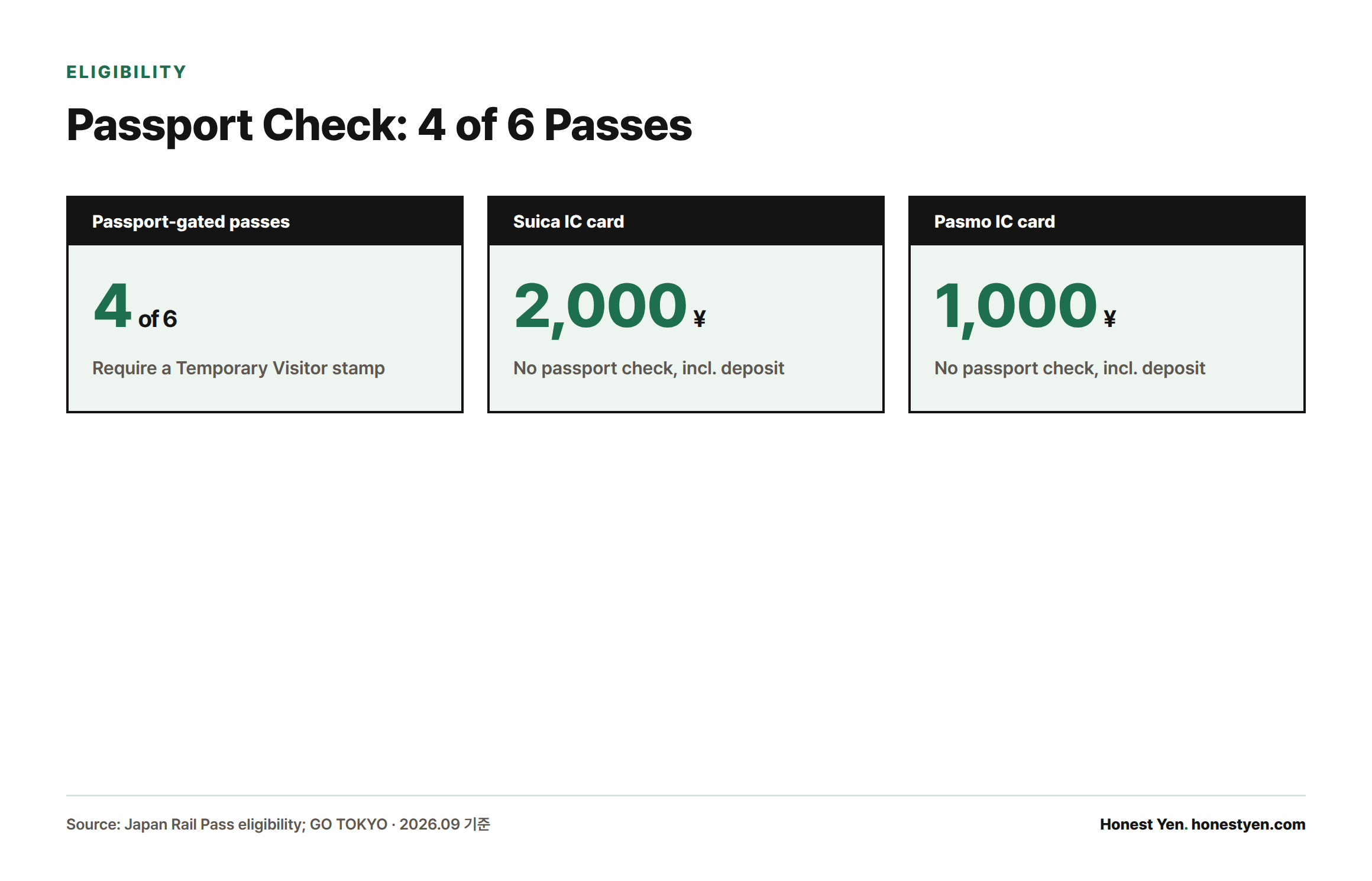
Automated e-gates skip the stamp: no stamp or sticker gets put on the passport[1]. Anyone who wants a JR Pass, the Tokyo Subway Ticket or the N’EX ticket needs a staffed lane, or must ask a clerk for a stamp after an e-gate[1]. A valid tourist visa alone does not satisfy any of the four.
Japanese nationals living abroad for 10 or more consecutive years[1] can also qualify for the JR Pass, though children under that threshold cannot[1]. Work, student and spouse visa holders fall outside all four passport-only products.
For ordinary single-city travel, a Suica or Pasmo IC card needs no passport check and costs from ¥2,000 or ¥1,000 including deposit[3]. These passport-only passes only pay off on specific multi-leg itineraries, not everyday rides.
The Japan Rail Pass costs 6% more from October 1, 2026
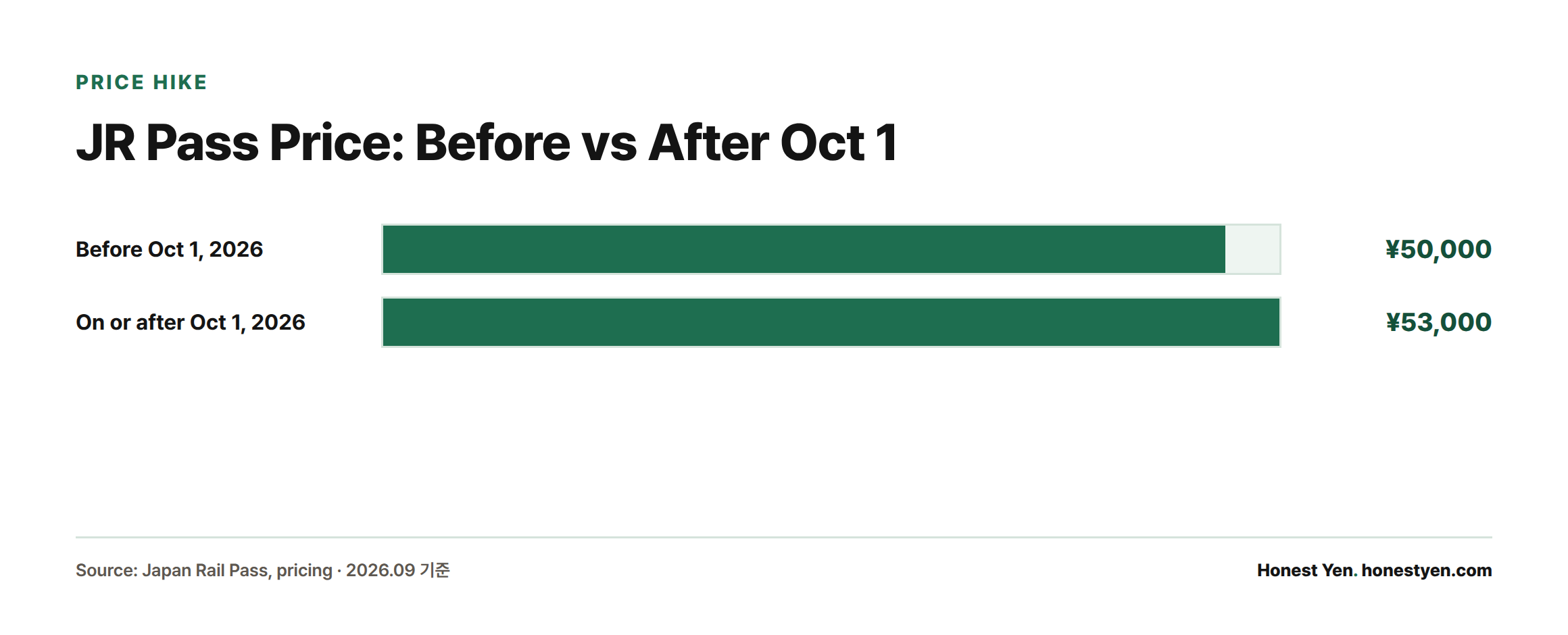
A 7-day Ordinary pass bought online costs ¥50,000[2] for purchases made before October 1, 2026. The same 7-day Ordinary pass bought overseas on or after that date costs ¥53,000[2].
The pass alone does not cover the fastest Shinkansen. Riding the Nozomi or Mizuho needs an extra “NOZOMI MIZUHO Ticket” bought on top of a valid JR Pass[9]. Travelers doing the Tokyo-Kyoto-Osaka loop should compare the pass against separate Nozomi, Hikari and Kodama fares before assuming the pass wins.
The Tokyo Subway Ticket and N’EX both check your passport
The Tokyo Subway Ticket gives unlimited rides on Tokyo Metro and Toei lines, limited to overseas tourists or visitors from outside greater Tokyo[3]. Adult prices run ¥800 for 24 hours, ¥1,200 for 48 hours and ¥1,500 for 72 hours[3]. A single Tokyo Metro or Toei ride costs anywhere from ¥180 to ¥430 depending on distance[4]. Anyone doing more than a handful of subway hops a day over three days should check how many rides it actually takes to break even.
The N’EX Tokyo Round Trip Ticket is a flat ¥5,000 for adults, and the operator states that passports will be inspected[3]. The comparable Limousine Bus return voucher costs ¥6,000[3], with no equivalent passport clause on the same page.
Tax-free shopping moves to a refund system on November 1, 2026
Anyone who entered Japan within the past six months can buy tax-free, once the store checks a passport or landing record[7]. Purchases must total at least ¥5,000 before tax at one store on one day[7].
From November 1, 2026[10], visitors will pay the consumption tax at checkout and claim it back after completing procedures before leaving the country[10]. That change applies to every tax-free purchase, not just rail travel.
The Hakone Freepass and Kansai Railway Pass Lite are not passport-gated
The Hakone Freepass page lists no nationality, visa or passport condition, describing it as suited to first-time and repeat visitors alike[8]. A 2-day pass from Shinjuku costs ¥7,100 for an adult[8]. Any resident can buy the same ticket at the same counter.
Surutto Kansai’s pages for the Kansai Railway Pass Lite list price and coverage only: ¥5,200 for two days[5], with no coverage on JR, Kyoto’s city subway or Randen lines[6]. Unlike the JR Pass or the Tokyo Subway Ticket, its own operator page carries no passport-check clause. It is sold as a digital ticket rather than from an ordinary machine[5].
What it actually costs, priced in September 2026
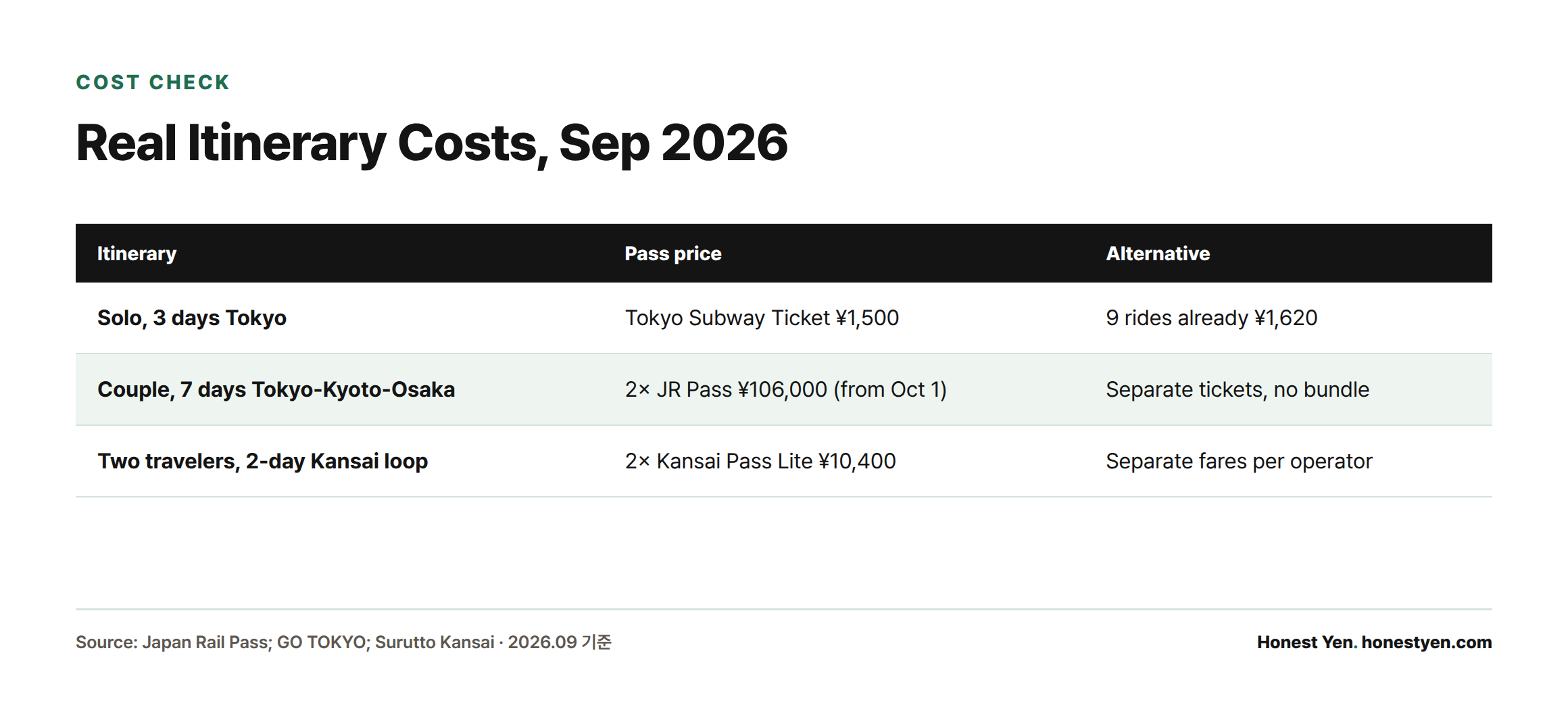
The table below runs the numbers for three real itineraries against the pay-per-ride or per-leg alternative.
| Item | Solo, 3 days in Tokyo | Couple, 7 days Tokyo-Kyoto-Osaka-Tokyo | Two travelers, 2-day Kansai loop |
|---|---|---|---|
| Foreigner-only pass | Tokyo Subway Ticket, 72-hour | Japan Rail Pass, 7-day Ordinary ×2 | Kansai Railway Pass Lite, 2-day ×2 |
| Pass price | ¥1,500[3] | ¥53,000 per pass from Oct 1, ¥50,000 before[2]; ¥106,000 for two | ¥5,200 per pass[5]; ¥10,400 for two |
| Alternative | Pay-per-ride at ¥180-¥430 a trip[4] | Separate long-distance tickets per leg, no bundled discount | Separate fares on each private operator |
| Verdict | Cheaper for heavy subway use, not just a few rides | Cheaper before Oct 1; still one ticket instead of several after | Convenience of one QR code, not a guaranteed discount |
Two 7-day Ordinary passes cost ¥50,000[2] each before October 1, 2026, ¥100,000 total. On or after that date each pass costs ¥53,000[2], ¥106,000 for two. Nine Tokyo subway rides at the ¥180[4] minimum fare already total ¥1,620. That is above the 72-hour Tokyo Subway Ticket’s ¥1,500[3] price. Two Kansai Railway Pass Lite 2-day tickets cost ¥5,200[5] each, ¥10,400 total.
Frequently asked questions
Can foreign residents of Japan buy the Japan Rail Pass?
No. The pass is limited to Temporary Visitor entry status or Japanese nationals who lived abroad for 10 or more years[1]. Work, student and spouse visa holders do not qualify.
Is the Hakone Freepass only for tourists?
No. Its own page states no nationality or passport condition, so any resident or tourist buys it at the same price[8]. That sets it apart from the four passport-checked products above.
What happens if I only get an e-gate stamp at immigration?
An automated e-gate leaves no stamp in the passport[1]. Without a staffed lane or a clerk’s manual “Temporary Visitor” stamp, you cannot exchange a JR Pass or buy the Tokyo Subway Ticket, even with a valid tourist visa.
Sources
- Japan Rail Pass, eligibility requirements
- Japan Rail Pass, pricing
- Japan National Tourism Organization, useful tickets for Tokyo
- GO TOKYO, subway fares and IC cards
- Surutto Kansai, Kansai Railway Pass Lite pricing
- Surutto Kansai, Kansai Railway Pass Lite overview
- Ministry of Land, Infrastructure, Transport and Tourism, tax-free shopping rules
- Hakone Navi, Hakone Freepass
- JR Central, online booking and Nozomi/Mizuho tickets
- Japan National Tourism Organization, tax-free shopping changes