Japan’s 2027 Holiday Calendar: When Golden Week, Obon and New Year Fall, and What Shuts Down
This post may contain affiliate links. If you book or buy through them, we may earn a commission at no extra cost to you.
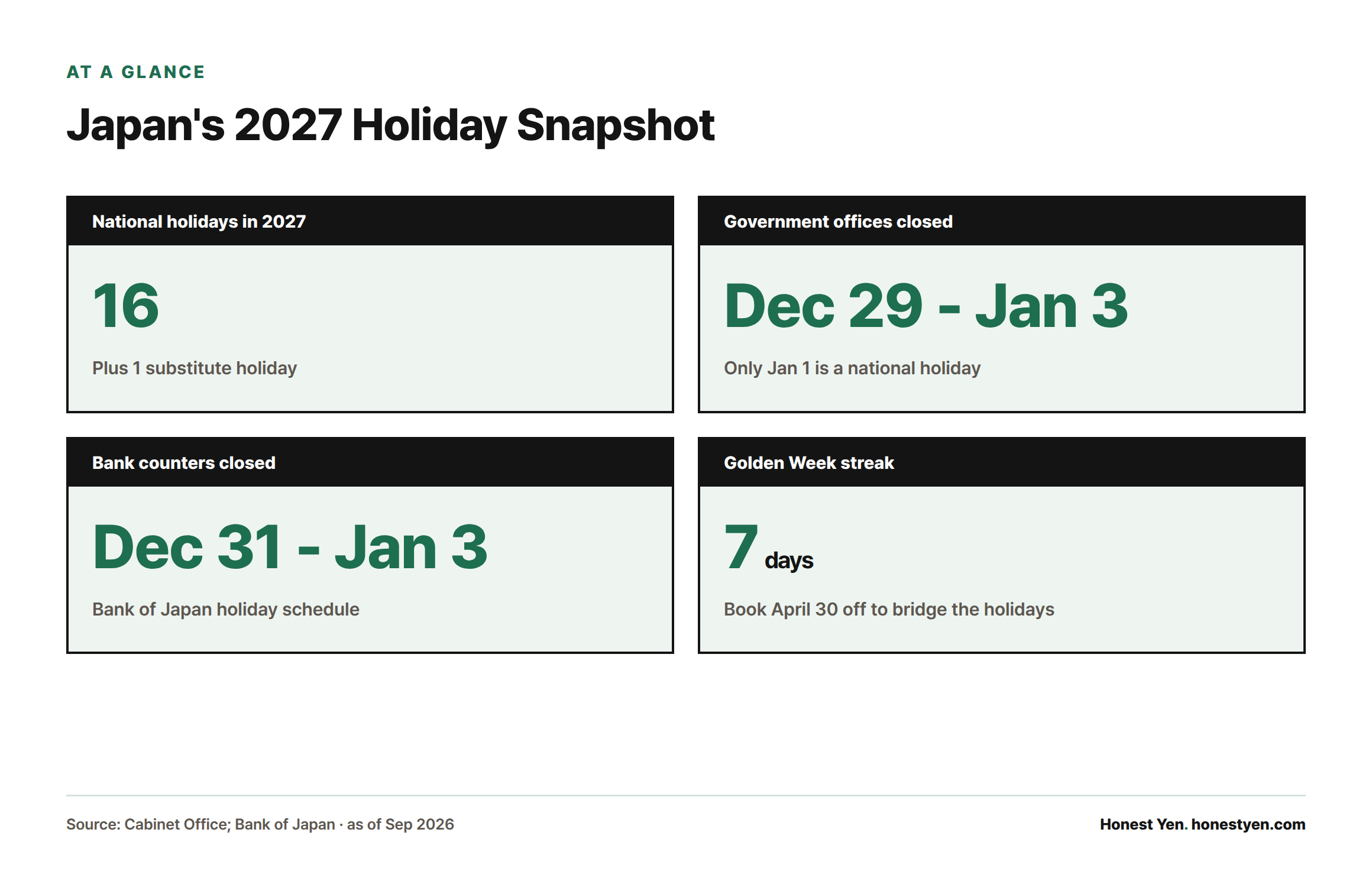
Japan has 16 national holidays in 2027, fixed by the Public Holidays Act, plus one substitute holiday.[1] As of September 2026, the two equinox dates that anchor the spring and autumn calendar are already confirmed. Anyone traveling during Golden Week, Obon or the New Year window should expect higher Shinkansen fares, sold-out trains and closed banks. Most shops and restaurants, though, keep their doors open.
| Date | Day | Holiday |
|---|---|---|
| January 1 | Friday | New Year’s Day |
| January 11 | Monday | Coming of Age Day |
| February 11 | Thursday | National Foundation Day |
| February 23 | Tuesday | Emperor’s Birthday |
| March 21 | Sunday | Vernal Equinox Day |
| March 22 | Monday | Substitute holiday |
| April 29 | Thursday | Showa Day |
| May 3 | Monday | Constitution Memorial Day |
| May 4 | Tuesday | Greenery Day |
| May 5 | Wednesday | Children’s Day |
| July 19 | Monday | Marine Day |
| August 11 | Wednesday | Mountain Day |
| September 20 | Monday | Respect for the Aged Day |
| September 23 | Thursday | Autumnal Equinox Day |
| October 11 | Monday | Sports Day |
| November 3 | Wednesday | Culture Day |
| November 23 | Tuesday | Labor Thanksgiving Day |
The Cabinet Office lists all 16 dates for 2027 alongside 2026.[1] The National Astronomical Observatory, which sets the two equinox dates by law, published its 2027 almanac on February 2, 2026, seven months before this article was published.[2] That timing matters: equinox-based holidays for any year beyond the following one aren’t yet official, so a “2028 calendar” published today would be guesswork.
Golden Week runs April 29 to May 5, and one day off makes it seven
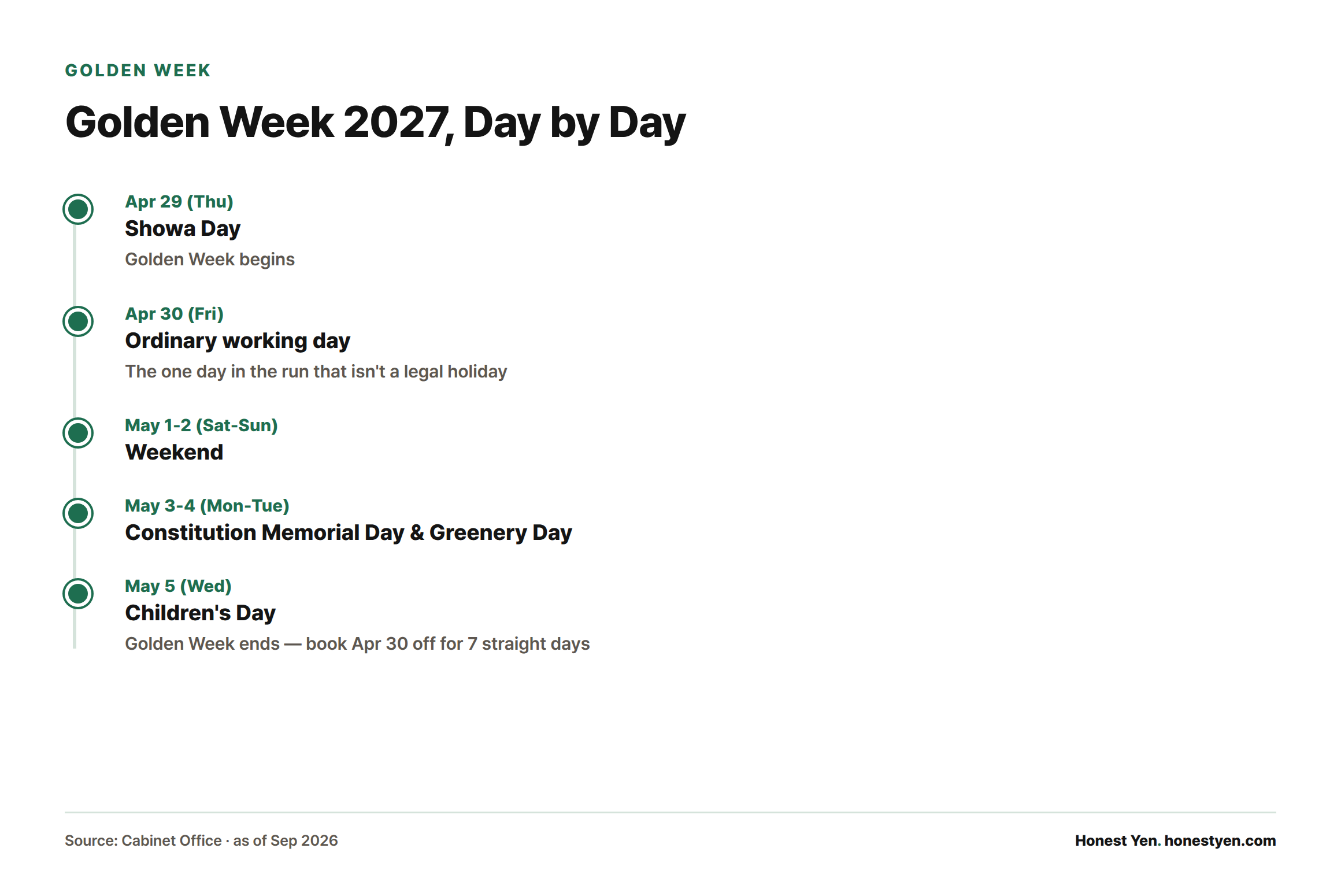
Golden Week 2027 opens with Showa Day on Thursday, April 29, and closes with Children’s Day on Wednesday, May 5.[1] Constitution Memorial Day (May 3) and Greenery Day (May 4) fill the middle, alongside the weekend of May 1 and 2. Friday, April 30 sits in between as an ordinary working day. Japan’s holiday law only converts a day into a rest day when both the day before and after are already holidays, and April 30’s following day, Saturday, is not one.[1] Book that single Friday off, and April 29 through May 5 becomes seven straight days away from work.
Obon isn’t a legal holiday, but it’s the busiest week on the rails
Obon has no status under the National Holidays Act; the only nearby legal holiday is Mountain Day on August 11.[1] In practice, most offices close for a few days around August 13-16, 2027, as families return to their hometowns for the Buddhist ancestor-honoring festival.[4] JR Central’s own fiscal-2027 seasonal fare calendar treats August 11 through 16 as its most-congested tier for reserved Shinkansen seats. That’s the same top pricing tier used for the core of Golden Week and New Year.[5]
The New Year window shuts government offices longer than shops
Only January 1 is a national holiday, but government offices close under a separate law from December 29 through January 3.[9] The Bank of Japan’s own holiday schedule closes bank counters from December 31 to January 3.[3] Regular post office counters typically follow a similar late-December through January 3 closure, though some larger “Yu-Yu” counters inside big post offices stay open on reduced hours. For a visitor arriving between Christmas and New Year, that means no bank-counter service and limited postal service for the better part of a week. The country itself isn’t on a single unified public holiday during that stretch.
Convenience stores and trains don’t stop for holidays; banks do
Convenience stores are the exception to nearly every closure above. Chains including 7-Eleven, FamilyMart and Lawson run 24 hours a day, even on national holidays.[4] Most shops in city centers keep their standard 10 a.m. to 8 p.m. hours through public holidays. Major attractions, temples and shrines stay open too, since holidays are exactly when they expect the most visitors.[4] Trains keep running on their normal timetables, roughly 5 a.m. to midnight, on every holiday date, though they run fuller and reservations disappear faster.[4] What closes is narrower than a first-time visitor expects: banks, post office ticket windows, government offices and many small, family-run shops and restaurants, particularly outside the main tourist districts.
What it actually costs: peak surcharges versus the standard fare
JR Central applies a seasonal surcharge to every reserved Nozomi seat: standard season is the base fare, “peak” season adds a surcharge, and “super-peak” season adds more. In its own words, a reserved seat costs “200 yen more” in peak season and “400 yen more” in super-peak, for a single-line journey like Tokyo-Kyoto.[7] Off-peak season, the same seat costs ¥200 less. The base reserved fares, current as of April 1, 2025, are ¥13,970 for Tokyo-Kyoto and ¥14,520 for Tokyo-Shin-Osaka on the Nozomi.[8]
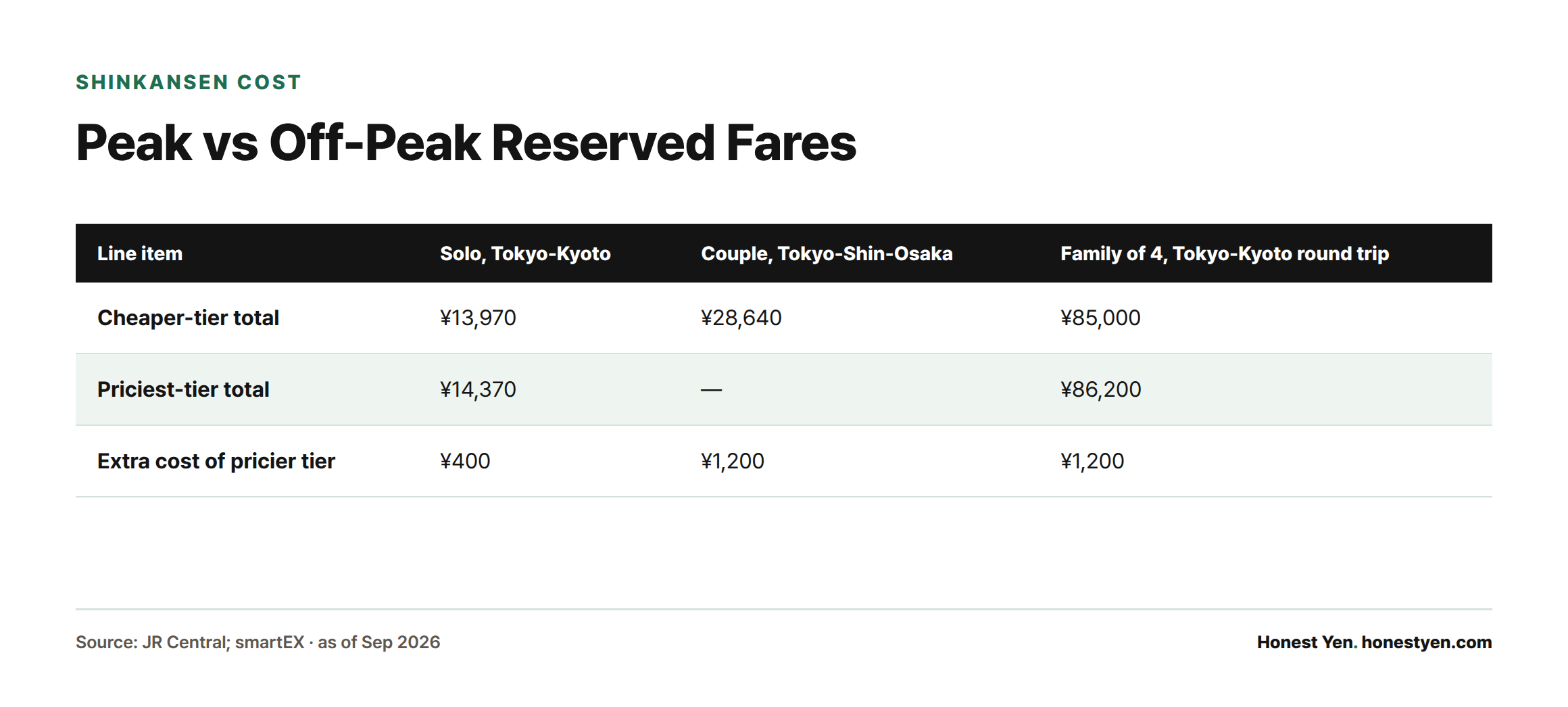
Here’s what that surcharge structure means in real bookings, for a solo traveler, a couple and a family of four.
| Line item | Solo, Tokyo-Kyoto | Couple, Tokyo-Shin-Osaka | Family of 4, Tokyo-Kyoto round trip |
|---|---|---|---|
| Cheaper-tier total | ¥13,970 | ¥28,640 | ¥85,000 |
| Priciest-tier total | ¥14,370 | — | ¥86,200 |
| Extra cost of the pricier tier | ¥400 | ¥1,200 | ¥1,200 |
For the family of four, two adult fares of ¥14,370 plus two child fares of ¥7,180, each doubled for the round trip, come to ¥86,200 on the most-congested dates. That’s (¥14,370 × 2 + ¥7,180 × 2) × 2. There is no off-peak day at all inside the December 29-January 3 window on JR Central’s fiscal-2027 calendar; the cheapest available tier there is still “peak,” not “off-peak.”[5] For Obon, shifting travel by two or three days from August 13 lands on August 15 or 16, both still super-peak on JR Central’s own calendar. Only a shift to August 18 or later actually reaches the off-peak tier.[5] JR Central’s own published example, from a past Obon period, shows the same mechanism: a family of four saved “1,800円おトク” by moving their travel dates out of the most-congested days.[6]
Book reservations and load an IC card before each window opens
Reserved seats open for booking up to a year ahead through smartEX, starting at 5:30 a.m. Japan time on the “1 year prior” date.[7] For Golden Week, Obon or New Year travel, the moment that window opens is the moment to book, since the most-congested dates sell out first. Carry more cash than usual for the New Year stretch, when bank counters and some ATMs are unavailable for several days.[3] Load a Suica, Pasmo or ICOCA card before the rush starts. Buy any tax-free purchases or Shinkansen tickets early too, since duty-free counters and ticket windows get overwhelmed during all three peak windows. A broader breakdown of typical trip costs by travel style is available in this cost guide.
FAQ: Japan public holidays 2027
Is Obon an official public holiday? No. It has no legal status under the National Holidays Act; the only legal holiday nearby is Mountain Day on August 11.[1] Businesses close for it voluntarily, not by law.
Is there a Silver Week in 2027? No. A Silver Week needs a single day sandwiched between Respect for the Aged Day and the Autumnal Equinox to become an automatic rest day. In 2027 those two holidays fall on September 20 and September 23, three days apart, too far apart for the bridge rule to apply.[1][2]
What’s open in Tokyo and Kyoto on January 1-3? Convenience stores, most restaurants and major temples and shrines stay open and are typically busier than usual, while banks, post office counters and government offices close.[3][4]
Sources
- Cabinet Office, “National Holidays” overview and 2026-2027 holiday list
- National Astronomical Observatory of Japan, 2027 calendar almanac (Reiwa 9)
- Bank of Japan, Holiday Schedule of the Bank
- Japan National Tourism Organization, Business Hours and Holidays
- JR Central, Seasonal Reserved-Seat Fares (fiscal 2026 and 2027 calendars)
- JR Central, Obon Seasonal Fare Guidance
- smartEX, Fare Overview
- smartEX, Reserved Ordinary Car Fare Chart (as of April 1, 2025)
- National Tax Agency, deadline handling on administrative-agency holidays