Osaka Amazing Pass Break-Even Calculator: How Many Stops Until It Pays Off (2026)

This post may contain affiliate links. If you book or buy through them, we may earn a commission at no extra cost to you.
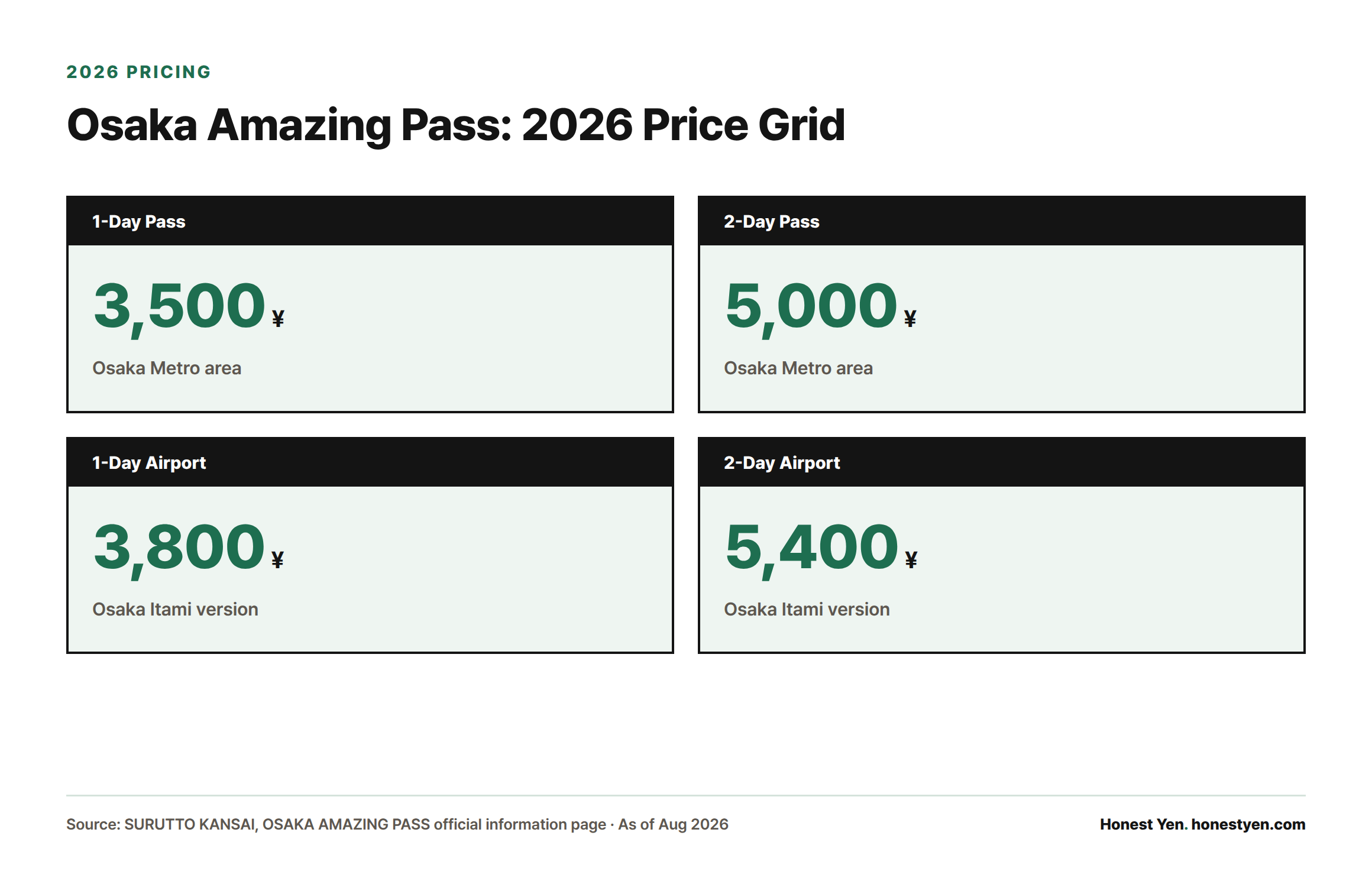
As of August 2026, the 1-day Osaka Amazing Pass costs ¥3,500 and the 2-day version costs ¥5,000[1]. Using official admission prices, most travelers clear that cost after visiting two paid attractions and using the subway or bus for a normal day of sightseeing — for example, Umeda Sky Building Observatory (¥2,000) plus Osaka Castle Museum (¥1,200) already covers ¥3,200 of the ¥3,500 price before you’ve ridden a single train[1][2]. Add any transit and the pass is ahead. The 2-day pass needs roughly four to five paid stops spread across two days to clear its higher ¥5,000 floor. Here’s the full math.
2026 Prices and What Changed
| Pass | 1-day | 2-day |
|---|---|---|
| Standard (Osaka Metro area) | ¥3,500 | ¥5,000 |
| Osaka Itami Airport version | ¥3,800 | ¥5,400 |
For the sales period now running (March 25, 2026 through March 31, 2027), the pass is issued exclusively as a digital e-ticket through the SURUTTO QRtto app — physical cards are no longer produced for either the 1-day or 2-day version[1][6]. Each pass must be activated within three months of purchase, and a pass-day is defined as 3:00am to 2:59am the following morning, so an early-morning activation just after midnight can strand you without coverage until 3:00am[1][3].
The Break-Even Formula
Savings = (regular admission at every attraction you enter, plus the value of the transit you’d otherwise pay for) minus the pass price. For transit, Osaka Metro’s own unlimited-ride day pass, the Enjoy Eco Card, prices a full day of subway and bus at ¥820 on weekdays and ¥620 on weekends[5] — a reasonable stand-in for “a normal day of getting around.” One catch Western visitors often miss: the pass covers Osaka Metro, city buses, the New Tram, and the Hankyu, Hanshin, Keihan, Kintetsu, and Nankai private lines within the zone, but not JR lines, including the JR Osaka Loop Line[3]. If you’re weighing this alongside a Japan Rail Pass break-even, treat the two as separate calculations — they don’t overlap.
Break-Even Table (1-Day Pass, ¥3,500)
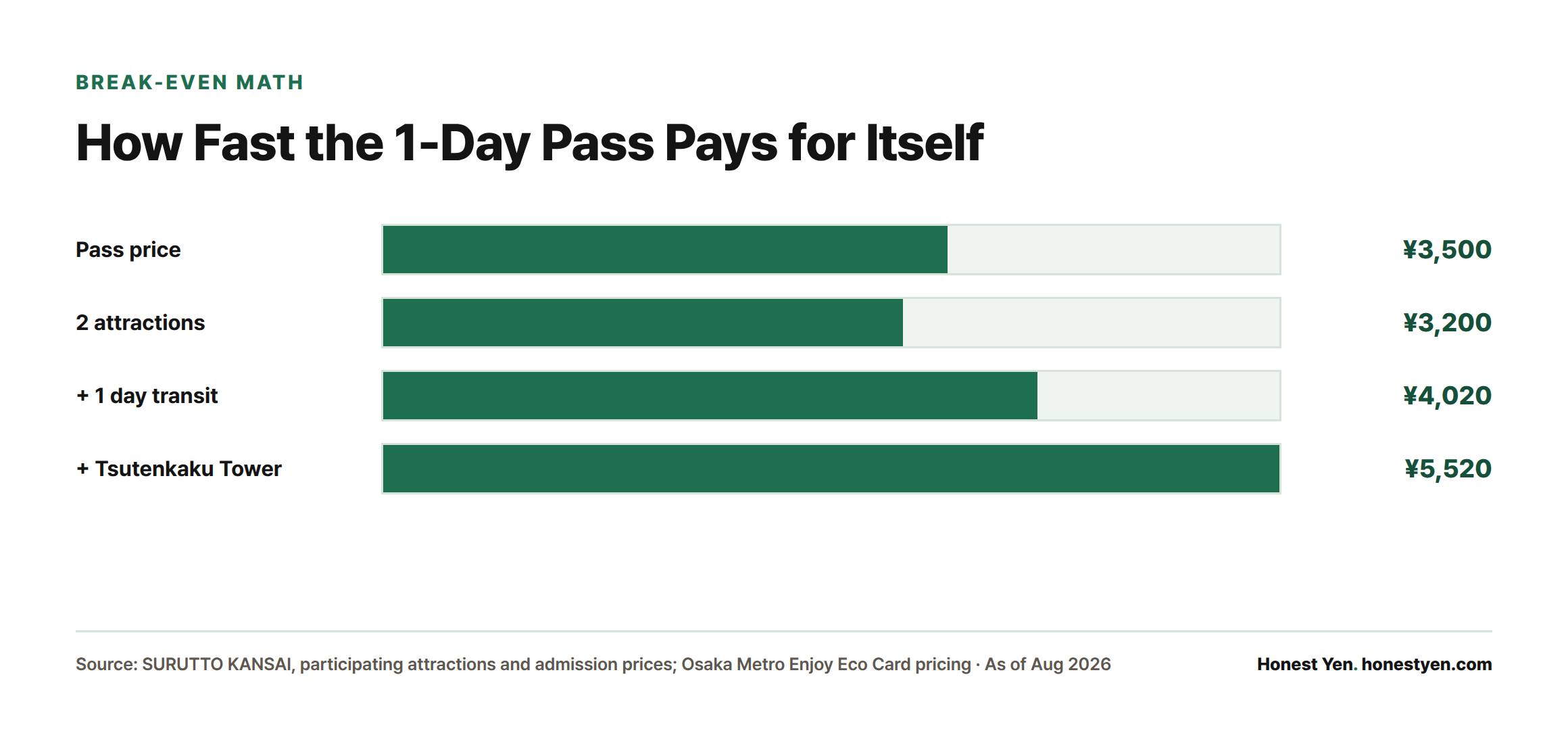
| Stop added | Regular price | Running total |
|---|---|---|
| Umeda Sky Building Observatory | ¥2,000 | ¥2,000 |
| + Osaka Castle Museum | ¥1,200 | ¥3,200 |
| + one day of metro/bus (Eco Card rate) | ¥820 | ¥4,020 — pass already ¥520 ahead |
| + Tsutenkaku Tower Observation Deck | ¥1,500 | ¥5,520 — pass ¥2,020 ahead |
For the 2-day pass, split a similar route across two days. Day 1: Osaka Castle Museum (¥1,200) plus a day of transit (¥820) = ¥2,020. Day 2: Tsutenkaku Tower (¥1,500), Osaka Museum of History (¥600), the HEP FIVE Ferris Wheel (¥1,000), and another day of transit (¥820) = ¥3,920. Two-day total: ¥5,940 against a ¥5,000 pass — ¥940 ahead, from five stops and two days of unlimited rides[2][5].
A Route Built to Break Even in One Day
- Morning: Osaka Castle Museum, reached by Osaka Metro to Tanimachi 4-chome or Osakajokoen (¥1,200)
- Midday: Metro to Namba/Dotonbori for lunch, then the Tombori River Cruise (¥2,000)
- Afternoon: Short ride to Shinsekai for Tsutenkaku Tower’s observation deck (¥1,500)
- Evening: Back to Umeda for sunset at the Sky Building’s Kuchu-Teien Observatory (¥2,000)
That single route totals ¥6,700 in admission alone, more than triple the ¥3,500 pass price, before counting the transit between each stop[2].
When the Pass Is a Loss
- Solo travelers planning just one paid attraction plus mostly free walking (Dotonbori, Shinsekai’s streets, Namba shopping)
- Anyone centering their day on Universal Studios Japan or Osaka Aquarium Kaiyukan — neither is included, and a USJ day leaves no room for other paid stops[2]
- Travelers based in one neighborhood who barely use transit, since the transit value is what usually pushes the math over the line
- Any day where combined admission plus transit stays under ¥3,000 — the pass can’t be beaten if you’re only entering one ¥1,000–1,500 attraction
1-Day vs 2-Day: Which to Buy
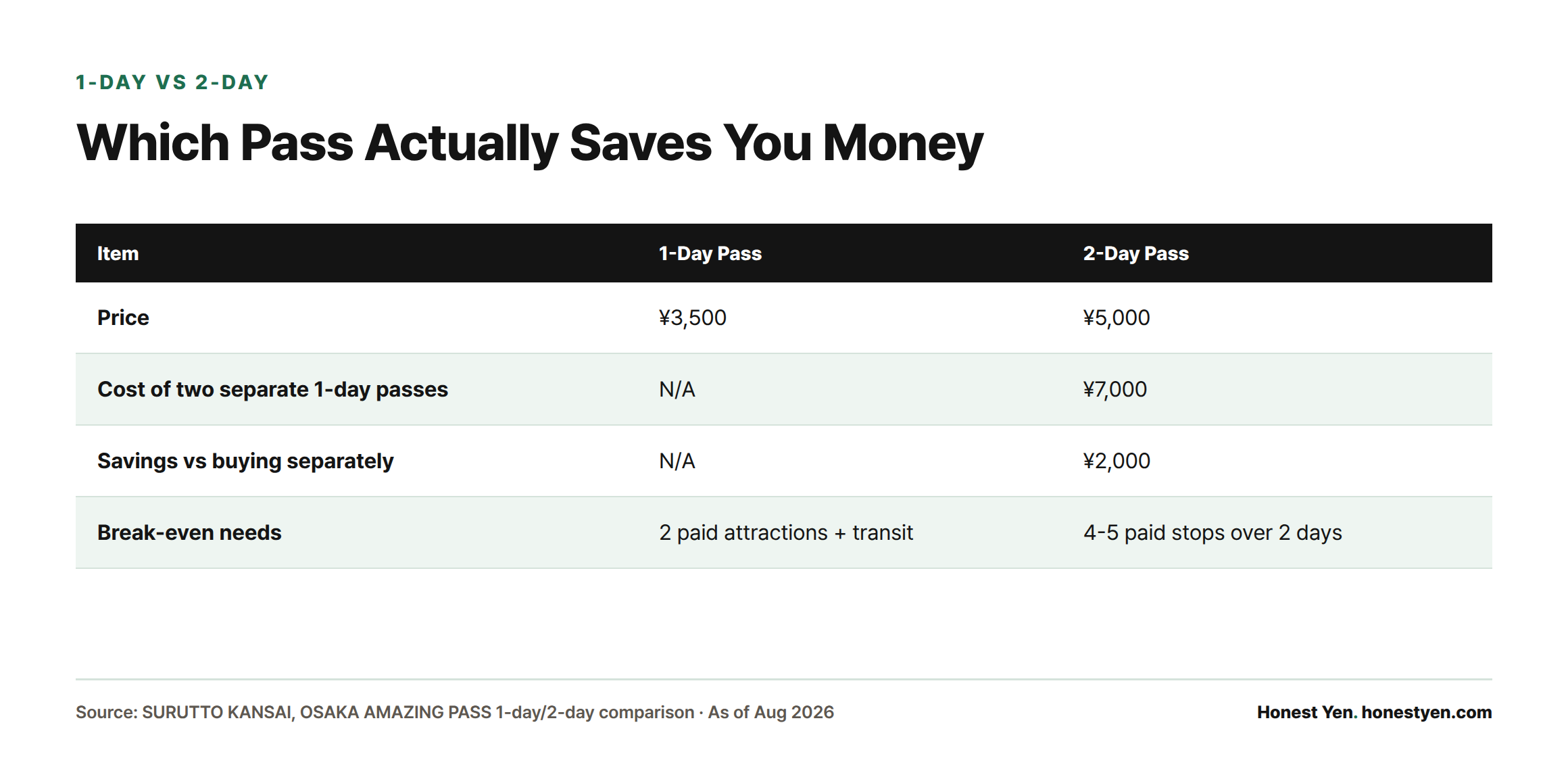
If you’re compressing sightseeing into one intense loop across 3+ neighborhoods, the 1-day pass is sufficient and cheaper. If you’ll spread visits over two days, compare ¥5,000 for the 2-day pass against ¥7,000 for two separate 1-day passes — the 2-day version saves ¥2,000, but only pays for itself if your combined two-day total (attractions plus transit) clears ¥5,000[1]. Note the 2-day pass must be used on two consecutive days, not split across a longer trip[3].
How to Buy, and How It Differs from the e-Pass
The official route is osaka-amazing-pass.com via a free SURUTTO QRtto account, paid by credit card. Unused tickets can be refunded any time before activation; once you tap “Start Using,” the ticket is final and cannot be refunded or reissued[4]. Klook, KKday, and Trip.com also list the pass — compare their checkout price and cancellation window directly at booking, since third-party refund terms can differ from the official pre-activation policy above.
A separate product, the Osaka e-Pass, is run by the city’s official tourism body, OSAKA-INFO. It covers 25+ facilities but excludes all transportation entirely[7]. It suits travelers who already have transit sorted — say, if you loaded an ICOCA card on the way in via the Kansai Airport to Osaka route and don’t want to pay for unlimited rides you won’t fully use.
Sources
- SURUTTO KANSAI, OSAKA AMAZING PASS official information page
- SURUTTO KANSAI, OSAKA AMAZING PASS participating attractions and admission prices
- SURUTTO KANSAI, OSAKA AMAZING PASS 1-day/2-day comparison
- SURUTTO KANSAI, OSAKA AMAZING PASS purchase and refund guide
- Osaka Metro, Enjoy Eco Card 1-day pass pricing
- Osaka Metro, 2026 OSAKA AMAZING PASS update notice
- OSAKA-INFO, Osaka e-Pass usage guide