How to Use the JR Kyushu Rail Pass: Types, Prices, and Seat Reservations (2026)
This post may contain affiliate links. If you book or buy through them, we may earn a commission at no extra cost to you.
The JR Kyushu Rail Pass is the fastest way to string together Fukuoka, Nagasaki, Kumamoto, Beppu, and Kagoshima without buying a stack of individual Shinkansen tickets. But there are three versions, a Shinkansen gap you need to know about, and a seat-reservation system that trips up first-timers. Here’s what’s actually true as of August 2026, following the pass’s April 1, 2026 price revision.[3]
The Three Passes, at a Glance
All prices are for adults; children aged 6–11 pay half, and kids 5 and under ride free (though a seat reservation for a child still requires a child pass or ticket).[1] Note the two price columns: booking through JR Kyushu’s own Online Booking site is ¥1,000 cheaper per pass than buying at a station counter or through a travel agency.[3]
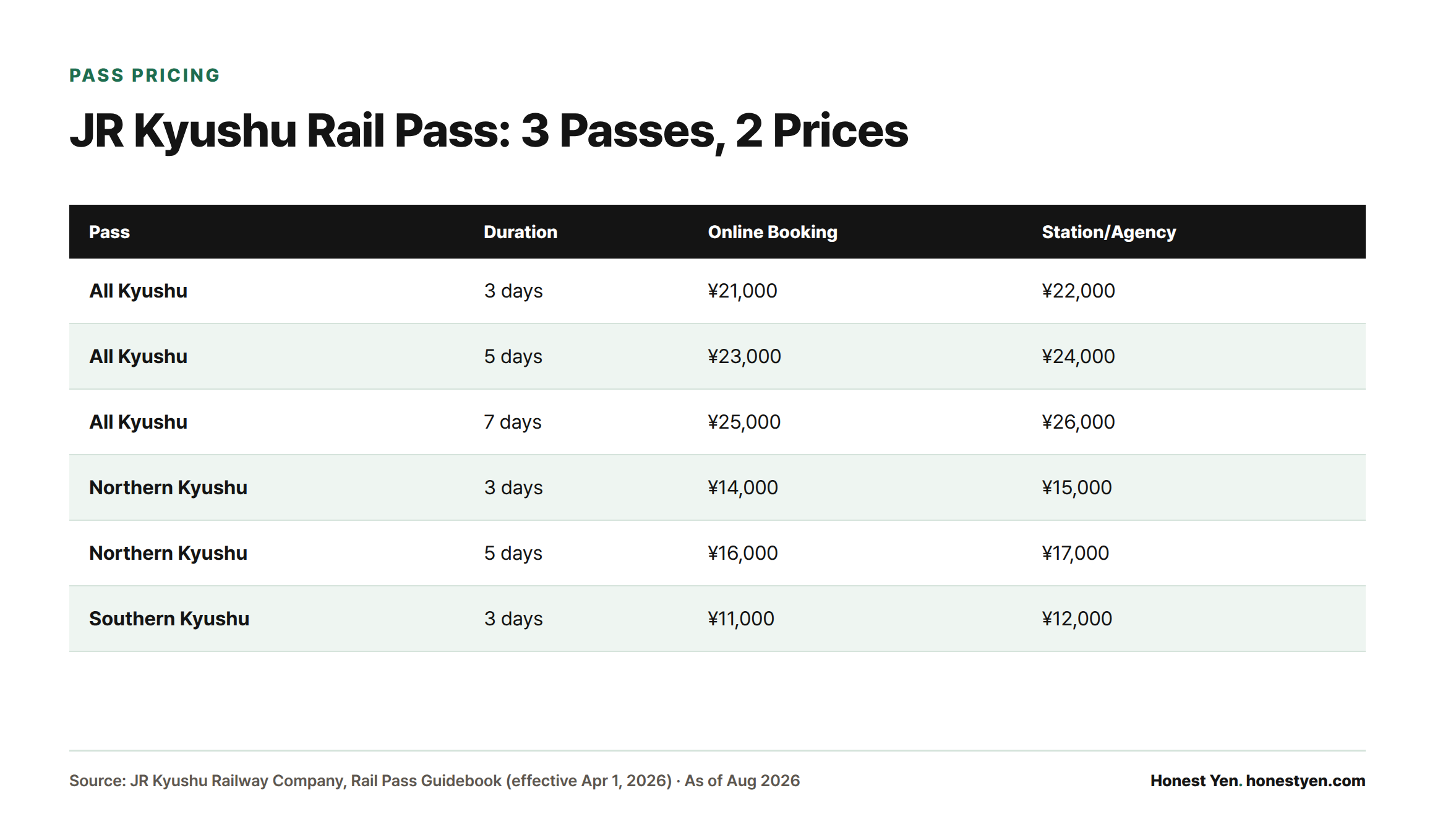
| Pass | Duration | Online Booking (Adult) | Station/Agency (Adult) |
|---|---|---|---|
| All Kyushu | 3 days | ¥21,000[3] | ¥22,000[1] |
| All Kyushu | 5 days | ¥23,000[3] | ¥24,000[1] |
| All Kyushu | 7 days | ¥25,000[3] | ¥26,000[1] |
| Northern Kyushu | 3 days | ¥14,000[3] | ¥15,000[1] |
| Northern Kyushu | 5 days | ¥16,000[3] | ¥17,000[1] |
| Southern Kyushu | 3 days | ¥11,000[3] | ¥12,000[1] |
Northern Kyushu covers Fukuoka, Saga, Nagasaki, Kumamoto, and Oita; Southern Kyushu covers Oita, Kumamoto, Miyazaki, and Kagoshima — the two overlap in the middle, so if your trip crosses both zones (say, Fukuoka to Kagoshima), you need the All Kyushu pass.[1]
What You Can Actually Ride — and the One Big Exception
All three passes cover reserved and non-reserved seats on the Kyushu Shinkansen (Mizuho, Sakura, Tsubame), the Nishi-Kyushu Shinkansen (Kamome), limited express trains, and local/rapid trains within their zone. Green Car (first class) requires an extra supplement, and it doesn’t cover the private Green sleeper cabins.[1]
The one gap every pass buyer needs to know: the Shinkansen between Hakata and Kokura is excluded, because that stretch is Sanyo Shinkansen track operated by JR West, not JR Kyushu.[1] You can still ride local and rapid trains between those two stations for free with the pass — you just can’t use the bullet train there. If you do want the Shinkansen for that short hop, a one-way reserved seat runs about ¥2,520.[4]
Where It’s Actually Cheapest to Buy
Because JR Kyushu’s own Online Booking site prices are ¥1,000 below both the in-Japan station price and the price travel agencies (including Trip.com and Klook, which sell the pass at the standard overseas-agent rate) are permitted to charge, the official site is the cheapest option in nearly every case.[3] The trade-off is flexibility: agency platforms sometimes offer free cancellation before you exchange your voucher, which the official site may not. If your itinerary is firm, book direct; if it might change, weigh that ¥1,000 against the cancellation terms.
Picking Up the Physical Pass
Whether you bought online or through an agency, you exchange your voucher for the physical pass at a staffed JR Kyushu ticket counter — not at an airport, with the single exception of Fukuoka Airport, which handles exchanges only (no sales).[1] Other exchange counters are at Hakata, Kokura, Mojikō, Saga, Nagasaki, Sasebo, Beppu, Oita, Kumamoto, Kagoshima-Chuo, Miyazaki, and Miyazaki Airport stations — though which stations apply depends on your pass area, since a Southern Kyushu pass can’t be exchanged at the northern-only counters and vice versa.[3] Bring your passport: only travelers on a Temporary Visitor visa status may purchase or exchange the pass, and staff will check it.[1] If everyone in your group is picking up a pass, everyone needs to be present at the counter.[1]
Seat Reservations: Free, But Not Unlimited
You do not need to reserve a seat to use the pass — non-reserved cars are included and can be ridden as many times as you like.[1] Reserving a seat is free too, but only up to a limit: unlimited reservations on the All Kyushu pass, and up to 6 reservations each on the Northern and Southern Kyushu passes.[1] Beyond that limit, or if you want to lock in a seat before you land, you have two options:
- At a station counter or reserved-seat machine in Japan — free, and counts against your included quota.
- Through JR Kyushu Rail Pass Online Booking, in advance — convenient, but each reservation carries an extra fee.[1]
One quirk worth knowing: if you transfer between a limited express train and the Nishi-Kyushu Shinkansen at Takeo-Onsen Station without exiting the ticket gates, that counts as a single reservation, not two.[1]
Rules That Catch People Out
The pass must be used on consecutive calendar days — a 5-day pass covers five days in a row from your first use, with no skipping a day and resuming later.[2] Cancel before your first day of use and you’ll get a refund minus a 10% handling fee; once you’ve used the pass even once, it’s non-refundable.[1] At automatic ticket gates, you can tap or insert the pass itself when riding non-reserved; if you’re carrying a separate reserved-seat ticket, use the staffed gate instead, since reserved tickets won’t open the automatic gates.[1]
JR Kyushu Rail Pass vs. SUNQ Pass
The SUNQ Pass is Kyushu’s unlimited-ride bus (plus some ferry) pass, covering roughly 2,400 routes across all seven Kyushu prefectures, Shimonoseki, and Nagato.[5] Its current digital-ticket prices are the All Kyushu 3-day at ¥12,000, the All Kyushu 4-day at ¥15,000, Northern Kyushu 3-day at ¥10,000, and Southern Kyushu 3-day at ¥8,500[5] — and unlike the rail pass, the digital SUNQ ticket lets you pick non-consecutive days within a window (for example, any 3 days within 5).[5]
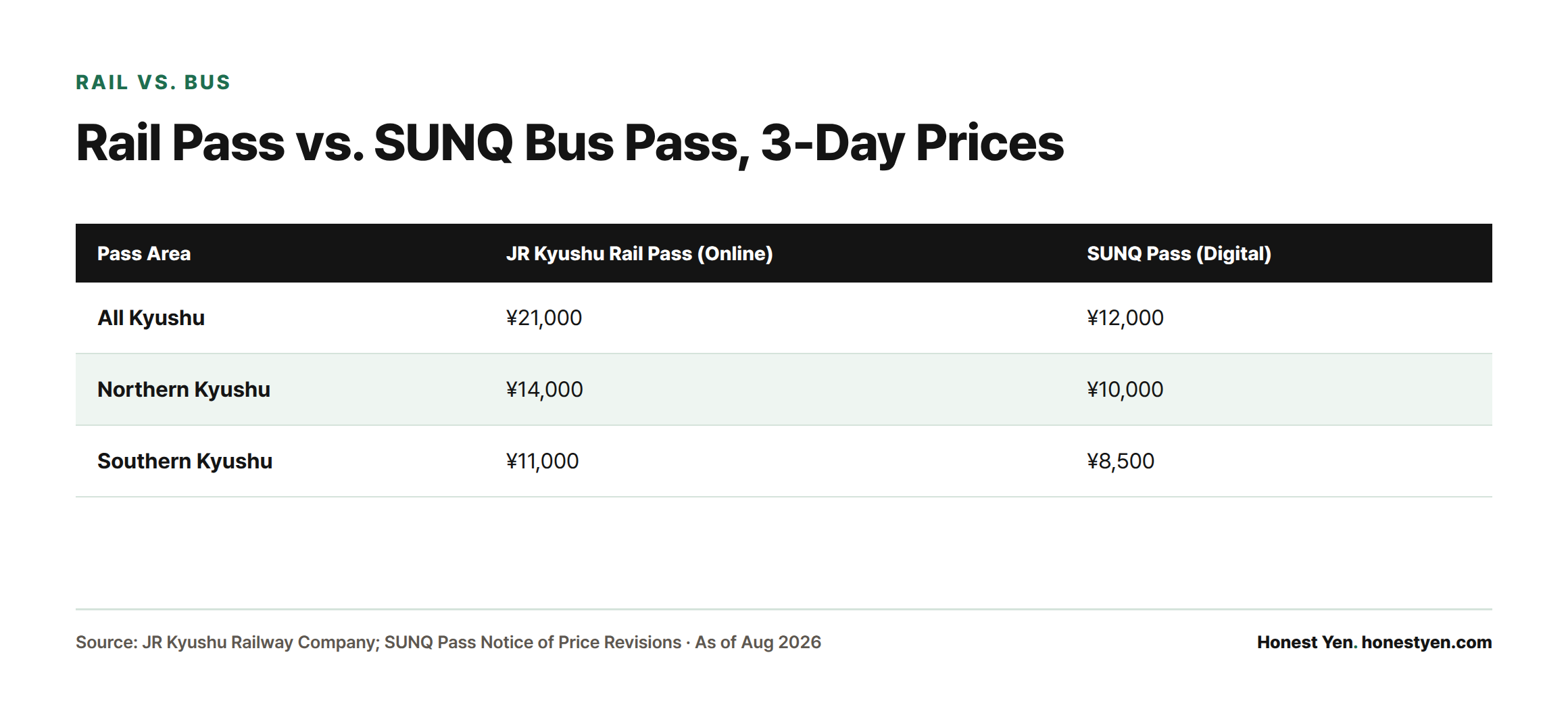
Pick the rail pass if your route runs along the Shinkansen corridor — Fukuoka, Kumamoto, Kagoshima, Nagasaki — where speed matters. Pick SUNQ if you’re headed to places the Shinkansen doesn’t reach well, like Yufuin, Aso, Takachiho, or Kirishima, or if your budget favors the cheaper bus fare and you don’t mind longer travel times.
Is It Worth It? A Real Cost Check
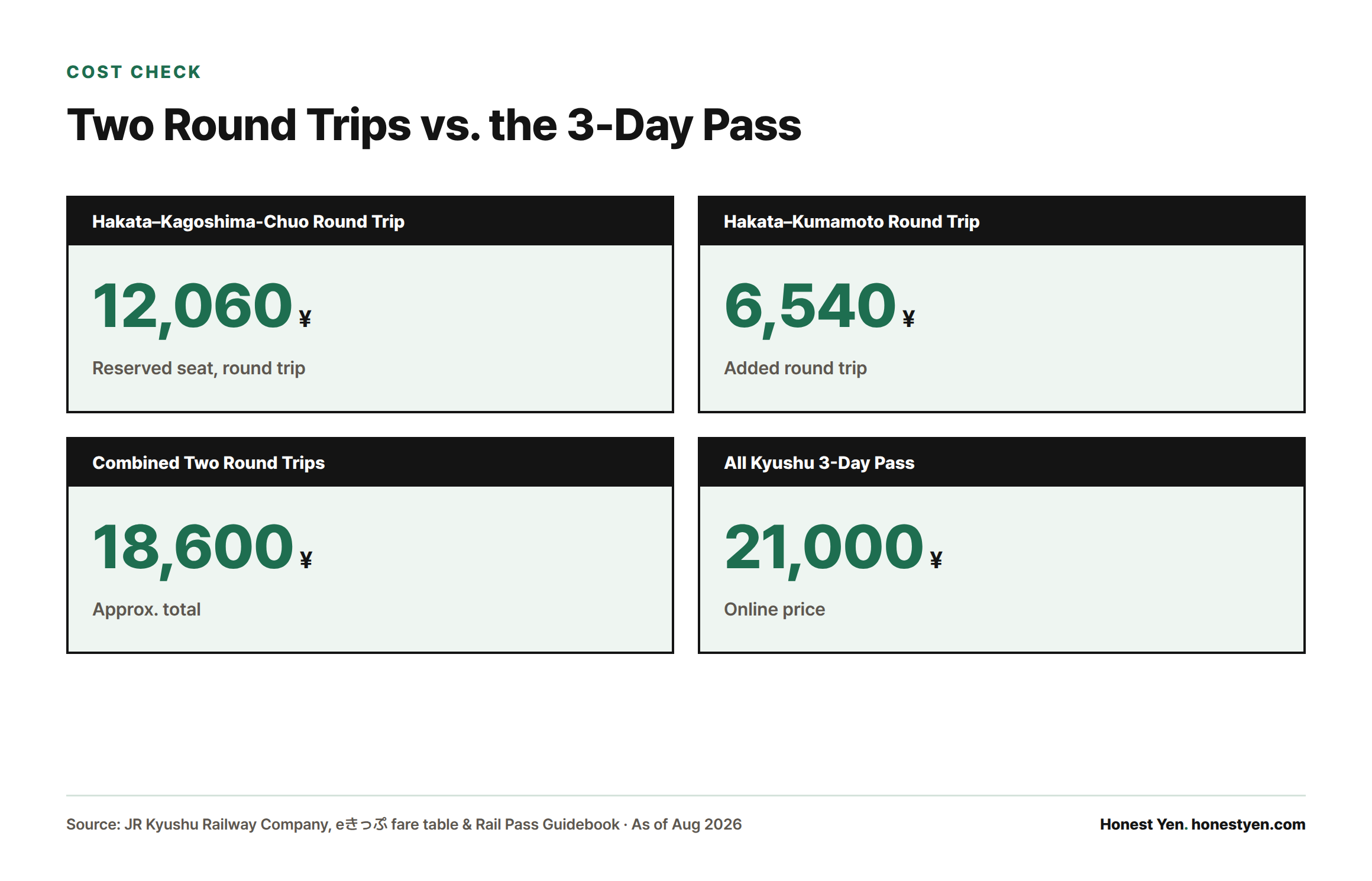
Using JR Kyushu’s own current advance-purchase fares, a Hakata–Kagoshima-Chuo reserved seat costs ¥6,030 one way, so a round trip alone runs about ¥12,060.[4] A Hakata–Kumamoto round trip adds roughly ¥6,540 more.[4] Combine just those two round trips and you’re already near ¥18,600 — close to the ¥21,000 All Kyushu 3-day online price, and any third leg (a Nagasaki side trip, a Beppu onsen stop) pushes individual tickets past the pass. Since the pass also throws in free seat reservations and unrestricted local/rapid trains, a 3-day loop touching three or more cities almost always beats buying tickets one at a time.
If your trip is a single out-and-back — say, a Fukuoka base with one day trip to Kumamoto and nothing else — individual tickets, paid with a prepaid IC card like Suica or ICOCA for the local legs, can work out cheaper than a pass.
Sources
- JR Kyushu Railway Company, “All Kyushu / Northern Kyushu / Southern Kyushu” (JR Kyushu Rail Pass official page)
- JR Kyushu Railway Company, JR Kyushu Rail Pass FAQ
- JR Kyushu Railway Company, “JR Kyushu Rail Pass” official guidebook (PDF, effective April 1, 2026)
- JR Kyushu Railway Company, “eきっぷ 設定区間・発売額等” fare table (PDF, effective April 1, 2025)
- SUNQ Pass, “Notice of Price Revisions” (PDF, effective October 1, 2024)