Travel Money Cards for Japan in 2026: Wise, Revolut, Starling, and Schwab Compared
This guide covers prepaid and debit travel money cards for Japan, current as of August 2026. Figures below are pulled from each provider’s official fee pages and Japan’s transit operators; rates and limits change without notice, so check the issuer’s app before you fly.
The short answer
For most Western travelers on a two-to-three-week Japan trip, a fee-free multi-currency card (Wise or Revolut) covers everyday spending and ATM cash, while a physical Suica, Pasmo, or ICOCA IC card still handles the trains more reliably than tapping a bank card directly at the gate. UK residents with a Starling account and US travelers with Schwab Bank Investor Checking already hold a strong Japan-ready card and don’t need to sign up for anything new.
What a “travel money card” actually is
A travel money card is a prepaid or debit card, usually tied to an app-based bank or brokerage account, that converts your home currency to yen at or near the wholesale exchange rate and lets you spend or withdraw cash in Japan without the 1-3% foreign transaction fee that traditional bank cards charge. It is not the same thing as a Japan eSIM, which handles mobile data, not money, and it’s not the same as an IC transit card (Suica/Pasmo/ICOCA), which is a closed-loop transit and convenience-store payment card, not a general foreign-exchange tool.
Core comparison: fees, ATM limits, and who can even get one
Eligibility matters as much as fees here: some of these accounts are restricted to residents of a specific country.
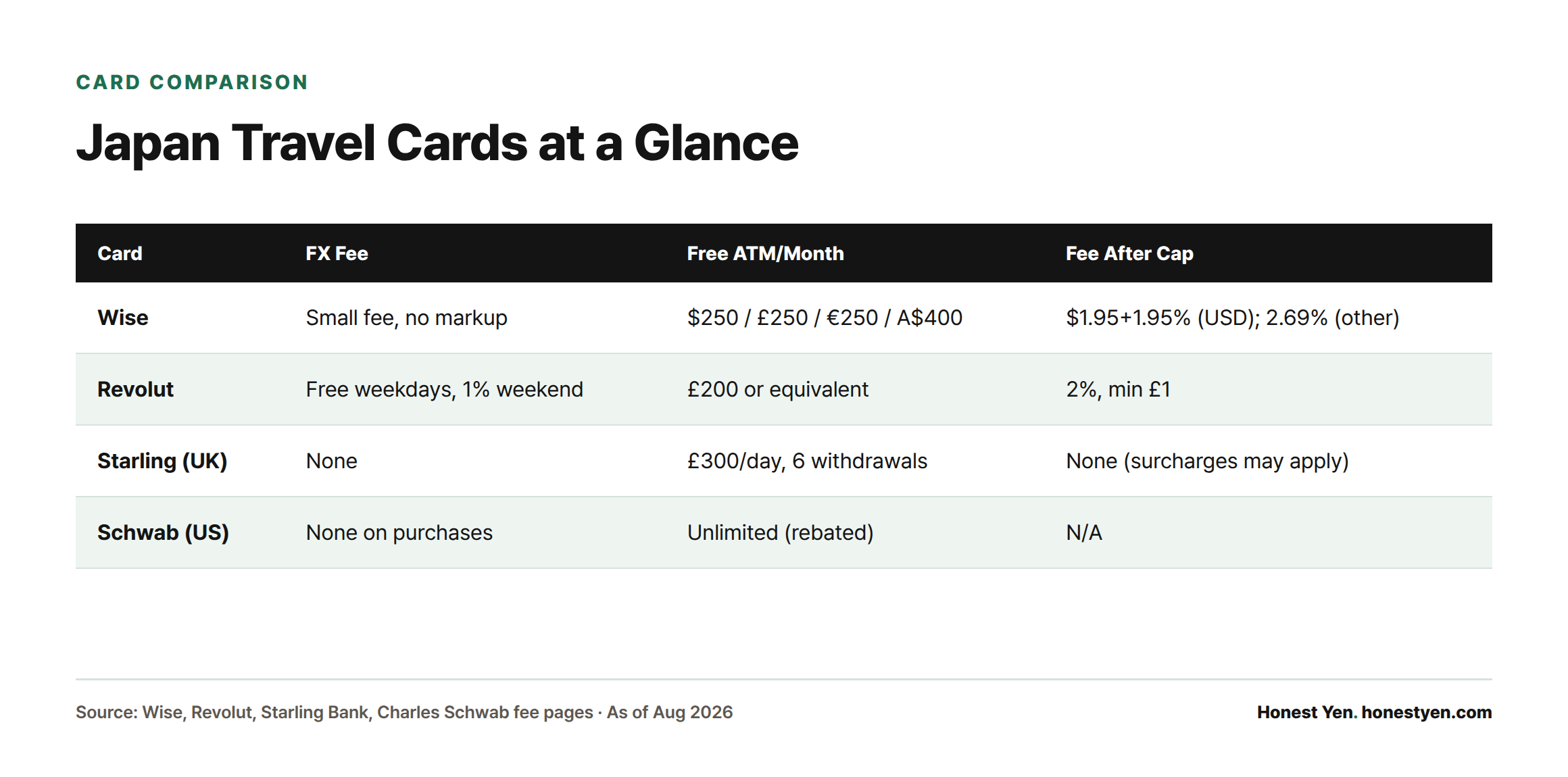
| Card | Who can open one | FX fee | Free ATM withdrawals | Fee beyond the free allowance |
|---|---|---|---|---|
| Wise | Available in 40+ countries | Small conversion fee (varies by currency pair), no markup on the mid-market rate | Up to 250 USD / 250 GBP / 250 EUR / 400 AUD per month[1] | 1.95 USD + 1.95% (USD); 2.69% (GBP/EUR/AUD)[1] |
| Revolut (Standard plan) | UK, EU, US, and other supported markets | Free on weekdays; 1% markup on weekend FX conversions[2] | Up to 200 GBP (or local equivalent) per month[2] | 2% fee, minimum 1 GBP[2] |
| Starling Bank debit card | UK residents (current account) | None — uses the Mastercard network rate[3] | Up to 300 GBP per day, six withdrawals per day[3] | No Starling fee at any amount; ATM operator surcharges may still apply[3] |
| Schwab Bank Investor Checking | US residents (requires a linked Schwab brokerage account) | None on card purchases[4] | Unlimited — all ATM operator surcharges are rebated[4] | Not applicable — rebates are uncapped[4] |
What the ATM actually charges you in Japan
Seven Bank ATMs, found in nearly every 7-Eleven store nationwide and open 24/7, accept foreign-issued Visa, Mastercard, UnionPay, American Express, JCB, Discover, and Diners Club cards, with a per-withdrawal cap of ¥100,000 (¥30,000 for magnetic-stripe-only cards)[5]. Japan Post Bank ATMs, located at post offices, are a second widely available network for foreign cards. Neither network’s own withdrawal fee is guaranteed to be zero — what you actually pay is mostly set by your card issuer’s ATM fee schedule above, not by the Japanese ATM operator, so the comparison table matters more than which convenience store you walk into.
Can you tap through the ticket gate without an IC card?
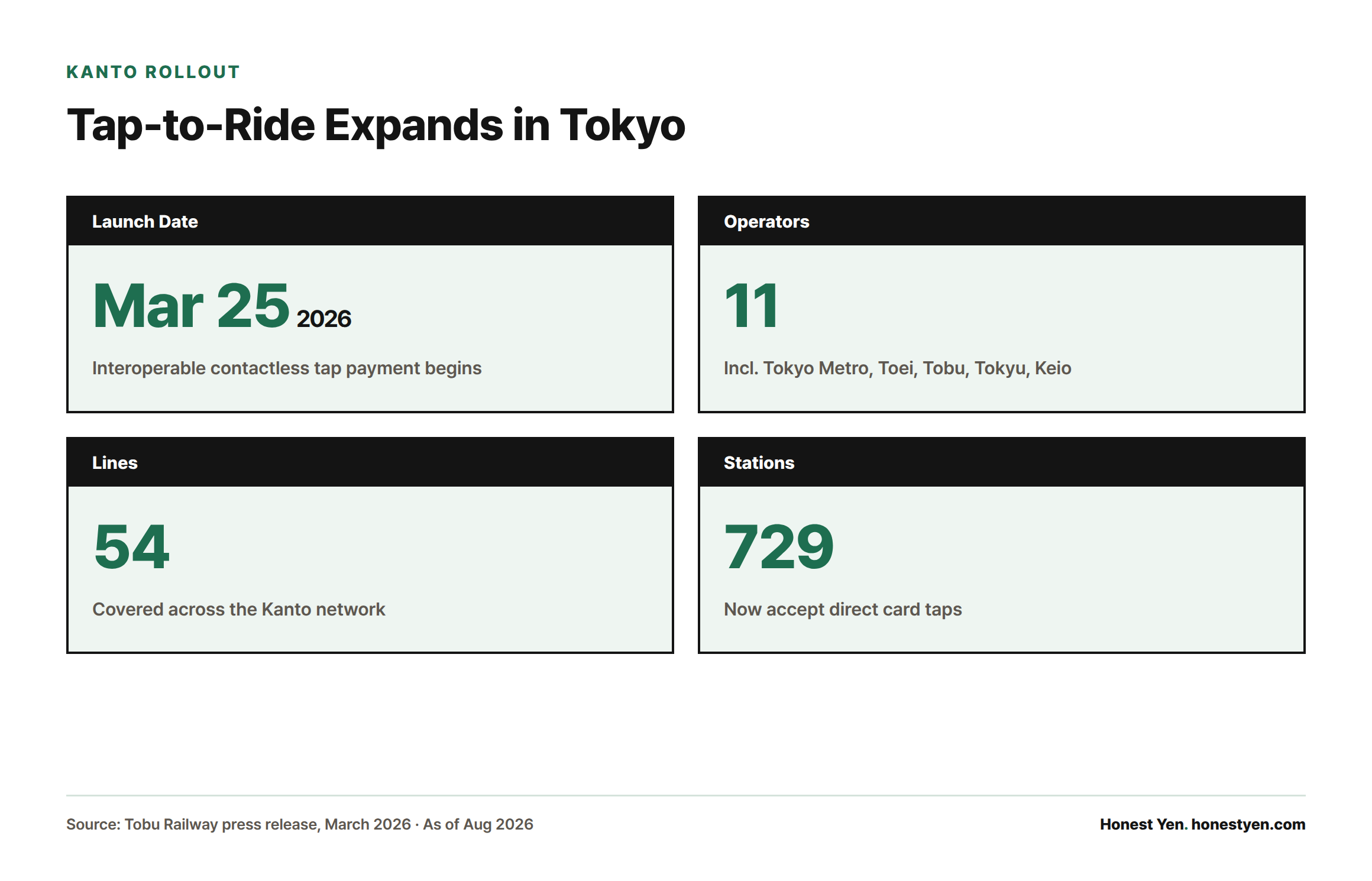
Japan’s train and subway network has historically required a rechargeable IC card (Suica, Pasmo, or ICOCA, either physical or loaded into Apple Pay/Google Pay) because gates couldn’t read ordinary bank cards. That’s now changing region by region. Osaka Metro’s subway, New Tram, city buses, and the Imazato Liner accept direct contactless tap payment from Visa, Mastercard, JCB, American Express, Diners Club, Discover, and UnionPay credit, debit, and prepaid cards, charging the standard adult fare regardless of the rider’s age[6]. In the Kanto region, eleven operators — including Tokyo Metro, the Toei subway and bus network, Tobu, Tokyu, Keio, Keikyu, Odakyu, Seibu, and Sagami Railway — launched interoperable contactless card tap payment across 54 lines and 729 stations on March 25, 2026[7]. JR East lines are not part of that network, so if your itinerary includes JR trains (which most Tokyo trips do), you’ll still want a Suica or Pasmo. If you’re flying into Narita, our Narita-to-Tokyo transport comparison covers where to pick one up on arrival. One practical wrinkle: topping up a mobile Suica or Pasmo in Apple Pay/Google Pay from outside Japan is more reliable with a Mastercard than a Visa, and foreign-issued debit cards are rejected more often than credit cards — if a top-up fails repeatedly, adding cash at a station machine sidesteps the issue entirely.
Which card fits which trip
- Short city trip (Tokyo and/or Osaka only, under 10 days): One fee-free card for spending and ATM top-ups, plus a Suica or ICOCA (physical or mobile) for JR lines, covers nearly everything. The Kanto and Osaka Metro contactless rollouts mean you can skip topping up an IC card for non-JR rides.
- Longer or more rural itinerary: Regional lines and small-town shops are still overwhelmingly cash-based, and you’ll rely on ATMs more often, so watch the monthly free-withdrawal cap on Wise or Revolut — a family withdrawing cash every few days can exceed 250 USD/GBP/EUR quickly. A physical IC card remains the more dependable transit option outside the two big metro networks.
- Frequent business travel: Lounge access starts to matter more than FX savings. Revolut’s Ultra plan includes unlimited lounge visits at 1,000+ airports worldwide through LoungeKey, while Metal and Premium plans offer discounted, pay-per-visit passes rather than free entry[8]. Wise, Starling, and Schwab do not include lounge access.
Frequently asked questions
Wise or Revolut — which is better for Japan?
They’re close. Revolut’s Standard plan gives a slightly higher free ATM allowance in GBP terms and free weekday FX conversion, but adds a 1% weekend markup; Wise has no weekend penalty and a transparent per-currency conversion fee. If you already bank with one of them for other travel, there’s little reason to open the other just for Japan.
Does the yen get a 0% exchange fee on these cards?
Yen is a standard supported currency on all four cards above — none of them singles out JPY for a worse rate or an added markup. Wise and Revolut apply their usual conversion fee (see the table); Starling and Schwab pass through the card network’s exchange rate with no markup at all.
How different are the ATM limits and fees, card to card?
Meaningfully different. Starling and Schwab effectively remove the ATM fee question — Starling caps at 300 GBP a day with no percentage fee, and Schwab rebates surcharges with no cap at all. Wise and Revolut are fee-free only up to a monthly allowance (around 250 USD/GBP/EUR), after which a 2-2.7% fee kicks in, which adds up fast on a cash-heavy rural trip.
Can I tap through the ticket gate with just a travel card, no Suica or Pasmo?
On Osaka Metro and the eleven Kanto operators listed above, yes — any contactless Visa, Mastercard, JCB, Amex, Diners, Discover, or UnionPay card taps directly at the gate at the standard adult fare. On JR East lines, no — you still need a Suica, Pasmo, or ICOCA.
Is it worth carrying two travel cards, or is one enough?
One is enough for most trips. A second card earns its keep mainly as a backup if the first is lost, blocked for suspected fraud, or simply not accepted at a particular machine — a real but occasional inconvenience, not a savings strategy. If you’re already carrying a UK Starling or US Schwab account, a second app-based card adds little.
Does a travel card replace needing an eSIM too?
No — they solve different problems. A travel card handles currency conversion and payments; a Japan eSIM or physical SIM handles mobile data. You’ll want both sorted before departure, since neither substitutes for the other.
Pre-departure checklist
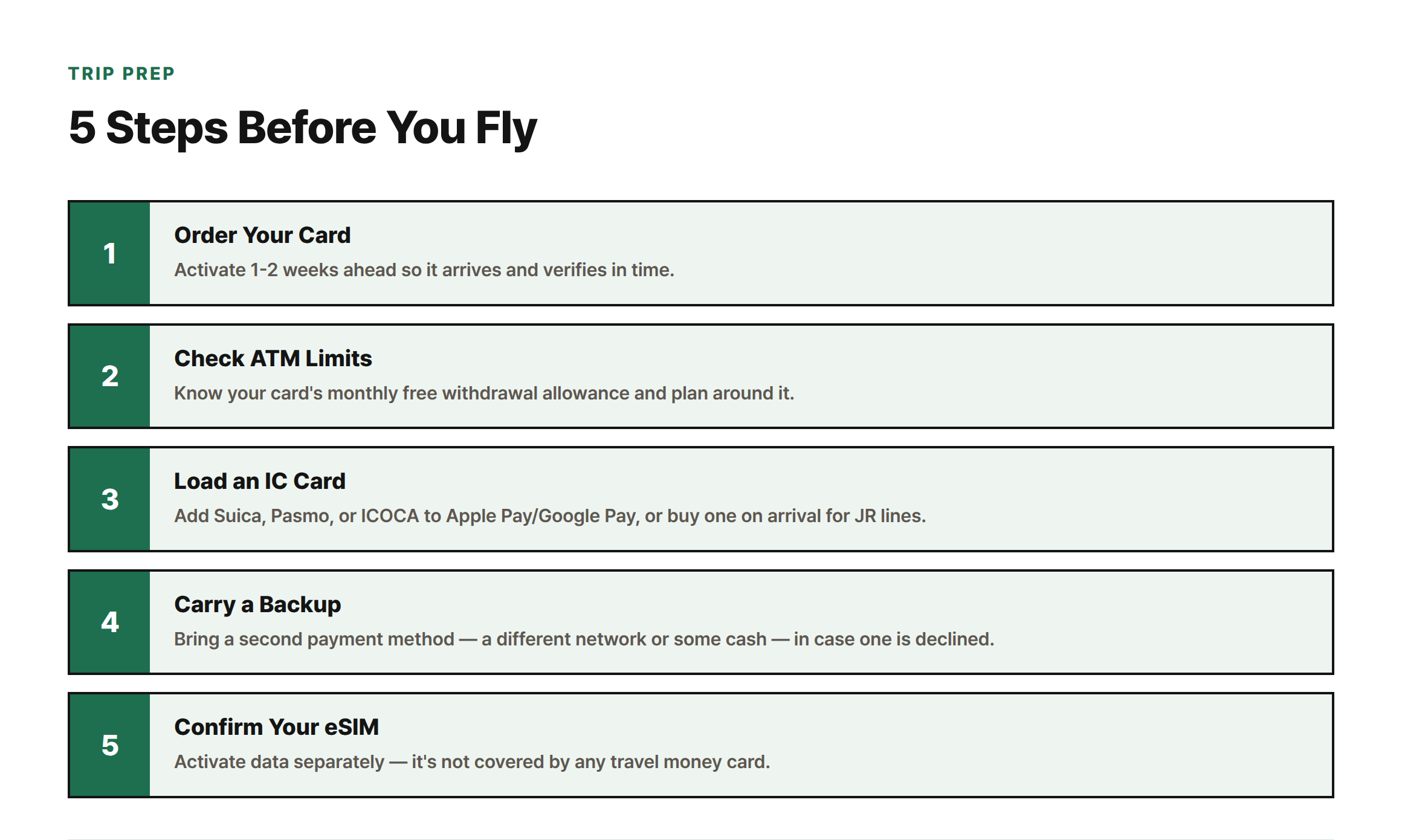
- Order and activate your primary travel card at least 1-2 weeks ahead so it arrives and verifies in time.
- Check your card’s monthly free ATM withdrawal allowance and plan cash withdrawals around it.
- Load a Suica, Pasmo, or ICOCA into Apple Pay/Google Pay before departure, or plan to buy one on arrival if you’ll be riding JR lines.
- Carry a second, independent payment method (a different card network or some cash) in case one card is declined.
- Confirm your eSIM or SIM is active separately — it is not covered by any travel money card.
Sources
- Wise, “ATM withdrawal structure and fees”
- Revolut, “Personal Fees (Standard Plan)”
- Starling Bank, “Travel Money”
- Charles Schwab, “Schwab Bank Investor Checking”
- Seven Bank, official guide to using overseas-issued cards at Seven Bank ATMs
- Osaka Metro, “Contactless payment”
- Tobu Railway, official press release on the 11-operator interoperable contactless payment launch (March 25, 2026)
- Revolut, “Airport Lounges”