Shibuya vs Shinjuku: The Honest Comparison for Choosing Your Tokyo Base (2026)
This post may contain affiliate links. If you book or buy through them, we may earn a commission at no extra cost to you.
Shibuya and Shinjuku are the two neighborhoods first-time visitors to Tokyo compare most, and for good reason: both sit on the Yamanote Line loop, both have more hotel rooms than almost anywhere else in the city, and both put you within a short ride of everything from Shibuya Crossing to the Tokyo Metropolitan Government Building’s free observation decks. This guide compares them on transit, airport access, price, and noise, using published fares and schedules rather than vague impressions. Figures are current as of August 2026 and are worth rechecking before you book, since rail and bus fares are revised periodically.
Shibuya vs Shinjuku at a Glance
| Factor | Shinjuku | Shibuya |
|---|---|---|
| Rail lines at the station | 12 lines converge here, the busiest station in the world by daily ridership[2] | Fewer lines, but direct access to Shibuya Crossing and the Yamanote Line |
| Typical hotel price tier | Ranges from budget business hotels near Kabukicho to upscale towers by the station; aggregator data suggests Shinjuku’s average sits somewhat below Shibuya at the same star rating[9] | Trends 20 to 30 percent above Shinjuku for comparable hotel categories, per aggregator market data[9] |
| Night atmosphere | Kabukicho keeps bars and restaurants open into the early morning; quieter pockets exist near Shinjuku Gyoen[2] | Center Gai and the area around the Crossing stay loud and crowded until late; side streets toward Shibuya Stream are calmer |
| Best for | Day-trippers, first-timers who want one-transfer access to almost everywhere, business travelers | Shopping-focused trips, younger travelers, anyone prioritizing nightlife and street-fashion culture |
Shinjuku: The Transit Hub and Day-Trip Base
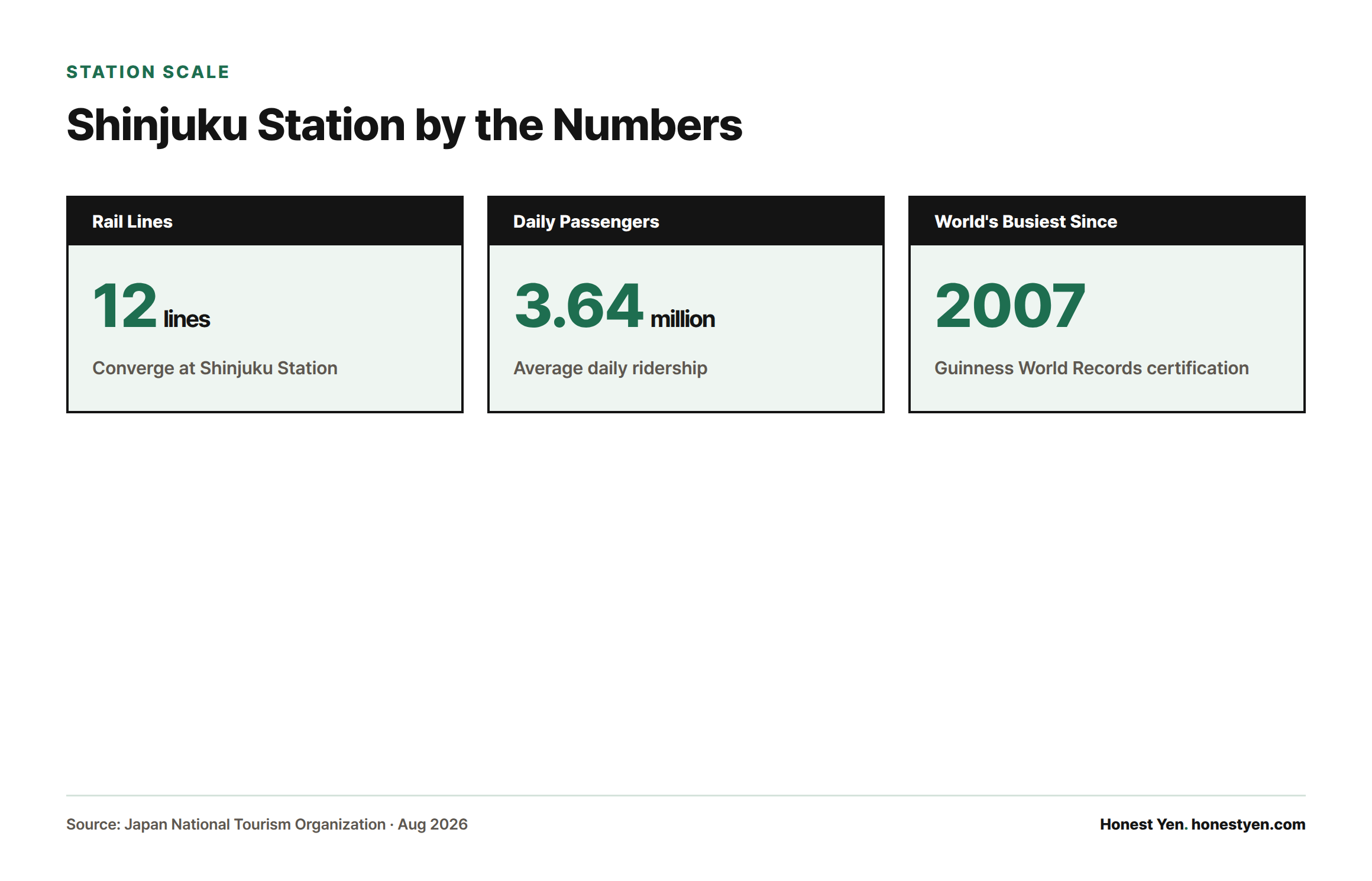
Shinjuku Station recorded an average of 3.64 million passengers a day when Guinness World Records certified it as the world’s busiest station in 2007, and it remains the junction for twelve railway lines[2]. That density is the whole argument for basing here: whichever direction you’re headed the next morning, a train leaves from Shinjuku with minimal or no transfer. The district itself splits into distinct zones — Isetan and Takashimaya department stores and electronics retailers on the east and south sides, the nightlife and izakaya cluster of Kabukicho to the north, and Shinjuku Gyoen, a former imperial garden that Japan’s tourism board describes as a tranquil escape from the neon, just a short walk away[2].
One subdistrict worth knowing about is Shin-Ōkubo, Tokyo’s Koreatown, which sits one stop north of Shinjuku on the JR Yamanote Line[4]. It’s a legitimate alternative if Kabukicho’s late-night crowds aren’t your scene: the main strip toward Shin-Ōkubo Station has its own dense run of K-pop shops, Korean restaurants, and skincare stores, and it’s busy but calmer after dark than the streets immediately around Shinjuku’s east exit. If you’re stocking up on skincare or snacks before flying home, it’s worth pairing with a stop at a drugstore — see our Japan drugstore shopping list for what’s actually worth buying at Matsumoto Kiyoshi or Don Quijote.
Shibuya: Shopping, Youth Culture, and the Crossing
Shibuya’s identity is built around its shopping streets and its famous scramble crossing, and Japan’s official tourism site frames the ward as a center of trend-driven retail and youth culture rather than a transit interchange[2] — the contrast with Shinjuku’s “hub” framing is deliberate. Center Gai, the pedestrian street running from the station toward Don Quijote and the fashion buildings, is where most of the nighttime foot traffic concentrates; it’s loud, bright, and busy well past midnight. If you want distance from that without leaving the neighborhood, hotels near Shibuya Stream or toward Daikanyama sit a 10 to 15 minute walk from the Crossing and are noticeably quieter at night. Shibuya also has more limited direct rail access than Shinjuku — most long-distance and airport connections require a transfer at Shinjuku, Shinagawa, or Tokyo Station first.
Airport Access: Narita vs. Haneda, Broken Out Separately
Most comparison pages lump “airport access” into one line. The two airports behave differently enough that they’re worth separating.
From Haneda Airport
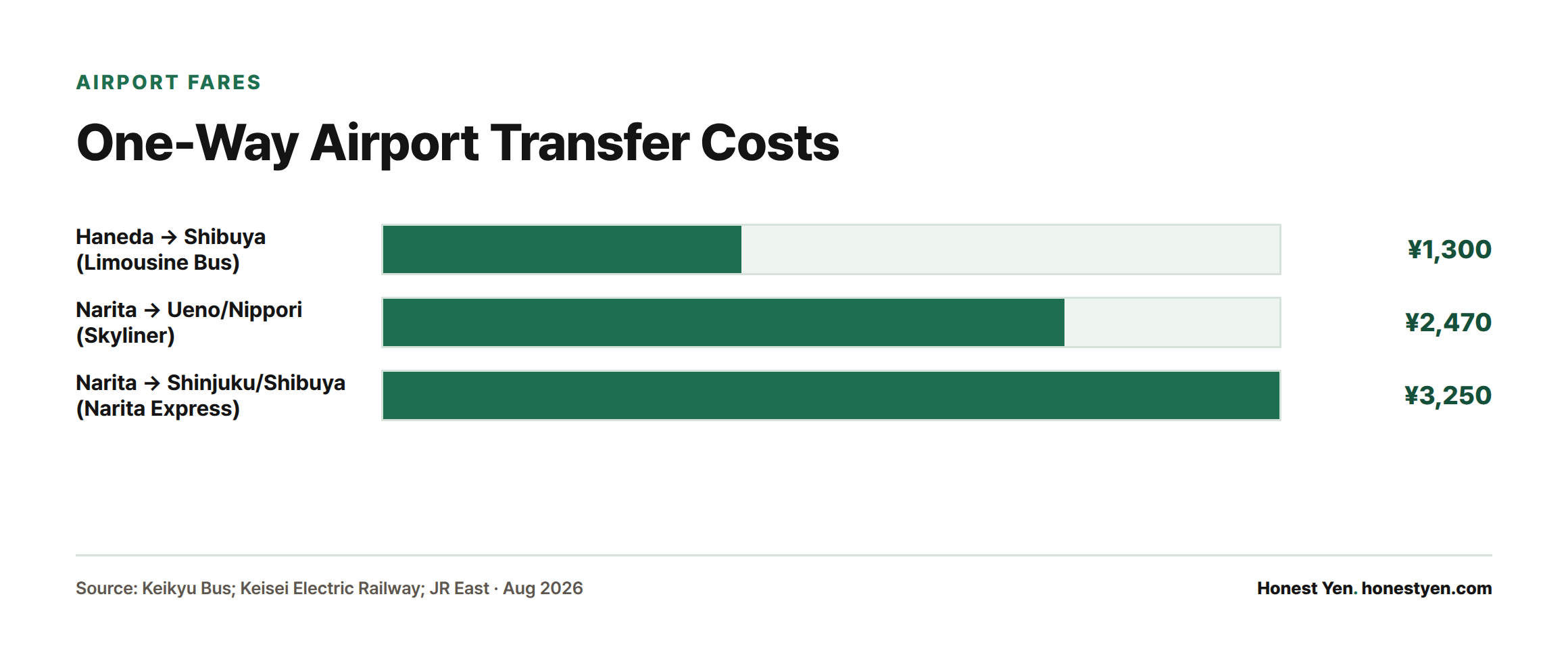
Haneda is the closer airport to central Tokyo for both neighborhoods. Airport limousine buses run directly to Shinjuku Station West Exit in about 35 minutes, and to Shibuya Station (Mark City) in about 40 minutes, according to Haneda’s official access page[1]. On fare, Keikyu Bus’s Haneda–Shibuya route is published at 1,300 yen for adults[5]. Train-and-subway combinations (Keikyu Line plus a transfer) can be cheaper but take longer and involve carrying luggage through at least one transfer.
From Narita Airport
Narita sits roughly an hour further out, and the fastest route depends on your destination. The Keisei Skyliner reaches Ueno or Nippori in as little as 36 to 41 minutes for a fare of 2,470 yen at the counter, or 2,465 yen when tapping an IC card at the gate[3] — but it doesn’t run directly to Shinjuku or Shibuya, so you’d still need a Yamanote Line transfer at Ueno or Nippori. For a one-seat ride into either neighborhood, JR East’s Narita Express (N’EX) runs direct to both Shinjuku and Shibuya Stations, with a one-way ordinary-car fare of 3,250 yen and a journey of roughly 80 to 90 minutes[6]. JR East also sells a discounted N’EX Tokyo Round Trip Ticket for passport holders at 5,000 yen round trip, which undercuts two one-way tickets bought separately[6].
Net effect: if your flight lands at Haneda, the airport-access question barely factors into Shibuya vs. Shinjuku — both are under 45 minutes by bus. If you’re flying into Narita, Shinjuku and Shibuya sit on the exact same N’EX line at the same fare and time, so there’s no real difference there either.
Suburb and Day-Trip Access: Hakone, Fuji, Kamakura, Yokohama
This is where the two neighborhoods genuinely diverge, and it’s the detail most comparison pages skip.
| Destination | From Shinjuku | From Shibuya |
|---|---|---|
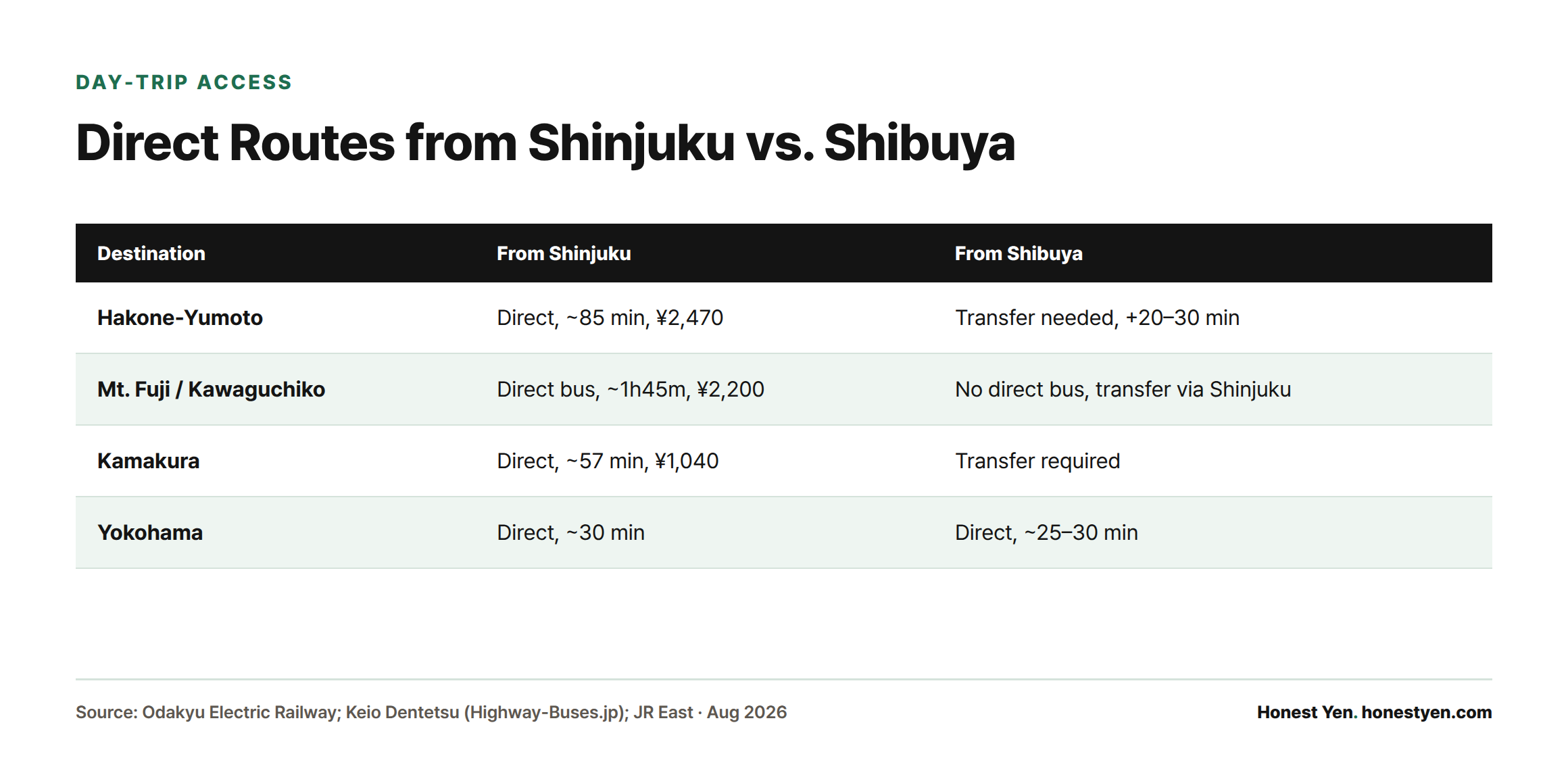
| Hakone (Hakone-Yumoto) | Odakyu Romancecar, direct, about 85 minutes, 2,470 yen one way (2,420 yen with a digital ticket)[7] | No direct train; requires a transfer to Shinjuku or via Odawara, adding 20 to 30 minutes |
| Mt. Fuji / Kawaguchiko | Direct highway bus, about 1 hour 45 minutes, 2,200 yen one way[8] | No direct bus from Shibuya; transfer via Shinjuku Bus Terminal required |
| Kamakura | JR Shonan-Shinjuku Line, direct, about 57 minutes, 1,040 yen | Transfer required, typically via Shinjuku or Yokohama |
| Yokohama | JR Shonan-Shinjuku Line, direct, roughly 30 minutes | Tokyu Toyoko Line, direct, roughly 25 to 30 minutes |
For Hakone, Fuji, and Kamakura specifically, Shinjuku is the clear winner: all three have a one-seat ride departing from Shinjuku’s own bus terminal or station concourse, mainly because Shinjuku is the Tokyo terminus for the Odakyu Line (Hakone) and the Chuo Highway Bus pool (Fuji/Kawaguchiko), and it’s a stop on the JR Shonan-Shinjuku Line that continues through to Kamakura. Shibuya only pulls even on Yokohama, thanks to the Tokyu Toyoko Line running direct from Shibuya’s basement platforms. If your itinerary includes more than one of these day trips, staying in Shinjuku saves you a transfer — and the luggage shuffle that comes with it — on every one of them except Yokohama.
How Much More Does Shibuya Actually Cost?
Neither neighborhood publishes official average room rates, so an exact same-date, same-grade comparison isn’t available from a primary source. Aggregator market data is the only way to gauge the gap: it puts Shibuya hotels at roughly 20 to 30 percent higher than Shinjuku for equivalent star ratings, with the difference most visible in the 3- and 4-star business hotel segment[9]. Treat that as a directional estimate rather than an exact figure, and always compare specific dates — both districts spike hard during late March through early April (cherry blossom season) and the Golden Week holidays in late April and early May, when availability at mid-range properties tightens well before the dates themselves. If you’re booking a ryokan-style stay for part of your trip instead of a standard hotel, our ryokan booking site comparison covers how Rakuten, Jalan, Agoda, and Trip.com differ on selection and cancellation terms.
Which One Should You Pick?
- First-time visitor, no fixed itinerary yet: Shinjuku. The rail density means you’re never more than one transfer from anywhere in Tokyo, and it’s typically cheaper on average.
- Shopping- and fashion-focused trip: Shibuya. You’ll be walking distance from Center Gai, Shibuya 109, and the flagship stores that drive most shopping itineraries, without needing a train each morning.
- Traveling with family or younger kids: Shinjuku, specifically a hotel away from Kabukicho — Shinjuku Gyoen and the west-side hotel cluster near the Metropolitan Government Building are quieter and closer to department-store food halls.
- Day trips are the priority (Hakone, Fuji, Kamakura): Shinjuku, without much competition — see the table above.
- Nightlife and late dining matter most: Either works, but budget for cheaper, later options in Shinjuku’s Kabukicho/Shin-Ōkubo area versus pricier, trend-driven spots in Shibuya.
FAQ
Is Shinjuku or Shibuya better for a first Tokyo trip?
Shinjuku, mainly for the transit density: with twelve lines converging at one station[2], you minimize the number of transfers on both airport arrival day and any day trip out of the city.
How much do hotel prices actually differ?
Aggregator data points to Shibuya running about 20 to 30 percent above Shinjuku for comparable star ratings[9]; there’s no official average-rate source that breaks this down by ward and date, so treat it as a general trend and verify against live prices for your travel dates.
Which is closer to the airports?
From Haneda, both are close: about 35 minutes to Shinjuku and 40 minutes to Shibuya by limousine bus[1]. From Narita, they’re effectively identical — the Narita Express runs direct to both at the same fare and roughly the same travel time[6].
Is Shin-Ōkubo safe, and how is it different from Shinjuku Station?
Shin-Ōkubo is a residential and commercial district built around Tokyo’s Koreatown, one JR Yamanote Line stop north of Shinjuku Station[4]. It’s busy with restaurant and shop traffic into the evening but doesn’t have the concentrated bar-and-club density of Kabukicho, which sits closer to Shinjuku Station itself.
Which area is better for day trips to Hakone, Kamakura, or Mt. Fuji?
Shinjuku, without a close contest — it’s the direct departure point for the Odakyu Romancecar to Hakone[7], the highway bus to Kawaguchiko[8], and the JR Shonan-Shinjuku Line to Kamakura, all without a transfer.
Which is quieter at night?
Neither ward is quiet at its core. In Shinjuku, distance from Kabukicho — toward Shinjuku Gyoen or the west-side skyscraper district — buys real quiet. In Shibuya, moving away from Center Gai and the Crossing toward Shibuya Stream or Daikanyama does the same.
When should I book to avoid the worst price spikes?
Late March through early April and the Golden Week window in late April to early May are the two periods when both districts see the tightest availability at mid-range hotels; booking those dates well ahead of a standard trip is worth the extra planning.
Sources
- Tokyo Haneda International Airport, Official Bus Access Guide
- Japan National Tourism Organization, Japan Travel — Shinjuku Destination Guide
- Keisei Electric Railway, Skyliner Fares from Major Stations
- JR East, Shin-Okubo Station Timetable (Yamanote Line)
- Keikyu Bus, Haneda Airport – Shibuya Station Route
- JR East, Narita Express (N’EX) Tickets and Fares
- Odakyu Electric Railway, Limited Express Romancecar Ticket Details
- Keio Dentetsu, Highway-Buses.jp — Lake Kawaguchiko and Fuji-Q Highland Route
- KAYAK, Shibuya, Tokyo Hotel Price Listings (booking aggregator, used only for price-range comparison since no official average-rate source exists)