Don Quijote Shibuya vs Shinjuku: The Honest Comparison, Verified Store by Store
This post may contain affiliate links. If you book or buy through them, we may earn a commission at no extra cost to you.
The Quick Verdict
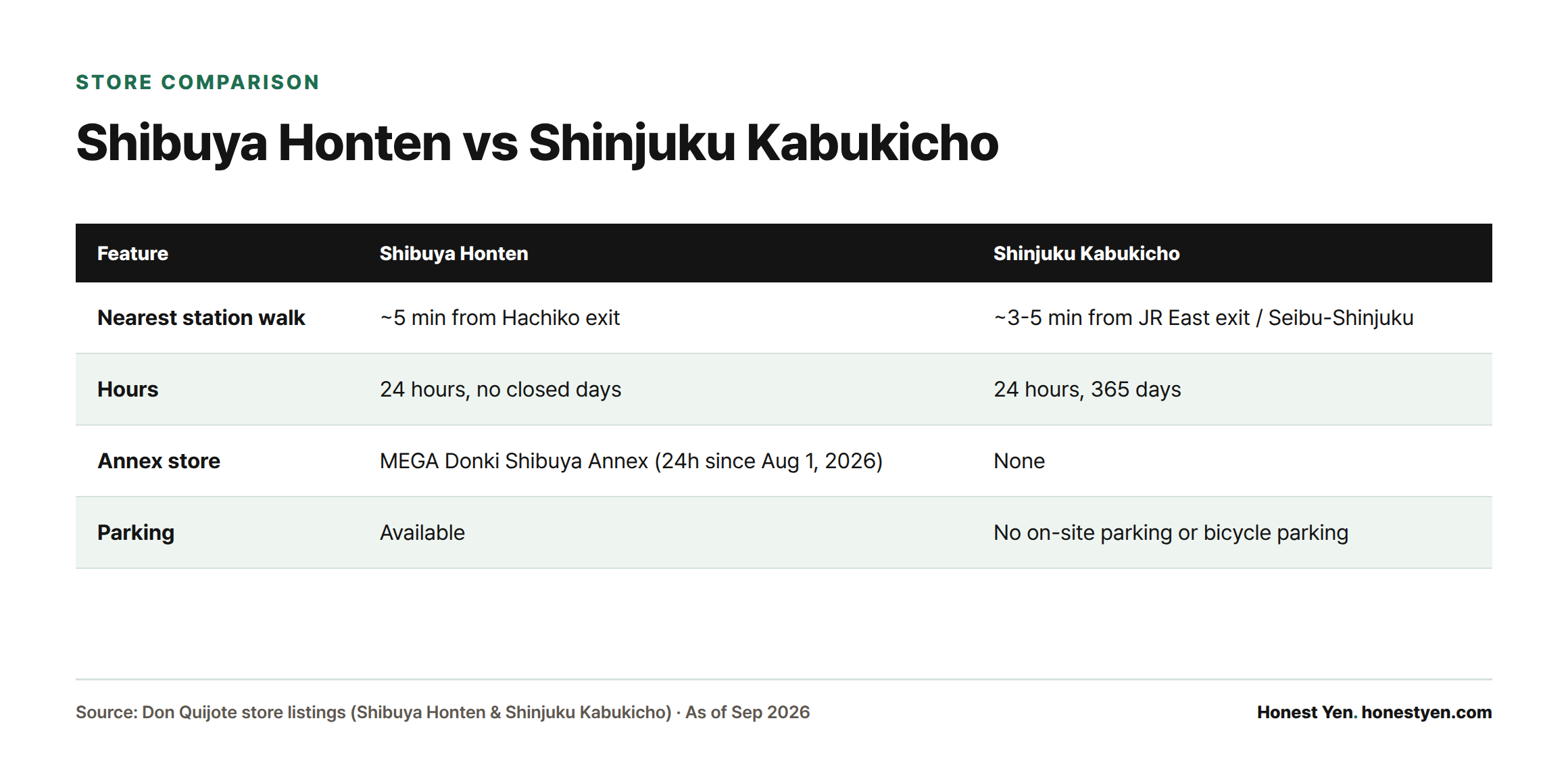
Both MEGA Don Quijote Shibuya Honten and Don Quijote Shinjuku Kabukicho are open around the clock, both sell tax-free, and both are a short walk from a major station[1][2]. If you only have time for one, go with whichever fits your route: Shibuya Honten is the larger, more organized “flagship” experience with a dedicated souvenir annex, while Shinjuku Kabukicho is the messier, more chaotic classic Donki that sits inside Tokyo’s biggest nightlife district. First-time visitors who want an easier layout and a calmer late-night walk back to their hotel tend to prefer Shibuya; travelers who are already out late in Kabukicho or Golden Gai will find Shinjuku more convenient. As of September 2026, here is what actually differs, verified against the stores’ own listings.
Shibuya vs Shinjuku at a Glance
| Feature | Shibuya Honten | Shinjuku Kabukicho |
|---|---|---|
| Address | Udagawa-cho 28-6, Shibuya-ku[1] | Kabukicho 1-16-5, Shinjuku-ku[2] |
| Nearest exit | ~5 min on foot from Shibuya Station Hachiko exit[1] | ~5 min from JR Shinjuku East exit; ~3 min from Seibu-Shinjuku Station[2] |
| Hours | 24 hours, no closed days[1] | 24 hours, 365 days[2] |
| Annex/sister store | MEGA Donki Shibuya Annex, Dogenzaka 2-25-12 — now 24 hours as of August 1, 2026[4] | None |
| Standout floors | B2F relaxation/clinic services, food on lower floors, cosmetics and electronics mid-floors, character goods and cosplay up top[3] | Basement food/liquor/daily goods, cosmetics and colored contacts, electronics and toys on the floors above[2] |
MEGA Don Quijote Shibuya Honten: What’s Actually There
The Shibuya flagship sits on Udagawa-cho, a five-minute walk from the Hachiko exit[1], on the same stretch as the scramble crossing shopping streets. According to Tokyo’s official tourism site, the lower floors run food — matcha sweets, instant noodles, roasted sweet potato stands and seasonal fruit — the middle floors carry cosmetics, skincare, medicine and electronics, and the upper floors shift into character goods, cosplay and party supplies[3]. The store’s own listing adds that B2F houses a relaxation and clinic corner and 1F has a Donpen Yaki food stand[1]. As of August 1, 2026, the colored-contact-lens section moved out of the main building entirely and into the newly 24-hour Annex nearby[1][4], so if you’re specifically hunting circle lenses, walk the extra two minutes to Dogenzaka rather than searching the main floors.
Don Quijote Shinjuku Kabukicho: What’s Actually There
The Kabukicho store is reachable from three directions: about five minutes from JR Shinjuku’s East exit, four minutes from the Toei Oedo Line’s Shinjuku-nishiguchi exit, or three minutes from Seibu-Shinjuku Station[2], which makes it the more convenient stop if you’re staying anywhere in the Kabukicho, Golden Gai or Shin-Okubo area. It runs 24 hours, 365 days a year with no scheduled closures[2], and the store confirms tax-free service is available, though — unlike Shibuya — there’s no on-site parking or bicycle parking[2], so this is a walk-in, train-access store rather than one to drive to.
Is It Really 24 Hours? The Detail Most Guides Get Wrong
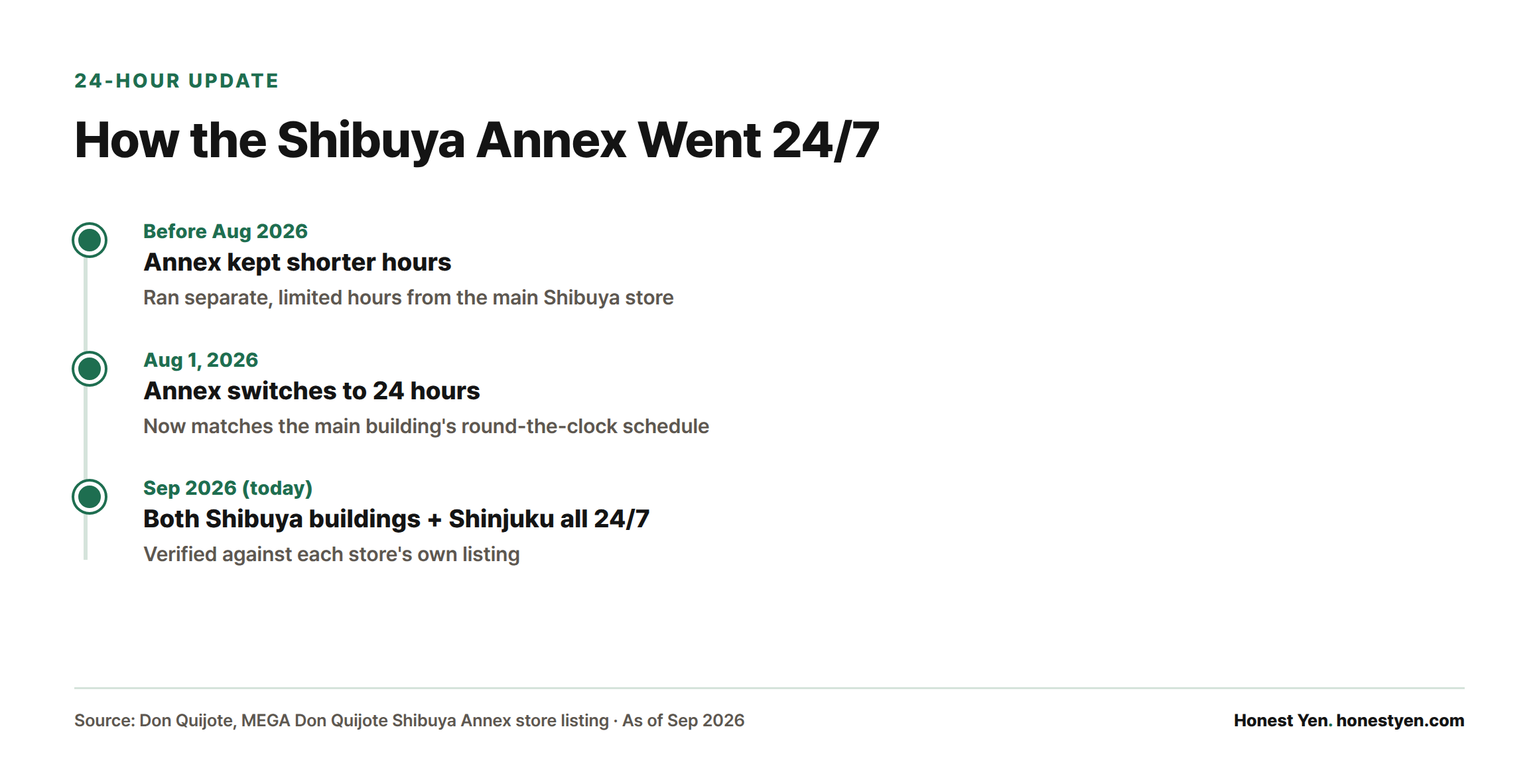
Both main stores genuinely run 24/7 with no listed exceptions[1][2]. Where older guides go wrong is the Shibuya Annex: for years it kept separate, shorter hours than the main store, which meant a late-night browse for souvenirs or contacts at the annex specifically wasn’t possible. That changed on August 1, 2026, when the Annex switched to round-the-clock operation to match the main building[4] — so as of this writing, both Shibuya buildings and the Shinjuku store are all genuinely 24 hours. The one real-world limit isn’t the store, it’s the trains: Tokyo’s lines stop for several hours overnight, so if you’re shopping in the dead of night, plan on a taxi back or on staying out until the first trains resume.
Tax-Free Rules and Coupons, Verified
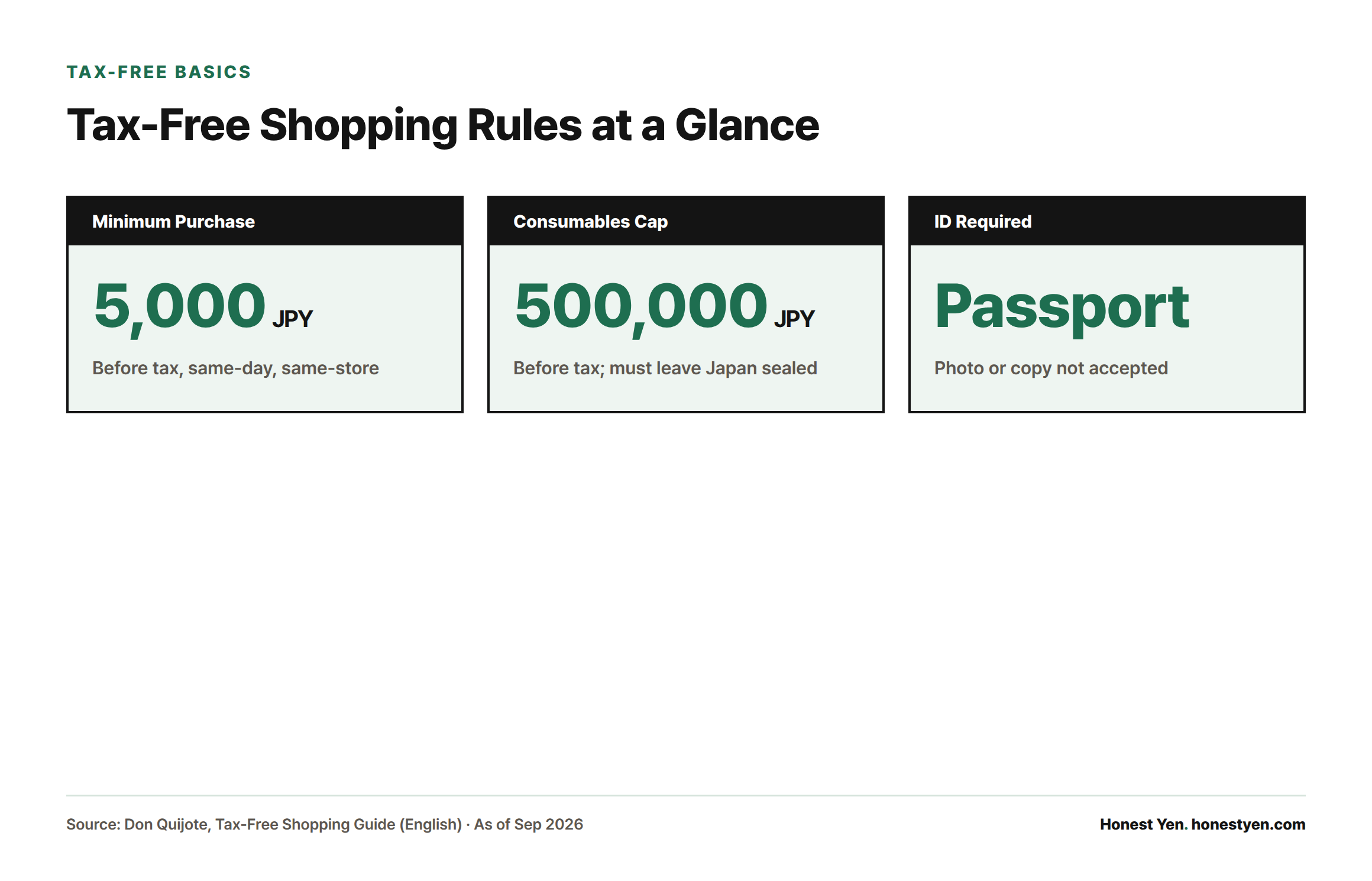
Don Quijote’s official tax-free terms apply at both stores identically: purchases need to total ¥5,000 or more before tax, made same-day at the same store, with your passport shown at checkout (a photo or copy isn’t accepted)[5]. General goods like electronics or bags have no upper limit; consumables — food, cosmetics, medicine, drinks — are capped at ¥500,000 before tax and must leave Japan sealed in the tax-free bag unopened[5]. You can combine general goods and consumables to clear the ¥5,000 line together[5]. Separately, Don Quijote runs a discount-coupon program for overseas visitors on top of that tax exemption — the official tax-free page confirms it exists and links out to a dedicated coupon portal[5]; in practice it’s shown as a barcode on your phone at the register rather than printed, and it’s distributed at the coupon corner near the store entrance or via the official Don Quijote app. For the full math on how the exemption itself works — and what changes when Japan’s refund system is revised — see Don Quijote Tax-Free Math, Explained.
When to Go If You Want to Avoid the Crowd
Neither store publishes footfall data, so treat this as general retail logic rather than measured numbers: both locations sit inside two of Tokyo’s busiest nightlife zones, so evenings pull in both shoppers and bar-hopping crowds at once, and weekend nights compound that with tourists and locals overlapping. A 24-hour store’s real advantage is that the quiet window isn’t a guess — it’s simply the early morning, roughly between the last trains stopping and the first trains resuming, when the aisles empty out because almost nobody else is awake to use them. If you can’t shop that late, arriving right after opening-adjacent morning hours (rather than lunchtime or evening) is the next best window at either location.
Where to Stay Near Each Store
If Shibuya Honten is your priority, staying anywhere between Shibuya Station and Dogenzaka keeps both the main store and the newly 24-hour Annex within a five-to-ten-minute walk. If Kabukicho is the plan, a hotel near Shinjuku’s East exit or around Seibu-Shinjuku puts you inside the three-to-five-minute range the store itself lists[2]. Since Shibuya and Shinjuku are two stops apart on the Yamanote Line, the choice usually comes down to which neighborhood you’d rather use as a base overall — a fuller breakdown of that trade-off is in Shibuya vs Shinjuku: The Honest Comparison for Choosing Your Tokyo Base.