Japan Drugstore Shopping List 2026: What to Buy at Matsumoto Kiyoshi, Daikoku, and Don Quijote
This post may contain affiliate links. If you book or buy through them, we may earn a commission at no extra cost to you.
This guide is current as of August 2026. Japan’s tax-free shopping rules are changing on November 1, 2026, which affects how and when you actually receive your discount — details are in the tax-free section below.
Quick-look: what to buy by category
| Category | Buy |
|---|---|
| Pain & first aid | Adhesive pain patches (Salonpas-type), cooling gel sheets, eye drops, blister plasters |
| Stomach & cold | Herbal digestive tablets (seirogan-type), motion-sickness tablets, throat lozenges |
| Skincare | Sunscreen (high SPF/PA+++), sheet masks, cleansing oil, hydrating toner |
| Household | Hand warmers (kairo, seasonal), toothpaste, contact lens solution, itch/bug-bite cream |
Medicine and first-aid essentials
Japanese drugstores stock effective, low-dose OTC remedies that pack easily and make practical gifts. Prioritize adhesive pain-relief patches for shoulder and back stiffness, cooling gel sheets for fever, moisturizing eye drops, blister-friendly plasters, and herbal digestive tablets for stomach upset. As a cost reference, a standard 40-sheet pack of Salonpas-brand patches retails for about ¥748 (tax included) through the manufacturer’s own shop[1] — a useful benchmark, since shelf prices at individual drugstores vary by location and promotion.
One caution: if you’re buying cold or allergy medicine to take home, check your own country’s import rules first. Some Japanese cold remedies contain stimulant-adjacent ingredients that are restricted or prescription-only elsewhere, even though they’re sold over the counter here.
Skincare and beauty essentials
Japanese sunscreen (look for high SPF with a PA+++ or PA++++ rating) is widely regarded as some of the most cosmetically elegant available, and travel-size sheet masks pack flat in a suitcase. Cleansing oil, hydrating toner, and lip balm round out the category. If Fukuoka is on your route, the Canal City Hakata shopping guide covers a mall with a large drugstore and cosmetics floor worth budgeting time for.
Household and lifestyle items
Disposable hand warmers (kairo) are a cheap, genuinely useful souvenir if you’re traveling October through March. Toothpaste, contact lens solution, and itch cream for mosquito or tick bites round out the practical list — none of these are exciting, but they’re what past travelers most often say they wish they’d bought two of.
Where to buy: Matsumoto Kiyoshi vs. Daikoku Drug vs. Don Quijote
There’s no single “cheapest” chain — each competes on a different lever, and the right pick depends on what you’re buying and when.
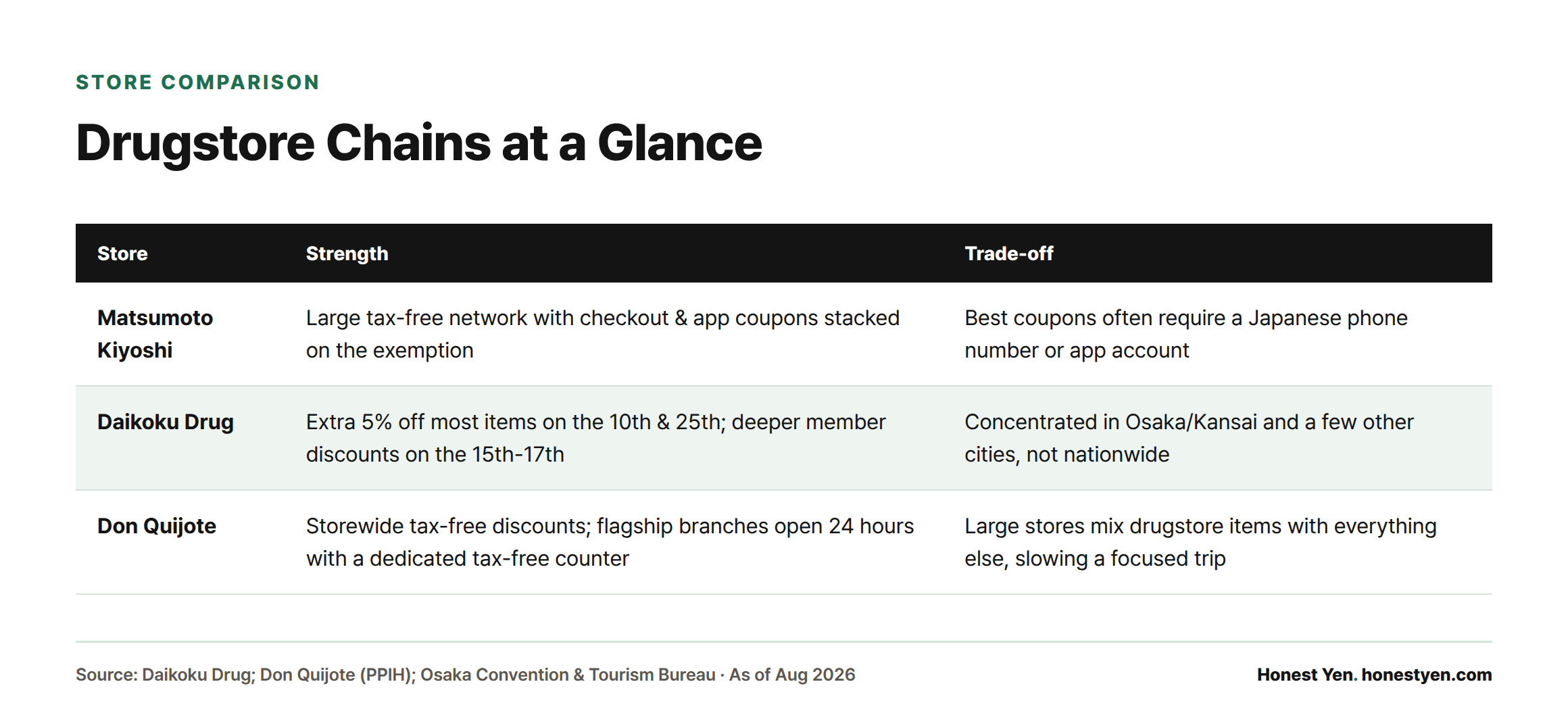
| Store | Strength | Trade-off |
|---|---|---|
| Matsumoto Kiyoshi | Large tax-free store network, with checkout and app coupons that stack on top of the tax exemption | The best coupons often require a Japanese phone number or app account to unlock |
| Daikoku Drug | Recurring storewide discount days — an extra 5% off most items on the 10th and 25th of each month, with deeper member discounts on the 15th–17th[2] | Concentrated in Osaka/Kansai and a handful of other cities, not nationwide |
| Don Quijote | Every store holds a tax-free license and discounts storewide rather than via coupons; flagship tourist-area branches (e.g. Dotonbori Midosuji) run 24 hours with a dedicated tax-free counter[3][4] | Large stores mix drugstore items in with everything else, which slows down a focused shopping trip |
For a walk-through of Don Quijote’s checkout process specifically, see the Don Quijote tax-free shopping guide.
How tax-free shopping works — and what changes on November 1, 2026
To buy tax-free in Japan, you must be a short-term foreign visitor (or a Japanese national who has lived abroad continuously for two or more years), spend at least ¥5,000 (tax-excluded) at one store on one day, and present your original passport — a photo or photocopy is not accepted[5]. General goods and consumables (food, cosmetics, medicine) can now be combined toward that ¥5,000 minimum, with consumables capped at ¥500,000 per day[5].
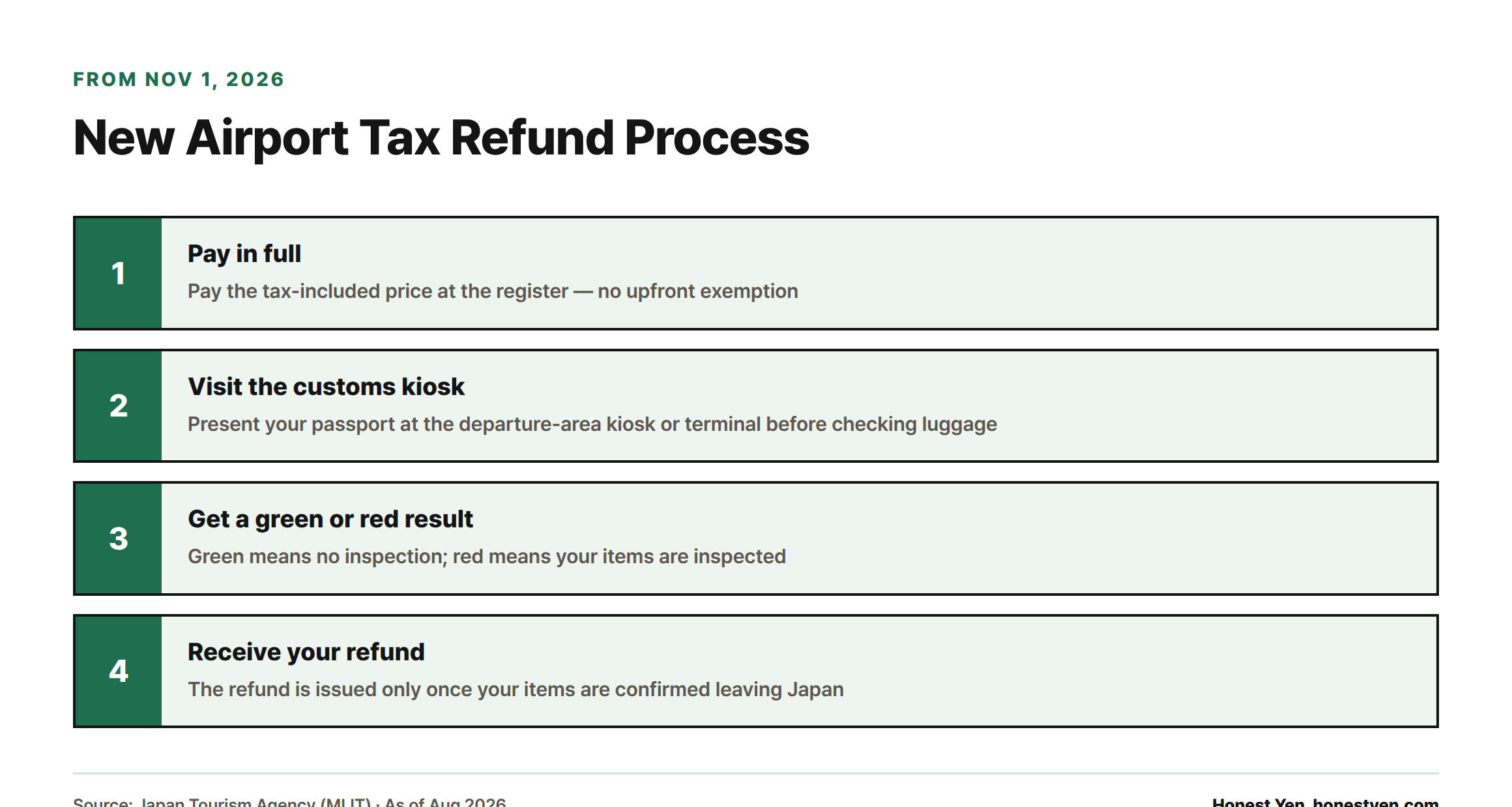
The major change: for sales from November 1, 2026, Japan is switching from up-front tax exemption to a “refund method.” You’ll pay the full, tax-included price at the register. To get the tax back, you then present your passport at a customs kiosk or terminal in the departure area before checking any luggage — the system returns a “green” result (no inspection needed) or a “red” one (inspection required), and the refund is issued only once your items are confirmed as leaving the country[6][7]. At major international airports — Narita, Haneda, Kansai, Chubu, Fukuoka, New Chitose, and Naha — you can pre-register purchases through Visit Japan Web over the departure-lobby Wi-Fi to speed this up[7]. Two practical consequences: every tax-free item must stay in your possession, unconsumed, and easy to produce at that checkpoint — you can’t retrieve something from checked luggage afterward, and even one missing receipt item can void the entire refund[7]. Mailing purchases home to skip this step isn’t an option either, since the separate-shipment (bessou) route was abolished back in March 2025[6]. If you’re combining drugstore runs with department store shopping, the department store tax-free procedure guide walks through the counter-by-counter process under the new rules.
Practical takeaway for an October or November 2026 trip: if your flight departs before November 1, nothing changes. If it departs on or after that date, budget extra time at the airport — get to the departure-area kiosk well before bag drop, not after.
Carry-on and checked baggage limits for drugstore purchases
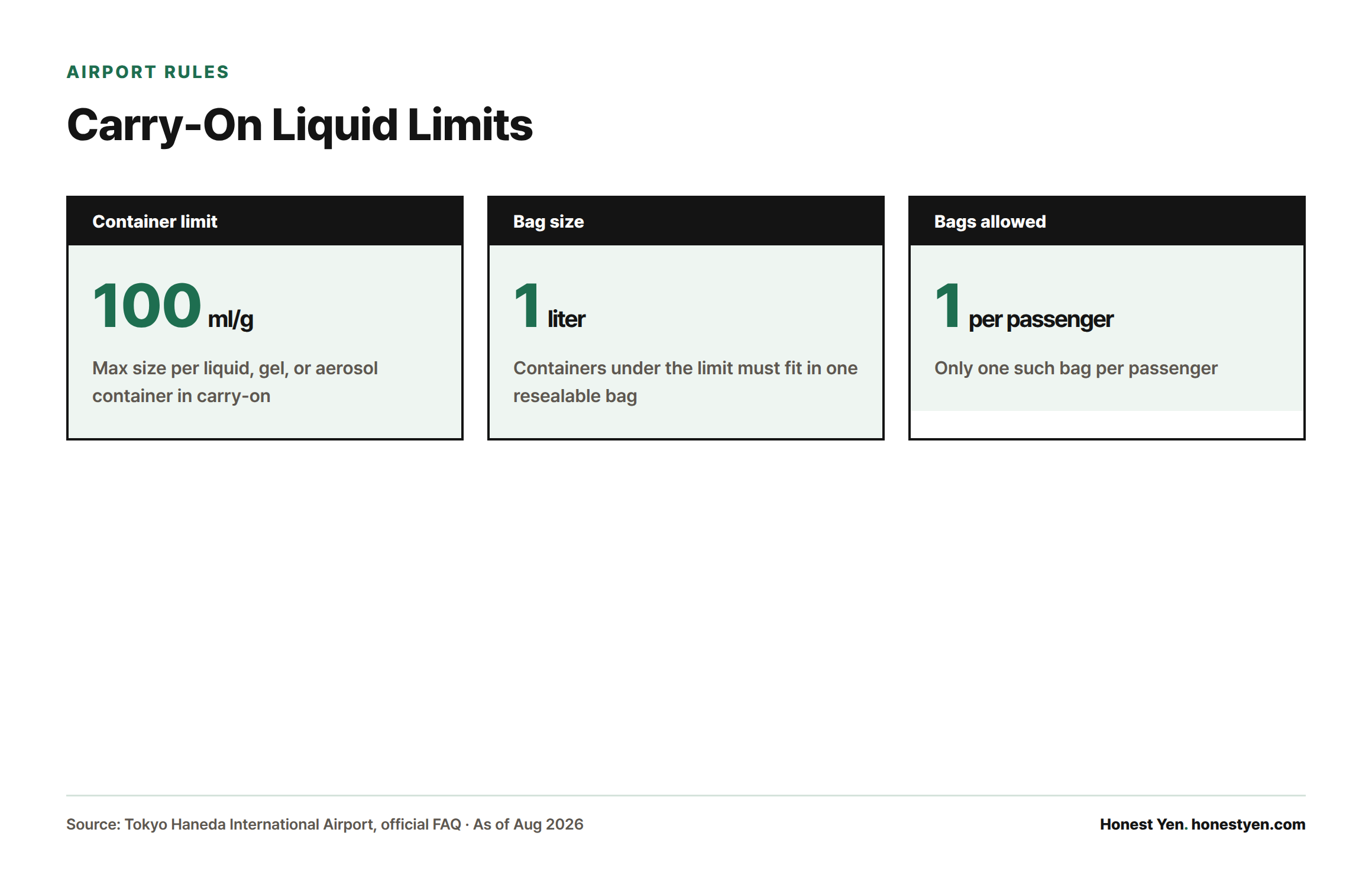
Liquids, gels, and aerosols from a drugstore run — sunscreen, toner, cleansing oil, liquid medicine — fall under the standard international rule: containers over 100ml/100g can’t go in carry-on at all, and containers of 100ml or less must fit inside one transparent, resealable bag of 1 liter or smaller, one bag per passenger[8]. That rules out carrying full-size sunscreen or toner bottles onto the plane; buy travel-size, or pack full-size bottles in checked luggage. Liquid medicine over 100ml is allowed after a separate inspection at security, so keep it accessible rather than buried in your bag[8]. If you’re connecting through a third country, that country’s liquid rules apply to the onward leg, so check with your airline before buying large bottles as souvenirs[8].
FAQ
Is Matsumoto Kiyoshi or Don Quijote cheaper?
Neither wins across the board. Don Quijote tends to discount storewide and keeps longer or 24-hour hours with dedicated tourist tax-free counters at flagship branches, while Matsumoto Kiyoshi layers checkout or app coupons on top of the standard tax exemption. If you’re shopping a large basket, it’s worth comparing both rather than assuming either is automatically cheaper.
How much do I need to spend to get tax-free?
At least ¥5,000 before tax, combined across general goods and consumables, at a single store on a single day[5].
Do I need my passport for tax-free shopping?
Yes — your original physical passport, not a photo or photocopy[5]. From November 1, 2026, you’ll also need it again at a customs kiosk before departure to actually receive your refund[7].
What should I actually buy at a Japanese drugstore?
Pain-relief patches, eye drops, sunscreen, sheet masks, and — if you’re traveling in colder months — disposable hand warmers are the items most consistently worth the suitcase space.
Sources
- Hisamitsu Wellness official shop, Salonpas product pricing
- Daikoku Drug, official discount day schedule
- Don Quijote (PPIH), official tax-free procedure page
- Osaka Convention & Tourism Bureau, Don Quijote Dotonbori Midosuji store information
- National Tax Agency, No.6559 Consumption tax exemption for foreign travelers
- Japan Tourism Agency (MLIT), consumption tax exemption system details and refund method reform
- Japan Tourism Agency (MLIT), refund method procedure and Visit Japan Web guidance
- Tokyo Haneda International Airport, official FAQ on liquid carry-on restrictions