Japan Department Store Tax-Free Shopping: The Full Counter-by-Counter Procedure (2026 Refund Rules)
This post may contain affiliate links. If you book or buy through them, we may earn a commission at no extra cost to you.
This guide covers how tax-free shopping actually works inside Japanese department stores such as Isetan, Takashimaya, and Daimaru — as of August 2026. It also explains the November 1, 2026 switch from instant tax exemption to a refund-after-departure system, since that change lands mid-way through many people’s travel planning window.
Step 1: Confirm You’re in a Licensed Tax-Free Shop
Only stores officially registered as an “export goods retailer” (輸出物品販売場) can process the exemption, and department stores route this through one internal system rather than licensing every boutique inside them separately. Look for a red-and-white “Tax-Free” or “免税” sign near the escalators, at the information counter, or on floor directories. If you can’t find one, ask any staff member for the “menzei counter.”
Step 2: Check What Qualifies and the ¥5,000 Minimum
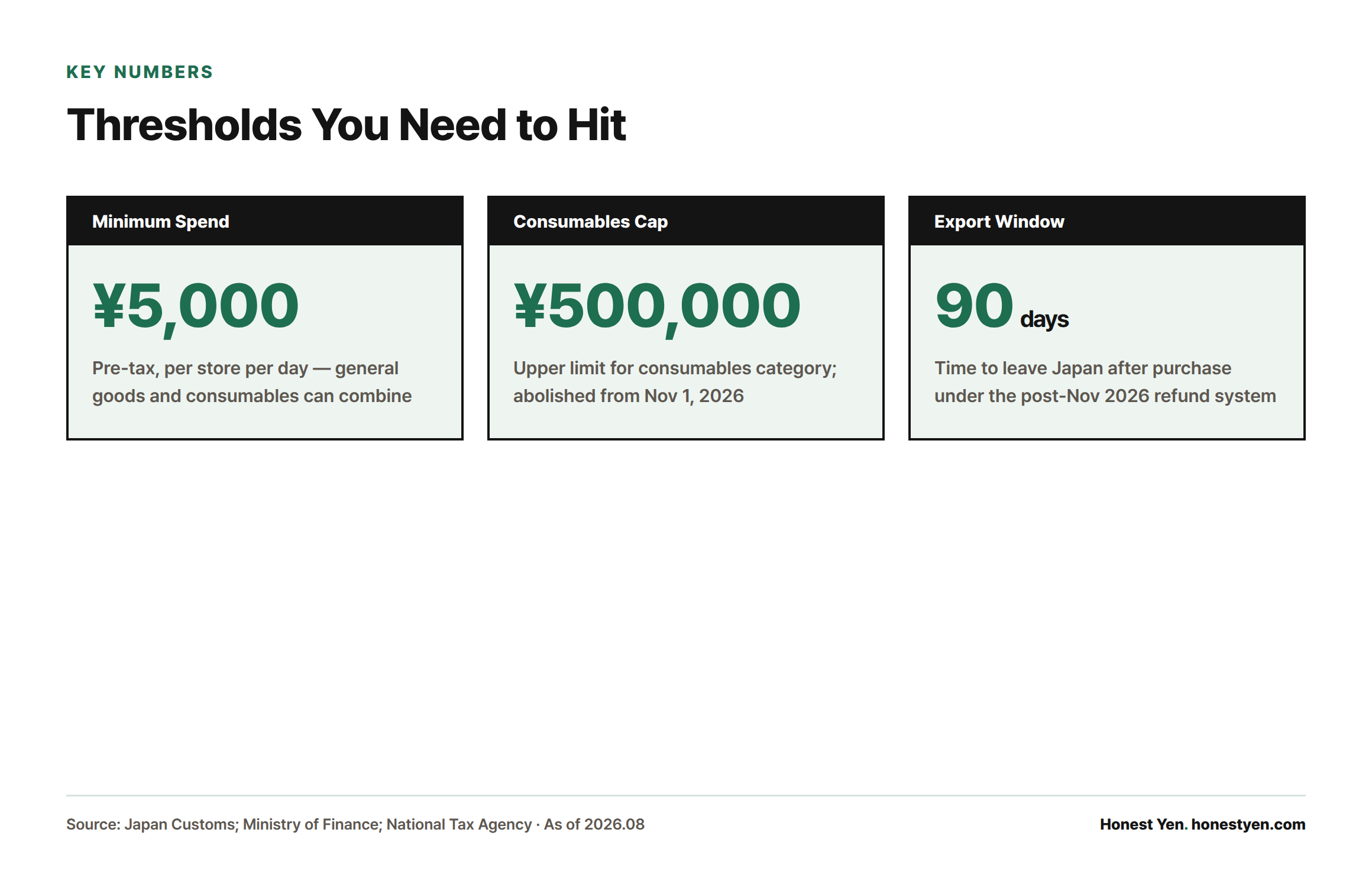
As of August 2026, purchases still fall into two categories with different packaging rules, based on Japan Customs and Ministry of Finance guidance[1][2]:
| Category | Minimum spend (pre-tax) | Upper limit | Packaging |
|---|---|---|---|
| General goods (clothing, electronics, bags) | ¥5,000 | None | Not required |
| Consumables (cosmetics, food, drinks, medicine) | ¥5,000 | ¥500,000 | Sealed, tamper-evident bag required |
General goods and consumables can be combined toward the ¥5,000 threshold at the same store on the same day[1]. A passport original is required — a photocopy or a photo on your phone is not accepted, at purchase or at departure customs[1][3].
Step 3: Shop the Floors, Then Settle at One Counter
Unlike a convenience store or a single-floor boutique, department stores don’t exempt tax at each department’s register. The usual sequence is:
- Pay normally at each department’s till and keep every receipt.
- Bring all receipts and your passport to the store’s centralized tax-free counter before you finish shopping for the day.
- Staff total your receipts, confirm the ¥5,000 minimum is met, and process the exemption electronically — this has been fully paperless since October 2021, so no stapled slip goes into your passport anymore[3].
Central Counters at Isetan, Takashimaya, and Daimaru
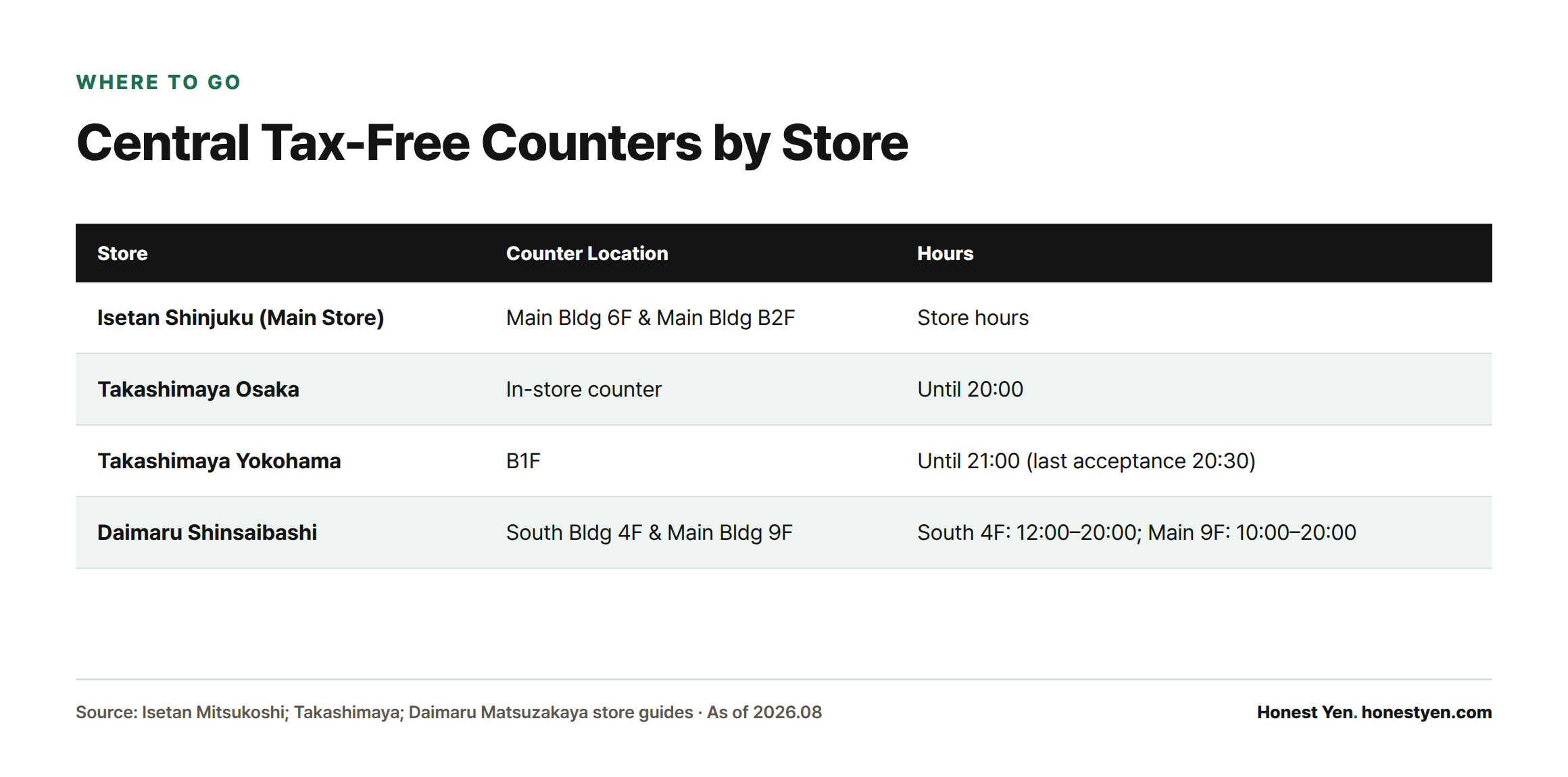
This is the part most guides skip, and it matters because these counters can be a 10–15 minute walk from wherever you’re shopping on a given floor:
| Store | Counter location | Hours |
|---|---|---|
| Isetan Shinjuku (Main Store) | Main Building, 6F and Main Building, B2F (two counters) | Store hours[4] |
| Takashimaya Osaka | In-store counter | Until 20:00[5] |
| Takashimaya Yokohama | B1F | Until 21:00 (last acceptance 20:30)[5] |
| Daimaru Shinsaibashi | South Building, 4F, and Main Building, 9F (Overseas Customer Service Center) | South 4F: 12:00–20:00; Main 9F: 10:00–20:00[6] |
At all three chains, purchases from different floors and different in-store boutiques are combined into a single daily total per store, so buying a scarf on 3F and skincare on 1F on the same visit counts toward one ¥5,000 minimum, processed at one counter[6]. Counters tend to fill up in the last hour before closing, since that’s when same-day shoppers finish up — going earlier in the day or on a weekday avoids the crunch.
Visit Japan Web: How Much It Actually Speeds Things Up
Visit Japan Web has issued a tax-free QR code since April 2023, generated from your pre-registered passport data[7]. Where a counter has a QR reader, staff scan the code instead of typing your passport details by hand, which the Digital Agency’s own documentation cites as producing fewer input errors than manual entry[7]. Not every counter has a reader yet, so keep your physical passport on hand regardless — it’s still the document customs checks at departure[1][3].
Consumables: Keep the Bag Sealed
Cosmetics, food, alcohol, and supplements bought as consumables are sealed by staff in a tamper-evident bag. Opening, tasting, or removing anything from that bag before you leave Japan invalidates the exemption for that item[1][2]. Wait until you’ve cleared departure and landed at your next stop.
What Changes on November 1, 2026
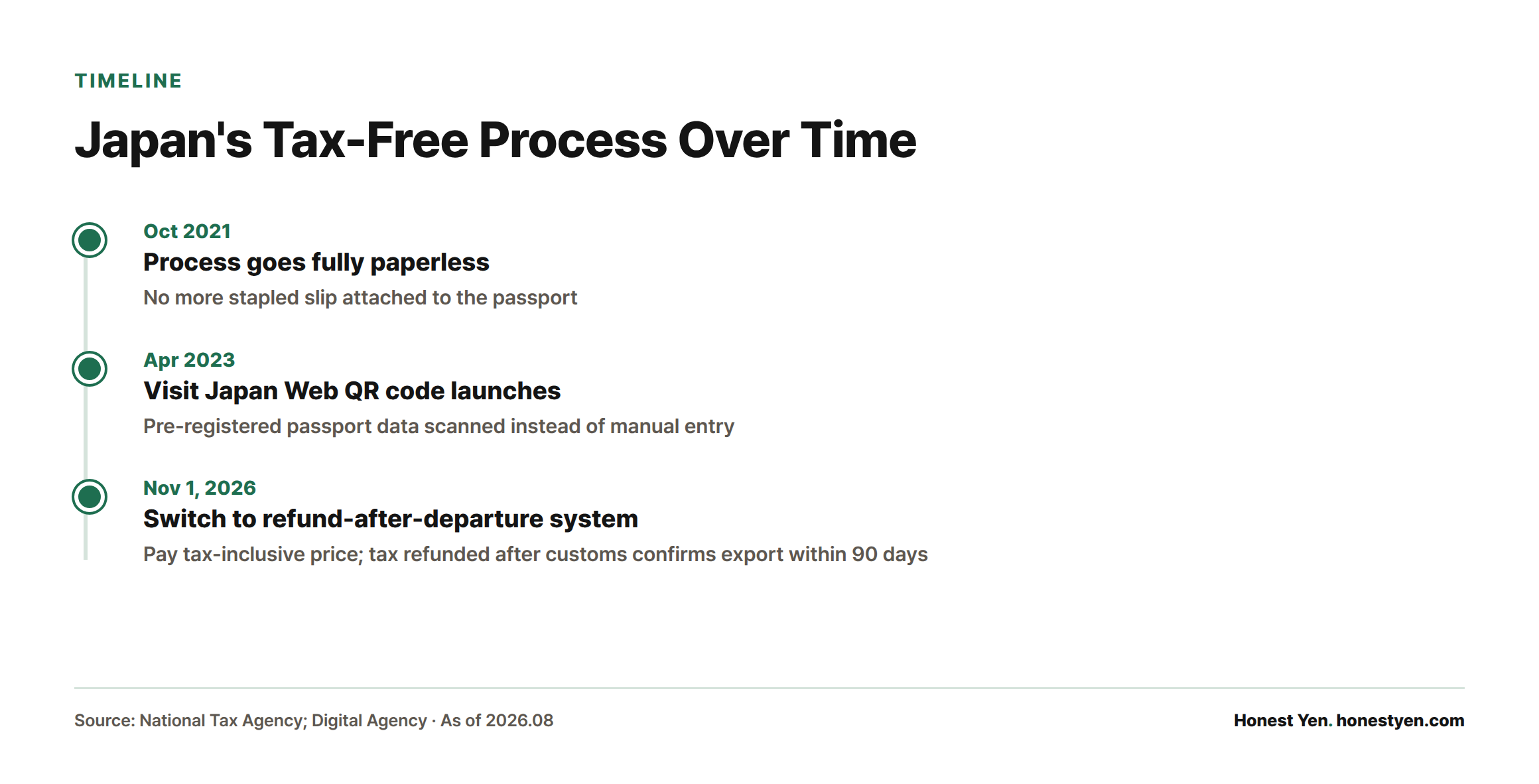
Japan’s National Tax Agency and Ministry of Finance are replacing the current point-of-sale exemption with a refund method (リファンド方式), effective November 1, 2026[8]. There is no overlap period — purchases made through October 31, 2026 follow today’s instant-exemption process exactly as described above; anything bought November 1 or later follows the new rules[8]:
- You pay the full tax-included price at the register, with no exemption applied at checkout.
- You must leave Japan within 90 days of the purchase date and have customs confirm export before the retailer refunds the consumption tax[8].
- The general-goods/consumables split, the ¥500,000 consumables cap, and the sealed-packaging requirement are all abolished — one unified ¥5,000-and-up (pre-tax) threshold applies to everything[9].
- Each retailer chooses its own refund method — bank transfer, credit card credit, an app-based payout, or cash at the airport — so it is not standardized store to store[8].
If you’re traveling before November 1, 2026, nothing here changes for you. If you’re traveling on or after that date, budget for paying tax-inclusive prices up front, ask each counter how it handles refunds, and build extra time into your departure for the refund step. The same cutover applies at general retailers, not just department stores — see our Don Quijote tax-free shopping guide for how the counter process compares there.
Customs at Departure: Common Mistakes
Japan Customs requires tax-free goods to be presented for confirmation before you leave, and failing to do so means the exempted (or, post-reform, refunded) tax gets charged back to you[1][10]. The recurring mistakes:
- Packing tax-free items into checked luggage before they’ve been shown to customs.
- Presenting a passport photocopy instead of the original at the counter.
- Losing track of which purchases were processed as tax-free when multiple receipts are involved.
- Under the post-November 2026 system, missing the 90-day export window or not knowing which refund method a given store uses[8].
FAQ
Does a passport photocopy work for tax-free shopping?
No. Both the store at purchase and customs at departure require the original passport[1][3].
How much do I need to spend to qualify?
¥5,000 or more before tax, at one store, in one day. General goods and consumables can be combined to reach that total[1][2].
Can purchases from different floors or shops inside the department store be combined?
Yes. Isetan, Takashimaya, and Daimaru all total same-day purchases across floors and boutiques at one central counter[6].
Can I open cosmetics or food before I leave Japan?
No — the sealed bag must stay unopened until after departure, or the exemption is void[1][2].
What changes in November 2026 — should I go now or wait?
There’s no reason to delay a trip. Before November 1, 2026, the current instant-exemption process applies; from that date, you pay tax-inclusive prices and get refunded after customs confirms export within 90 days[8].
What happens if customs catches an item I didn’t actually export?
You’re charged the tax amount that was exempted or refunded for that item[1][10].
Do any counters require card payment only?
Refund methods aren’t standardized, and several retailers route post-2026 refunds back to the credit card used at purchase, so paying by card can simplify getting your money back — ask the counter staff how that specific store handles it[8].
Sources
- Japan Customs, Customs Answer 5004: Export Tax Exemption for General Goods and Consumables
- Ministry of Finance, FY2025 Tax Reform Outline — Review of the Tax Exemption System for Foreign Tourists
- Go Tokyo (Tokyo Convention & Visitors Bureau), Tax-Free Shopping Guide
- Isetan Mitsukoshi, Isetan Shinjuku Store — Services
- Takashimaya, Osaka Store — Business Hours
- Daimaru Matsuzakaya, Daimaru Shinsaibashi — Service Guide for International Guests
- Digital Agency, Visit Japan Web Phase 2: Tax-Free QR Code Development Overview
- National Tax Agency, Reform of the Export Goods Retailer System to the Refund Method
- Japan Tourism Agency, Consumption Tax-Free Shop Site — Traveler Information
- Japan Customs, Customs Procedures for Departing Travelers