Do You Need Travel Insurance for Japan? What the Medical Bills Actually Show (2026)
This post may contain affiliate links. If you book or buy through them, we may earn a commission at no extra cost to you.
Short answer: yes. Japan does not require proof of travel insurance for short-term tourist entry, but hospitals bill foreign visitors the full, undiscounted cost of treatment up front, and one serious accident can run into the millions of yen. As of August 2026, at least ¥10 million (roughly $68,000) in emergency medical coverage is the realistic minimum, not a nice-to-have.
Why it matters: what treatment actually costs
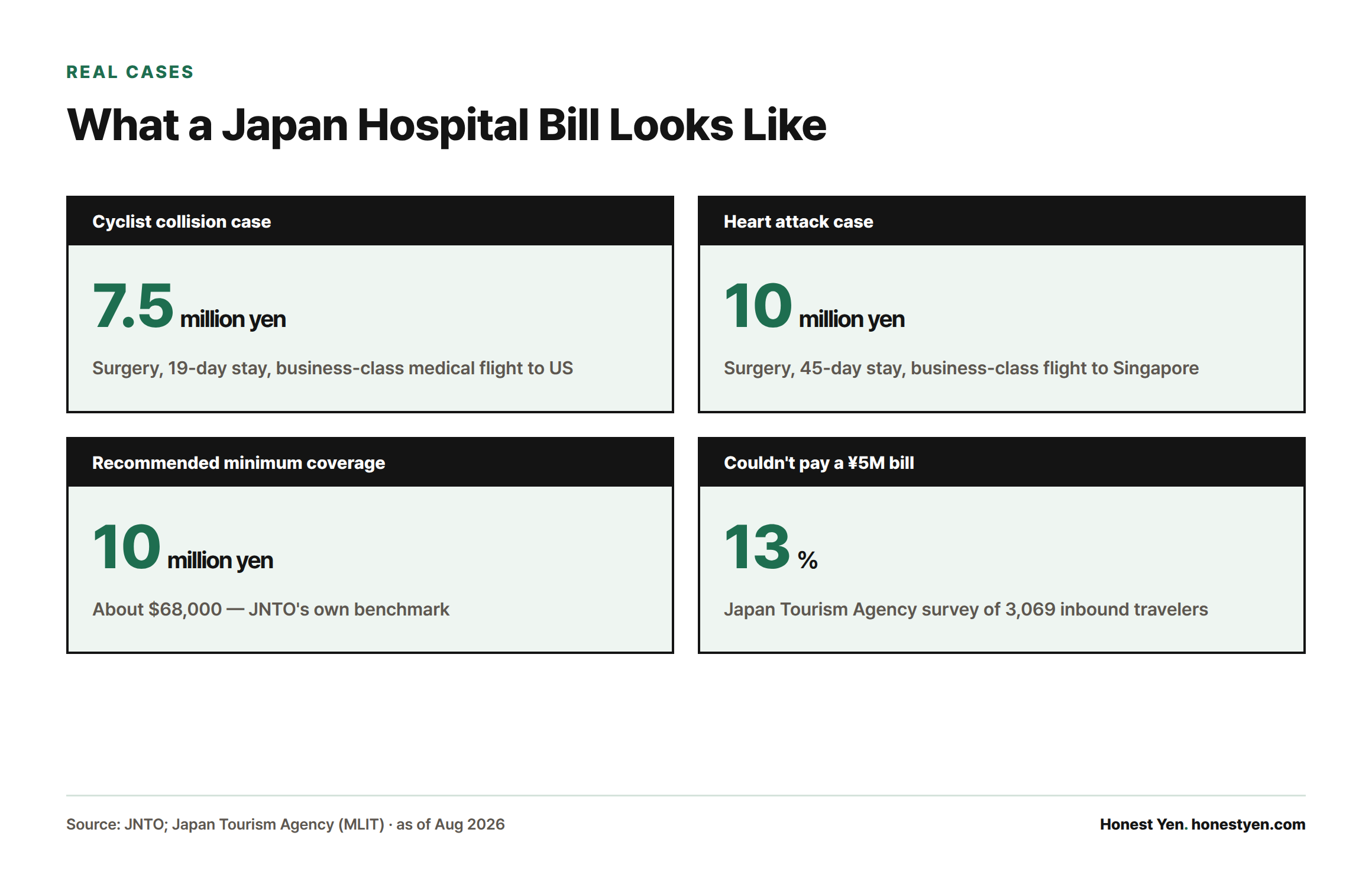
Japan’s tourism board, JNTO, publishes real settled-claim examples for foreign visitors. A cyclist hit in a collision needed surgery, a 19-day hospital stay, and a business-class medical flight home to the US: total cost ¥7.5 million [1]. A visitor who had a heart attack needed surgery, 45 days in hospital, and a business-class repatriation flight to Singapore: total cost ¥10 million [1]. Both cases were paid under travel insurance; without it, the visitor owes the hospital directly.
The UK Foreign, Commonwealth and Development Office puts it plainly: treatment in Japan is expensive, and visitors should “expect to pay the whole cost of any treatment,” and hospitals may check your insurance before treating you, which can delay care [4].
Japan’s Tourism Agency surveyed 3,069 inbound travelers at five airports between October 2023 and February 2024. About 73% had bought private medical insurance before the trip, but only 5% bought travel insurance after already arriving, and roughly 4% got sick or injured during the trip [3]. Asked how they’d cover a large bill, 7% said they had no way to pay a ¥200,000 charge, in Japan or after going home; at ¥5 million, that share rose to 13% [3]. That gap is exactly what turns into unpaid hospital debt.
How much coverage is enough
| Coverage type | What to look for |
|---|---|
| Emergency medical & hospitalization | At least ¥10 million (about $68,000) — JNTO’s own reference point [1][2] |
| Medical evacuation & repatriation | Included with no low sub-limit — both real cases above bundled the flight home into the total [1] |
| Cashless hospital payment & interpreter arrangement | A genuine benefit on Japan-focused plans, since hospitals often want payment or proof of ability to pay before treating a non-resident [1] |
| Baggage & personal liability | Standard on comprehensive policies, but not where the real financial risk sits |
Is your credit card’s travel insurance enough?
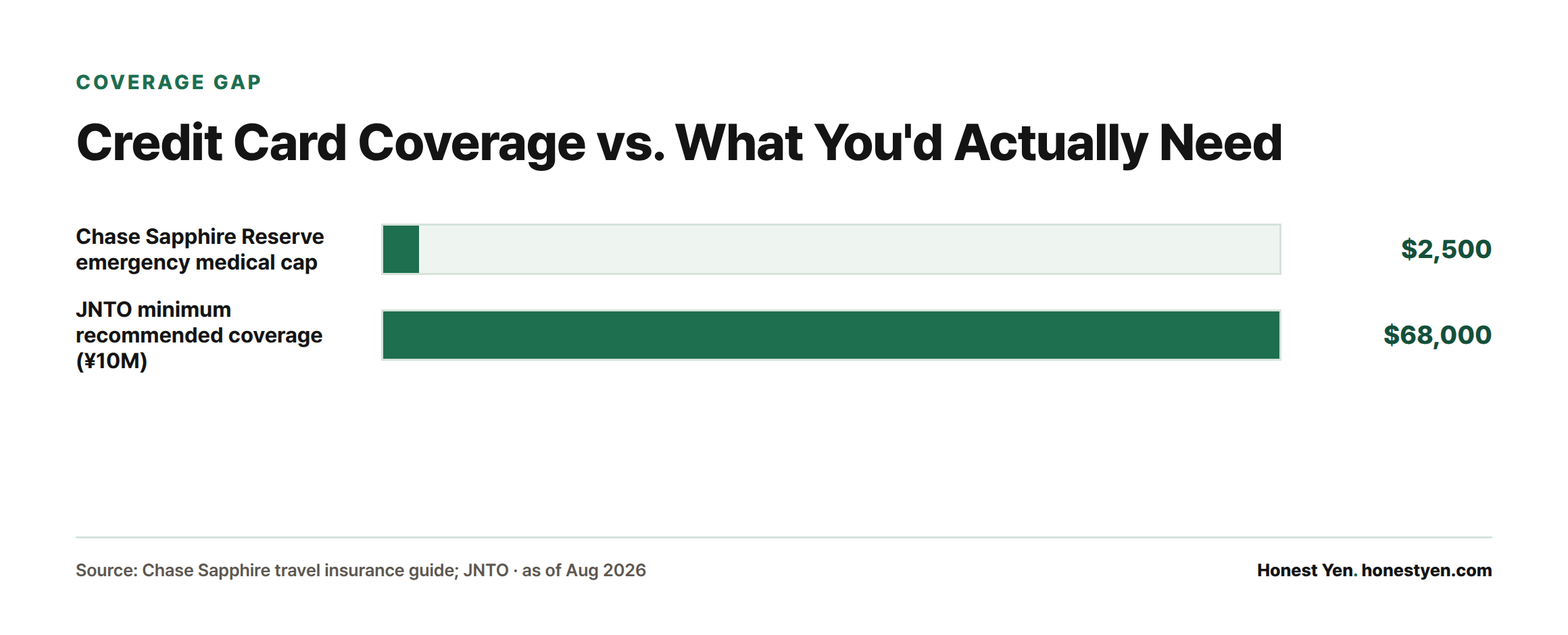
Premium travel cards often bundle some emergency medical benefit, but limits run far below what a serious hospitalization costs in Japan. Chase’s own benefits guide for the Sapphire Reserve card caps emergency medical and dental reimbursement at $2,500, with a $50 deductible, plus up to $100,000 for emergency evacuation and transportation [5] — useful, but a fraction of the ¥7.5–10 million cases above. Cards also typically skip cashless hospital billing or interpreter arrangement, which matters when you’re trying to be understood in Japanese at 2 a.m.
If your only coverage is a prepaid travel money card rather than a credit card, check the fine print more carefully still — most prepaid and debit-style travel cards (Wise, Revolut, and similar, compared in our guide to travel money cards for Japan) carry no built-in travel insurance at all. Treat a card’s insurance, if any, as a supplement to a dedicated policy, not a replacement.
What it actually costs in 2026
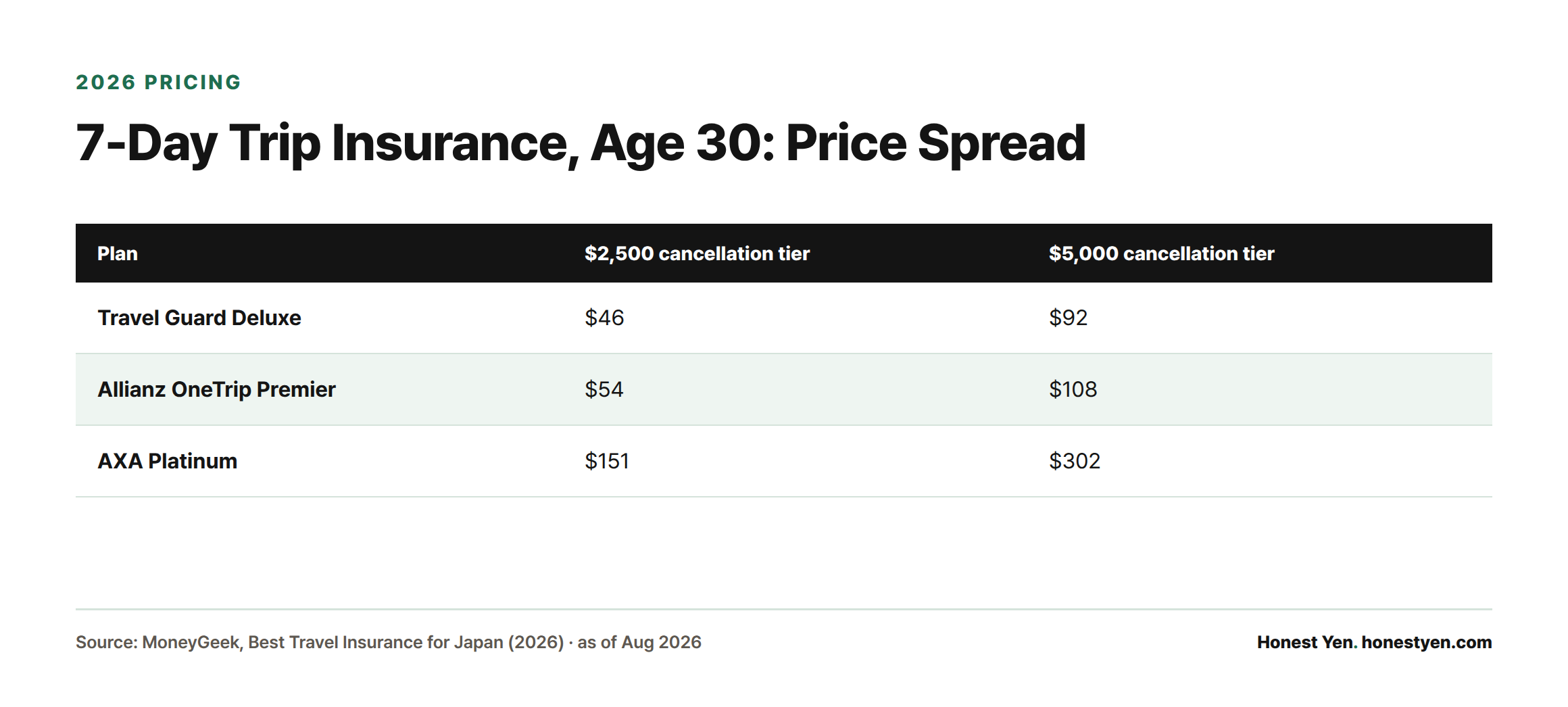
There’s no single official price list — premiums track age, trip length, coverage tier, and destination. For reference, one insurance marketplace’s published comparison for a 7-day trip at age 30 shows the spread across major US providers [8]:
| Plan | $2,500 cancellation tier | $5,000 cancellation tier |
|---|---|---|
| Travel Guard Deluxe | $46 | $92 |
| Allianz OneTrip Premier | $54 | $108 |
| AXA Platinum | $151 | $302 |
Premiums climb with age, trip length, and any declared pre-existing conditions, so run your own dates through a quote tool rather than borrowing someone else’s number.
How to buy it before you fly
- Compare plans against the coverage checklist above, medical limit first.
- Enter trip dates, destination, and traveler details, and declare existing conditions honestly — omissions are the most common reason claims get denied.
- Pay online; you’ll get a policy document and certificate by email immediately, so save the PDF and the 24/7 emergency assistance number somewhere reachable offline.
- Confirm you’ll actually be able to make that call from Japan — a data-only eSIM without voice support can leave you stuck. Our SIM, eSIM, and pocket WiFi comparison covers which options include calling.
Filing a claim: process and documents
Call the emergency assistance line as early as possible, ideally before or during treatment, since many Japan-focused policies arrange cashless payment directly with the hospital instead of reimbursing you later. If you do pay upfront, insurers generally want:
- Medical claims: the itemized hospital bill and doctor’s notes or discharge summary [6][7].
- Theft or loss claims: a police report, filed at the nearest kōban (police box) in Japan, plus proof of ownership like receipts or photos [6][7].
- Delay claims: written proof of the delay from the airline or carrier, plus receipts for meals or accommodation you had to buy [7].
File through the insurer’s online claims portal and upload everything you have — most insurers note that missing documentation is the single most common reason claims stall.
FAQ
Is travel insurance legally required to enter Japan?
Not for most short-term tourist visa holders as of August 2026 — it isn’t checked at immigration. But hospitals require payment or proof of ability to pay before treating non-residents, so in practice it functions as a requirement the moment you need care.
How much coverage is enough?
Around ¥10 million in medical coverage, matching JNTO’s own benchmark, with evacuation included and no low sub-limit [1][2].
Can my credit card’s travel insurance replace a standalone policy?
Only partially. Chase Sapphire Reserve’s $2,500 emergency medical cap [5] is a small fraction of the ¥7.5–10 million real Japan hospital cases JNTO documents [1]. Use a card’s coverage as a supplement, not a substitute.
What does it actually cost by age and trip length?
Roughly $46 to $151 for a 7-day trip at age 30 across major US providers [8]; older travelers, longer trips, and pre-existing conditions push the price up. Get a personalized quote rather than relying on someone else’s figure.
How do I actually file a claim, and what documents do I need?
Call the emergency assistance line first, then submit itemized bills, doctor’s notes, police reports for theft, and proof of delay for travel delay through the insurer’s online portal [6][7].
If I can’t pay a medical bill, will it affect future entry to Japan?
JNTO’s own visitor guidance states plainly that “foreign visitors who fail to pay their medical expenses may be denied entry into Japan in the future” [1]. Unpaid-bill data is tracked and shared with authorities, so this is stated policy, not a theoretical risk.
Sources
- Japan National Tourism Organization, “For safe travels in Japan – Guide for when you are feeling ill”
- Japan National Tourism Organization, Travel insurance guidance for visitors
- Japan Tourism Agency (MLIT), survey on medical care for inbound foreign travelers (published June 2024)
- UK Government, Foreign travel advice: Japan – Health
- Chase, “A Guide to Chase Sapphire Travel Insurance”
- World Nomads, Sending documentation to support your claim
- AIG Travel Guard, Documents Required to File a Reimbursement Claim
- MoneyGeek, Best Travel Insurance for Japan (2026 quote comparison)