Japan Luggage Storage Cost Guide: Lockers vs Counters vs Takkyubin
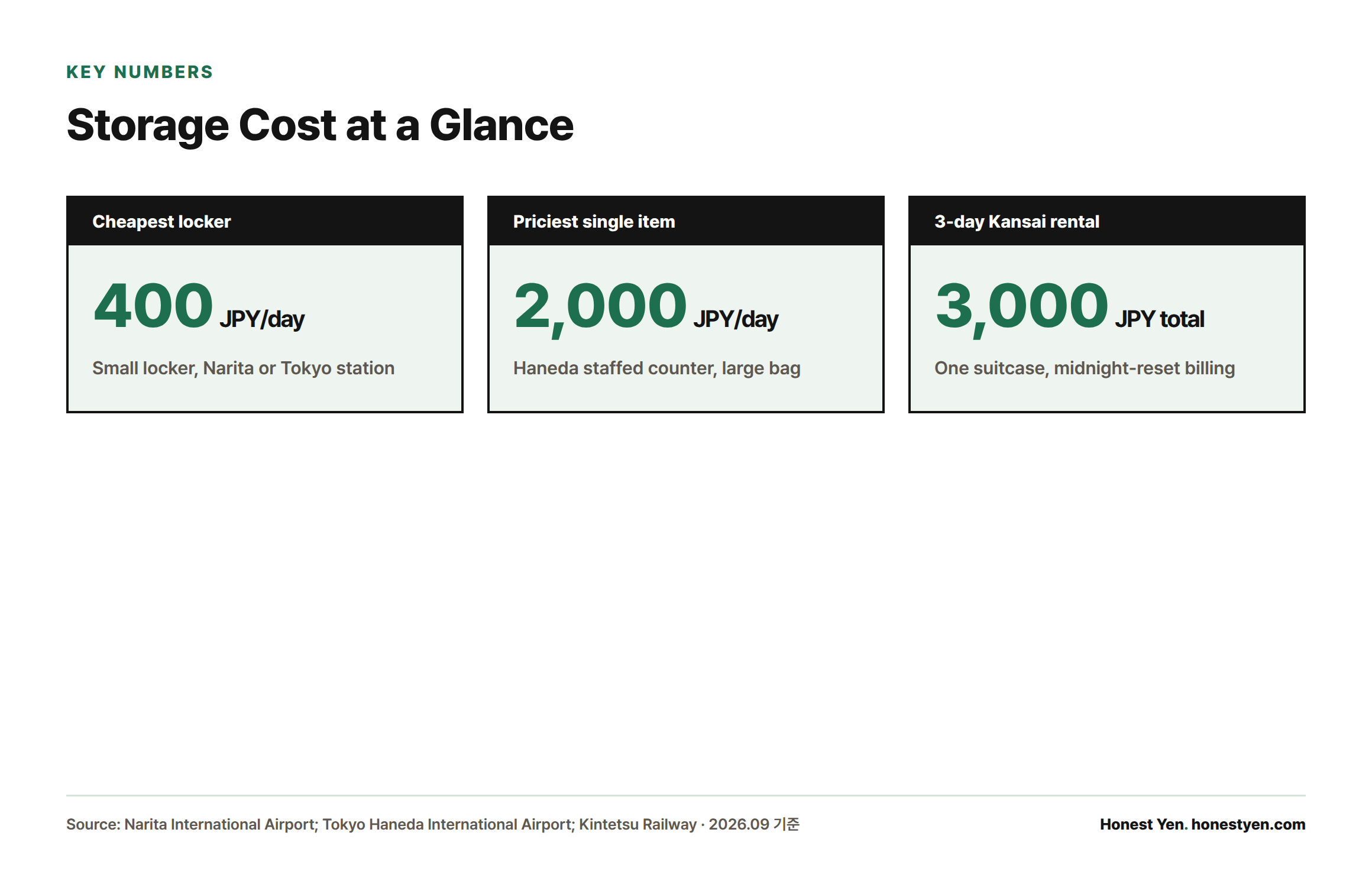
- A 3-day Kansai locker rental for one large suitcase totals ¥3,000, because storage resets at midnight rather than after 24 hours[4].
- The priciest single line item is Haneda’s staffed counter for a large bag at ¥2,000 a day[2]. Forwarding the same bag by Yamato TA-Q-BIN instead adds a ¥660 airport fee on top of the parcel rate[3].
- The cheapest realistic option is a small locker at ¥400 a day, the going rate at both Narita and central Tokyo stations[1].
This post may contain affiliate links. If you book or buy through them, we may earn a commission at no extra cost to you.
Lockers win for a few hours, forwarding wins for multi-day trips
A coin locker is the better choice for storing one bag over a single afternoon. Once a trip stretches past a day, or the bag is bulky, a staffed counter or a delivery service usually costs less per day and removes the risk of finding every locker full.
The deciding factors are how many days the bag sits, how big it is, and whether it needs to come back at a specific time. Lockers charge by the calendar day and by locker size, while counters and forwarding charge by the bag’s total dimensions instead.
Locker sizes and prices at Tokyo, Narita, and Kansai-area stations
Tokyo station lockers run in four sizes. Small units cost about ¥400 to ¥500 a day, medium about ¥500 to ¥600, and large about ¥700 to ¥800[6]. Extra-large units cost about ¥1,200 a day[6]. Most accept a tap of Suica or Pasmo directly on the locker pad, and other IC cards work the same way at IC-enabled units[6].
At Narita, a small daily-rate locker (33 × 34 × 66 cm) costs ¥400 a day[1]. A medium locker (50 × 34 × 66 cm) costs ¥600, and a large locker (86 × 34 × 66 cm) costs ¥800, both per day[1]. A large Narita locker is deep enough for a full checked suitcase, while the small size only fits a day bag or backpack[1].
Around Kansai, Kintetsu-operated stations in Osaka, Nara, and Kyoto price lockers by size band. Small runs ¥400 to ¥600, medium ¥400 to ¥700, large ¥600 to ¥1,000, and extra-large ¥800 to ¥1,500[4]. Standard lockers need ¥100 coins, and coin changers are not guaranteed at every station[4]. Kintetsu’s Smart Lockers skip coins entirely and add refrigerated units at ¥1,900 to ¥2,300[4].
Airport storage prices differ: Narita’s lockers versus Haneda’s counter
Narita runs two pricing tracks. Daily-rate lockers charge ¥400 (small), ¥600 (medium), or ¥800 (large) per day, for up to eight days[1]. Hourly-rate lockers in Terminal 2 and Terminal 3 charge from ¥300 for six hours plus ¥400 for each additional day, useful for a short wait before a flight[1].
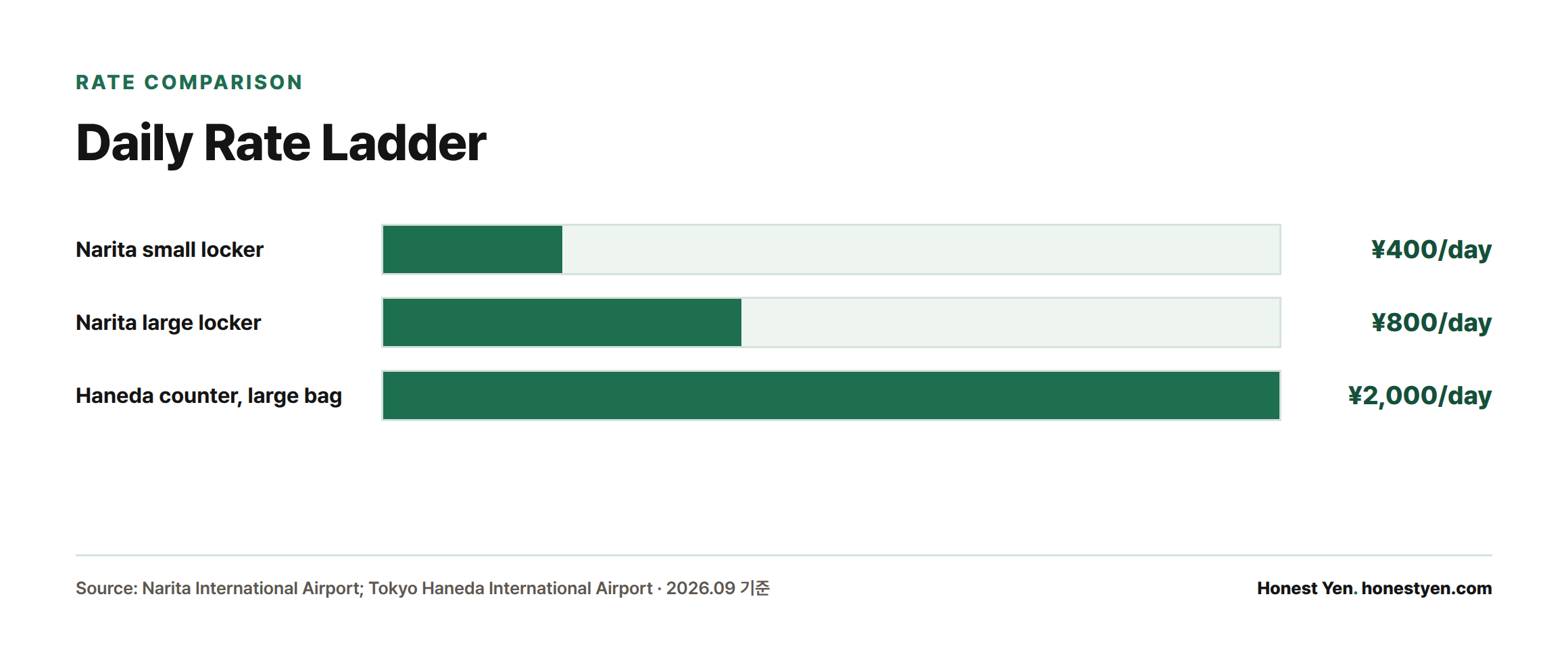
Haneda’s baggage service is a staffed checkroom, not a coin locker network, and it prices by total dimensions rather than a size label. Bags under 120 cm combined cost ¥800 a day, 120 to 199 cm cost ¥1,000, and 200 to 300 cm cost ¥2,000 per day[2]. Storage can run up to 30 kg per bag and up to two weeks[2].
What it actually costs: three worked scenarios
The table below breaks down three real situations: a solo day-tripper, a couple on a multi-day Kansai loop, and a family flying home from Narita.
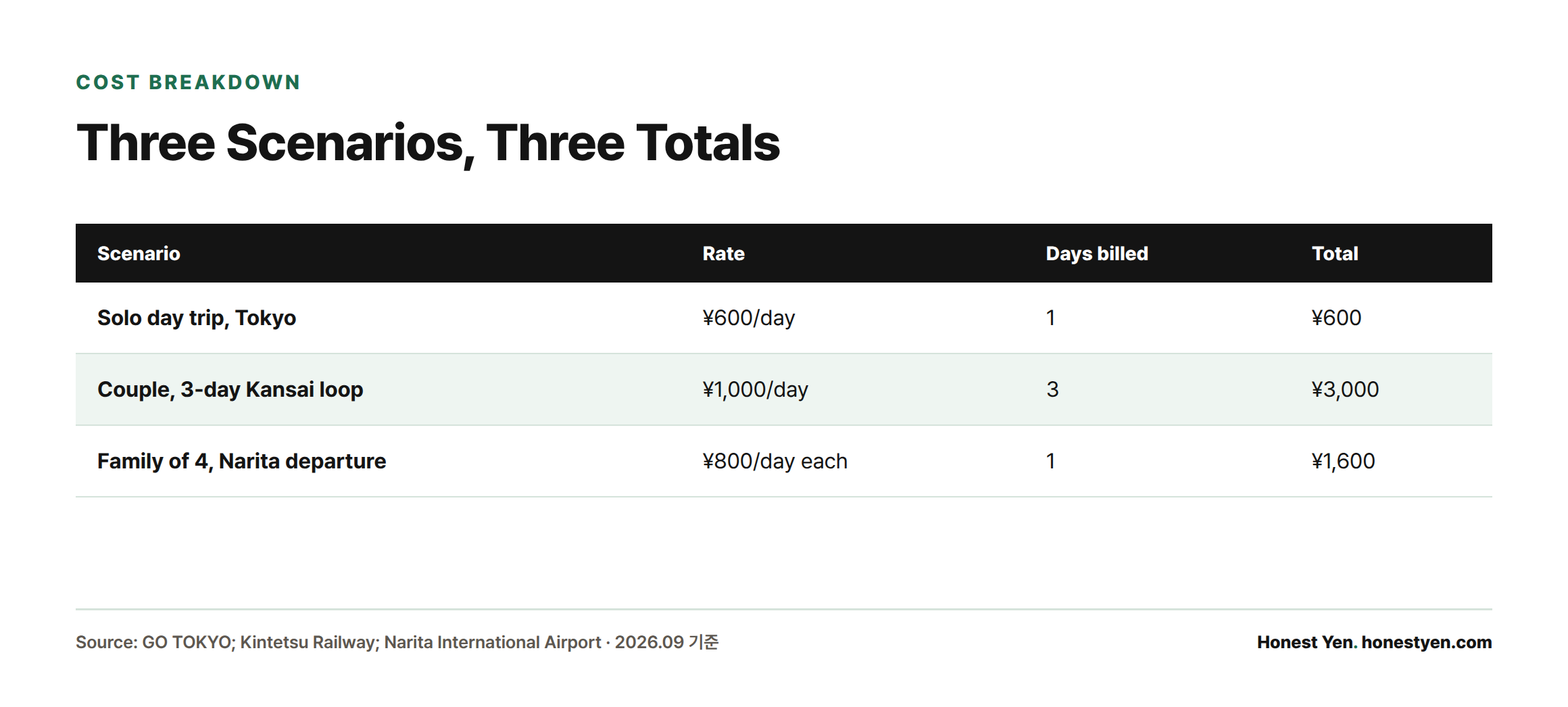
| Scenario | Solo day trip, Tokyo | Couple, 3-day Kansai loop | Family of 4, Narita departure |
|---|---|---|---|
| Rate | ¥600/day[6] | ¥1,000/day[4] | ¥800/day each[1] |
| Days billed | 1 | 3 | 1 |
| Total | ¥600[6] | ¥3,000[4] | ¥1,600[1] |
Scenario one: one medium locker for one calendar day costs ¥600[6]. Scenario two: dropping a suitcase off in the evening and collecting it two days later crosses two midnights[4]. That bills three separate days at the top of Kintetsu’s large-locker range: ¥1,000 × 3 = ¥3,000[4]. Scenario three: two large Narita lockers for one day come to ¥800 × 2 = ¥1,600[1]. The same two bags at Haneda’s staffed counter, priced by total size rather than a locker slot, would run ¥2,000 per bag per day[2]. That is ¥4,000 for both bags, ¥2,400 more than Narita’s lockers[2].
What pushes the price up
Extra-large bags cost the most everywhere. Narita’s extra-large hourly locker (227 × 34 × 66 cm) runs ¥1,200 per 12-hour block[1]. Its MULTIECUBE smart locker LW size adds ¥1,200 per day, plus ¥500 if reserved in advance[1]. Refrigerated Kintetsu lockers start at ¥400 and climb to ¥1,200 as the fee increases every two hours[4]. Staffed counters penalize bulk hardest: Haneda’s large band costs 2.5 times its small band for the same day[2].
How to spend less
Match the locker size to the bag instead of defaulting to large. A day bag fits Narita’s small locker at half the large rate[1]. For a short wait before a flight, Narita’s hourly lockers beat the daily rate: six hours in a medium locker costs ¥500 against ¥600 for the full day[1]. Any suitcase under 45 cm counts as a bag at ecbo cloak, at ¥500 a day rather than the ¥800 suitcase rate[5].
The midnight-reset trap: an evening drop-off can bill two days
Narita defines one locker-day as the period from drop-off to midnight, with a new charge starting right after. Drop a bag off in the evening and collect it after midnight, and the locker bills for two full days even though only a few hours passed[1]. ecbo cloak works the same way for its shop partners: dropping off in the late afternoon and picking up the next morning still counts as two business days[5]. Plan an evening drop-off only if the next-day pickup happens early, or budget for the extra day.
When every locker is full: counters, ecbo cloak, and takkyubin forwarding
Coin lockers at busy stations fill up by mid-morning during peak seasons. Three fallbacks exist. Staffed counters, where available, take bags of nearly any size for a flat daily fee, such as Haneda’s checkroom[2].
The ecbo cloak app lists shops and hotels that hold bags for ¥500 (under 45 cm) or ¥800 (45 cm and over), 20 kg maximum[5]. Some JR station partner locations charge a flat ¥1,000 per bag regardless of size instead[5].
For a bag that will not be needed again before a flight, Yamato Transport’s airport TA-Q-BIN service can forward it directly to Narita, Haneda, or Kansai airport[3]. The service adds a ¥660 airport handling fee on top of its regular parcel rate[3]. A full walkthrough of the forwarding rates by parcel size is in How Much Does Luggage Forwarding Cost in Japan? A Yen-by-Yen Guide. If the bag needs a locker’s extra-large slot instead, check Shinkansen Oversized Baggage Rules before boarding a bullet train with it.
Three habits prevent a lost locker or a lost key.
- Photograph the locker number and section before walking away.
- Keep the paper key or app QR code somewhere other than inside the bag just stored.
- Check whether the unit takes coins only or also taps an IC card, since not every locker at a station has been upgraded[4].