Winter Driving in Hokkaido: The Studless Tire Law and What Insurance Really Costs
This post may contain affiliate links. If you book or buy through them, we may earn a commission at no extra cost to you.
Japan bans studded tires nationwide under the Studded Tire Regulation Law, so every car on Hokkaido’s winter roads runs on studless tires instead.[1]
Anyone visiting from the US, UK, Australia, Canada or Singapore also needs an International Driving Permit to rent one.[2] None of those five countries has a license agreement with Japan.[2] This guide reflects prices and rules published as of September 2026.
| Rule | What it requires | Applies to |
|---|---|---|
| Studded tires | Banned nationwide under the Studded Tire Regulation Law[1] | Every vehicle in Japan |
| Rental car tires | Studless winter tires fitted as standard equipment for the winter season[3] | Hokkaido rental fleets |
| Expressway chains | Chains required in designated sections during heavy snow warnings, even over studless tires[4] | NEXCO expressway drivers |
| Ice-road speed cap | Reduced to 50-80 km/h on affected sections in poor conditions or visibility[4] | NEXCO expressway drivers |
| Foreign driver’s license | International Driving Permit under the 1949 Geneva Convention required[2] | All countries except Switzerland, Germany, France, Belgium, Monaco and Taiwan[2] |
Rental cars default to studless tires, not chains
Rental companies fit their Hokkaido fleets with studless tires as standard equipment for the winter season, so cars are ready for snow the moment you collect them.[3]
Toyota Rent a Car equips every one of its Hokkaido shops this way during its designated winter period, with no separate request needed.[5]
Outside Hokkaido, some networks only supply winter tires if you request them at booking, and will not swap them in if you ask on arrival.[6]
Ice cuts tire grip by up to eight times over dry pavement
NEXCO’s own snow-driving guide says a car is 3.2 times more likely to slip on packed snow and up to 8.0 times more likely to slip on ice than on dry asphalt.[7]
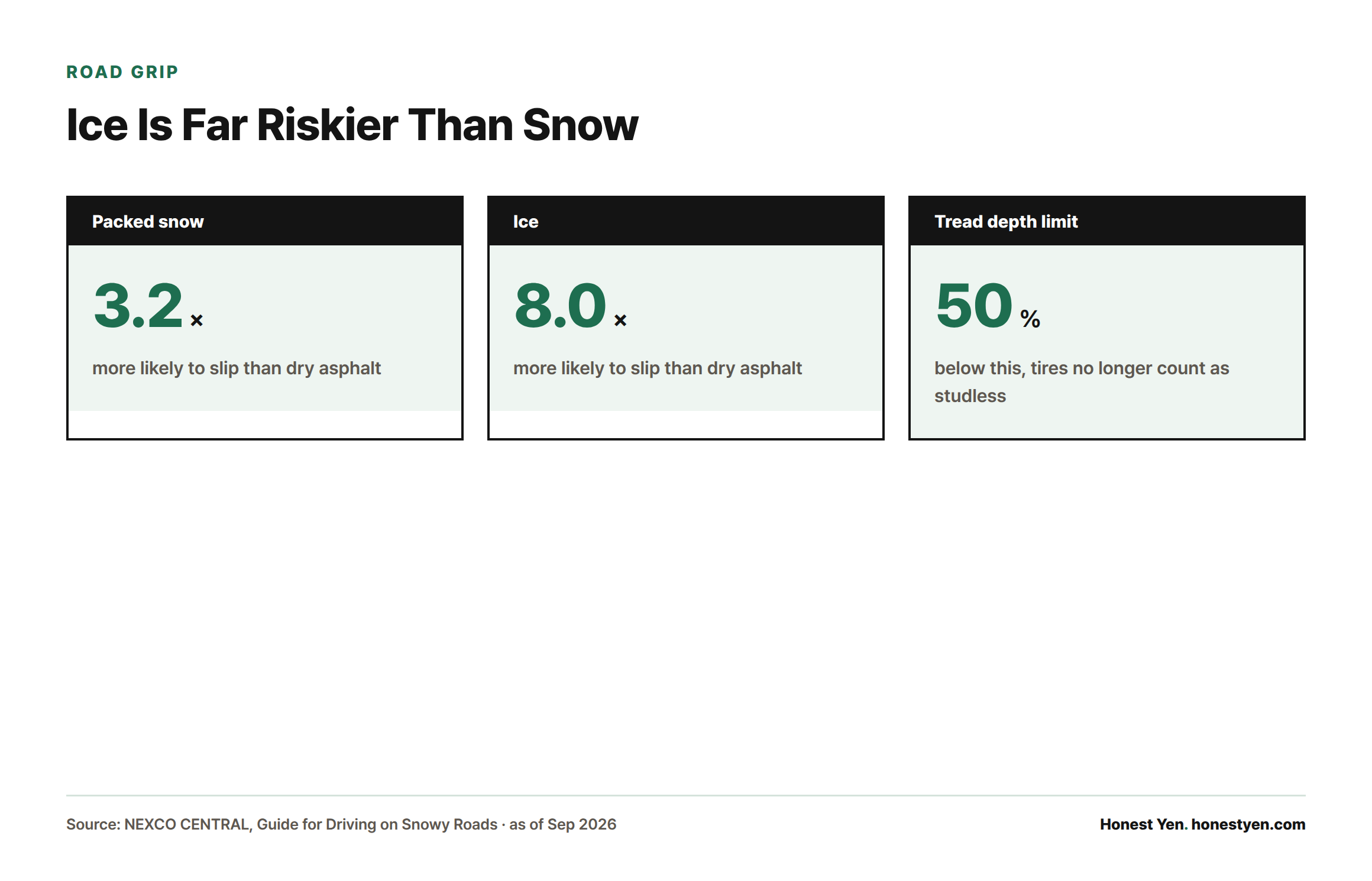
Studless tires stop counting as legally studless once the tread wears down to less than 50% of its original depth, so check it before you drive off.[7]
Black ice forms most often on bridges, overpasses and shaded curves, so slow down well before those spots.[6] Increase following distance and brake earlier than usual, since roads are slippery in ways that are not always visible.[8]
If the car starts to skid, ease off the accelerator and steer smoothly toward the direction you want to go. Do not brake.[6]
Chain zones and the ice-road speed cap you cannot ignore
On NEXCO’s designated snow sections, travel speed can be capped at 50-80 km/h due to poor road conditions or visibility.[4] Inside a chain-regulation zone during a heavy snow warning, you cannot proceed without a tire chain, even on studless tires.[4]
NEXCO East, which operates Hokkaido’s expressway network, runs the same chain-regulation program during heavy snow warnings.[9]
What CDW, NOC and the winter fee add to the bill
Nippon Rent-A-Car’s Standard (W) class starts at ¥8,030 for 24 hours, before any winter charges.[10]
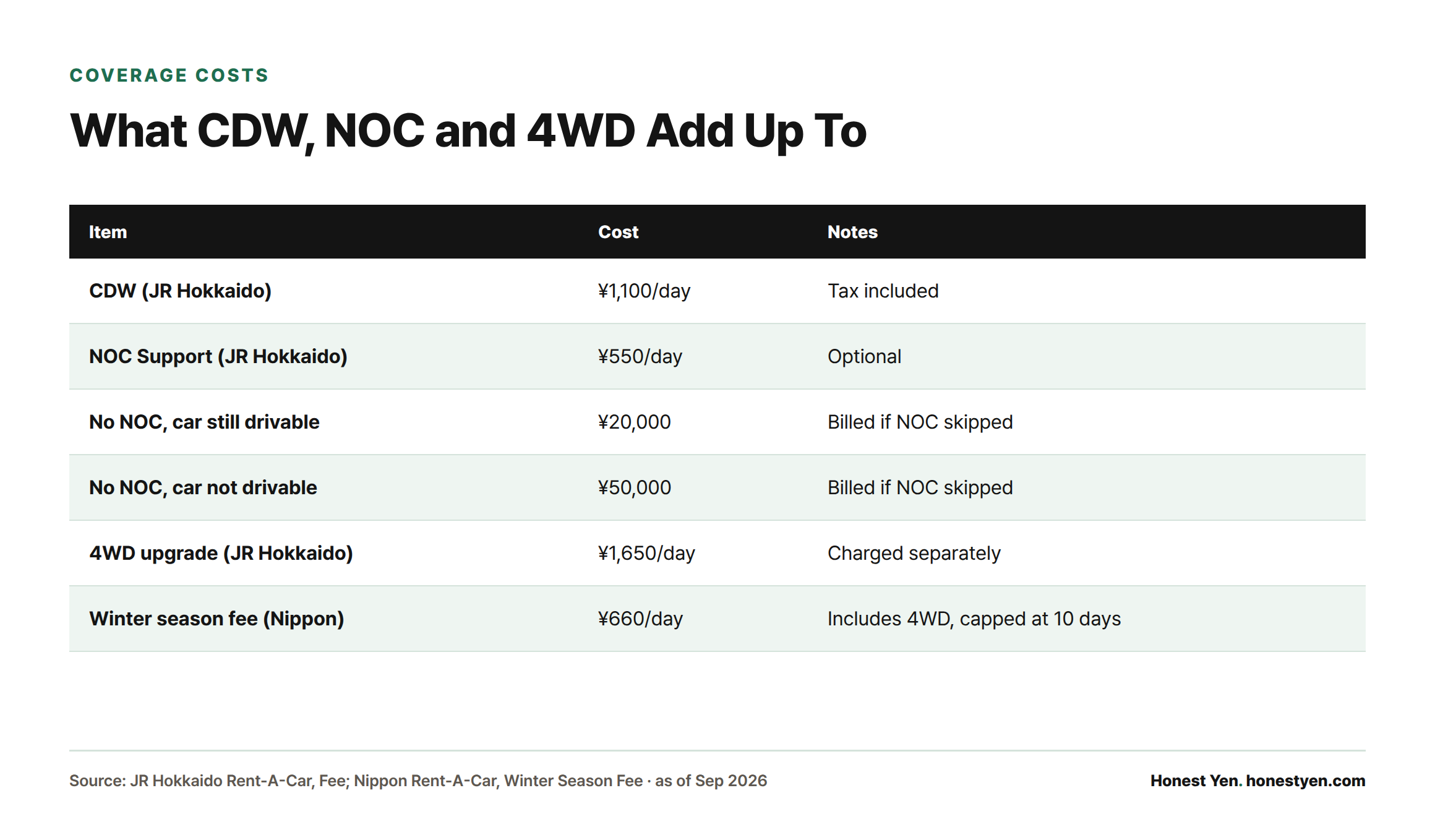
Its Hokkaido winter season fee adds ¥660 per day from November 1 to April 20, capped at 10 days, and folds 4WD in as standard equipment for that period.[11]
JR Hokkaido Rent-A-Car prices its Collision Damage Waiver at ¥1,100 per day, tax included, and its NOC Support option at ¥550 per day.[12] Skip NOC and the company bills ¥20,000 if the car is still drivable, or ¥50,000 if it is not.[12]
JR Hokkaido also charges a separate ¥1,650-per-day 4WD upgrade, while Nippon folds 4WD into its Hokkaido winter fee at no extra cost.[12] These per-day add-ons behave like the other hidden costs on a Japan itinerary; see how four hidden fees add up, with the math.
What a real Hokkaido rental costs, worked out
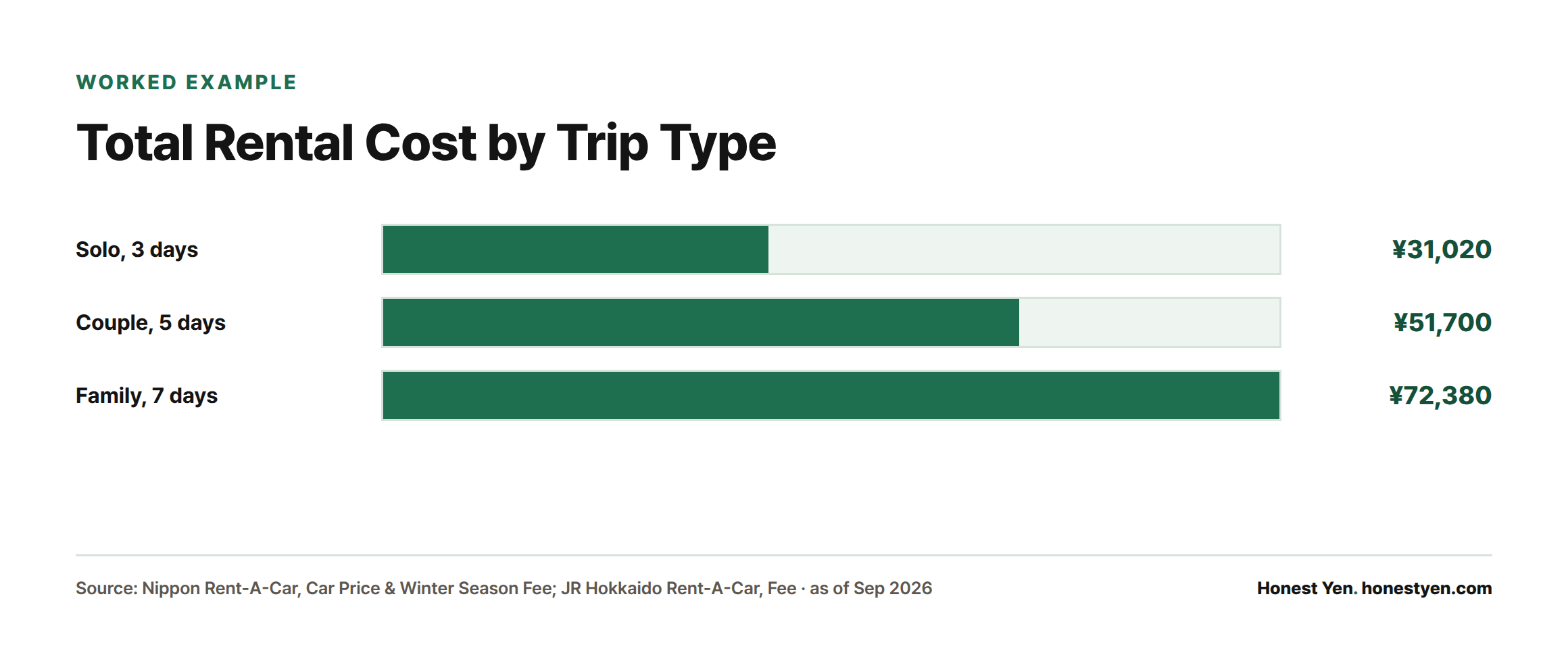
Three worked examples: a solo traveler renting a compact car for 3 days, a couple renting a sedan for 5 days, and a family of four renting for 7 days. The table below combines Nippon’s Standard class and winter-fee rates, published as of April 2026, with JR Hokkaido’s published CDW and NOC rates.[10][11][12]
| Cost item | Solo, 3 days | Couple, 5 days | Family, 7 days |
|---|---|---|---|
| Base rate (Standard/W) | ¥24,090 | ¥40,150 | ¥56,210 |
| Winter season fee (4WD included) | ¥1,980 | ¥3,300 | ¥4,620 |
| CDW | ¥3,300 | ¥5,500 | ¥7,700 |
| NOC Support | ¥1,650 | ¥2,750 | ¥3,850 |
| Total | ¥31,020 | ¥51,700 | ¥72,380 |
For the solo traveler: ¥8,030 × 3 + ¥660 × 3 + ¥1,100 × 3 + ¥550 × 3 = ¥31,020.[10][11][12]
The example above assumes a Nippon booking. Choosing JR Hokkaido instead adds its own base rate plus a ¥1,650 daily 4WD charge on top of CDW and NOC.[12]
Skipping both coverage options entirely exposes a renter to up to ¥100,000 in CDW deductibles, plus another ¥50,000 in NOC charges if the car cannot be driven afterward. That’s a possible ¥150,000 out of pocket for one accident.[12] For how this stacks up against a full itinerary, see our Japan trip cost breakdown by travel style.
Should you drive at all, or take the train
Japan’s official tourism site recommends visitors avoid driving in snow and use trains, buses or taxis instead.[8]
Two or more people covering rural loops like Furano or Biei, where rail service is thin, get the most out of a car. A solo traveler sticking to Sapporo, Otaru and Asahikawa can cover all three by train without ice-road driving.
If you do drive, carry a jack and snow chains even with studless tires fitted, plus jumper cables and blankets for emergencies.[8] If a snowstorm strands you, pull over safely, turn on hazard lights and call 110 for police or 9910 for expressway roadside assistance.[8]
A first-timer’s pre-drive winter checklist
- Carry an International Driving Permit issued under the 1949 Geneva Convention, since the US, UK, Australia, Canada and Singapore fall outside Japan’s short list of translation-only countries.[2]
- Confirm the car has studless tires fitted before you leave the lot.[3]
- Plan the route along major roads rather than back streets, and overestimate driving time after checking weather forecasts.[3]
- Switch to freeze-resistant washer fluid, since the regular kind can freeze in Hokkaido’s winter temperatures.[3]
- Pull the wipers away from the windshield before parking overnight so they do not freeze to the glass.[6]
Questions travelers ask before driving in Hokkaido
Do I need to bring my own snow tires or chains?
No. Hokkaido rental cars come with studless tires already fitted as standard equipment.[3]
Is winter driving safe for a first-time visitor?
Stick to major roads and daylight hours, and default to trains or buses between cities you can reach by rail. Save driving for routes like Furano and Biei, which trains cover poorly.
What happens if I skip coverage and have an accident?
With JR Hokkaido Rent-A-Car, an uninsured renter faces up to ¥50,000 in property damage and up to ¥50,000 in vehicle damage. NOC charges add ¥20,000 to ¥50,000 more, depending on whether the car can still be driven.[12]
Sources
- Ministry of the Environment, Studded Tires Regulation Law
- JAF, Drive With a Foreign License
- JAF, Snow-Covered and Icy Roads
- NEXCO CENTRAL, Pay Attention to Traffic Regulations
- Toyota Rent a Car, Shops Offering Winter Tires as Standard Equipment
- ToCoo! Car Rental, Winter Driving Guide
- NEXCO CENTRAL, Guide for Driving on Snowy Roads
- Japan Travel (JNTO), What You Need to Know When Driving in Japan During Winter
- NEXCO EAST, Measures for Securing Road Traffic This Winter
- Nippon Rent-A-Car, Car Price
- Nippon Rent-A-Car, Winter Season Fee
- JR Hokkaido Rent-A-Car, Fee