Japan Trip Cost by Travel Style: The 2026 Numbers, Sourced and Dated
- A splurge day that mixes the Narita Skyliner, one day of a Japan Rail Pass, and teamLab Planets runs about ¥66,200 per person, worked out below.
- The Japan Rail Pass is the single biggest lever in any multi-city trip, and every duration rises in price on October 1, 2026[1].
- A backpacker day in Tokyo, hostel bed and IC card deposit included, prices out at roughly ¥7,100.
This post may contain affiliate links. If you book or buy through them, we may earn a commission at no extra cost to you.
Three travel styles in Japan produce three very different daily totals, and the gap between them is wider than a single “average cost” figure suggests. The figures below are drawn from official transport, tourism, and tax authority sources, not aggregator estimates.
The real bill: one day, three travel styles
The table below prices one full day at each travel style, in yen, tax included. Transport, admission, and tax figures are footnoted below. Lodging and meal costs are the guide’s own assumptions, used to run the calculation.
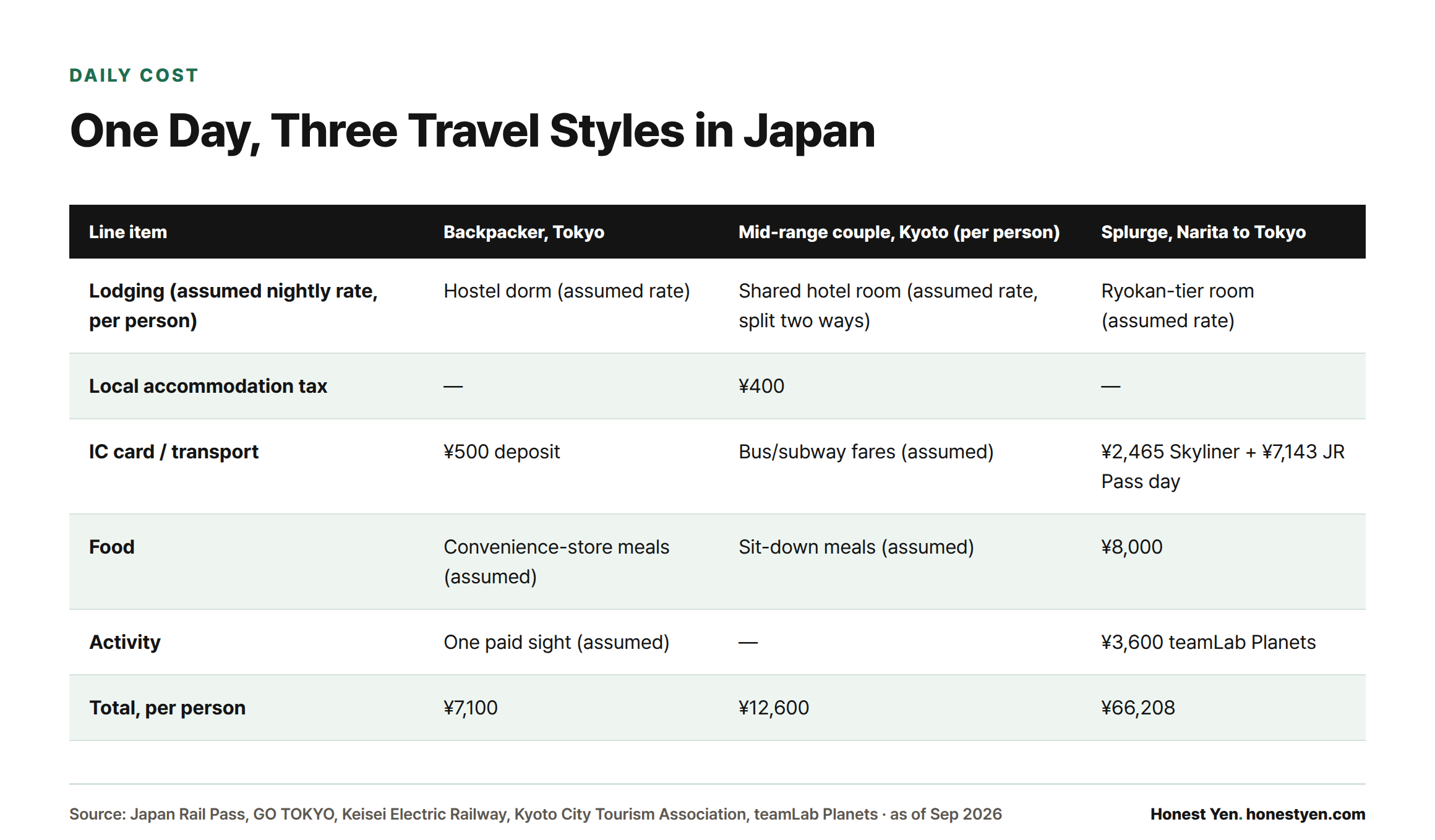
| Line item | Backpacker, Tokyo | Mid-range couple, Kyoto (per person) | Splurge, Narita to Tokyo |
|---|---|---|---|
| Lodging (assumed nightly rate, per person) | Hostel dorm (assumed rate) | Shared hotel room (assumed rate, split two ways) | Ryokan-tier room (assumed rate) |
| Local accommodation tax | — | ¥400[4] | — |
| IC card / transport | ¥500 deposit[2] | Bus/subway fares (assumed) | ¥2,465 Skyliner[3] + ¥7,143 JR Pass day[1] |
| Food | Convenience-store meals (assumed) | Sit-down meals (assumed) | ¥8,000 |
| Activity | One paid sight (assumed) | — | ¥3,600 teamLab Planets[7] |
| Total, per person | ¥7,100 | ¥12,600 | ¥66,208 |
The splurge column shows the arithmetic behind the biggest single item: a 7-day Ordinary Japan Rail Pass costs ¥50,000[1], and ¥50,000 ÷ 7 = ¥7,143 for one day of use.
Kyoto’s accommodation tax on a ¥15,000 room falls in the ¥6,000 to 19,999 band, charged at ¥400 per person per night[4].
In Kyoto, it pays to compare the one-day bus and subway pass against paying per ride. This Kyoto bus and subway pass breakdown runs those numbers before you go.
What pushes the price up
The 7-day Ordinary pass goes from ¥50,000 to ¥53,000, 14-day from ¥80,000 to ¥84,000, and 21-day from ¥100,000 to ¥105,000[1].
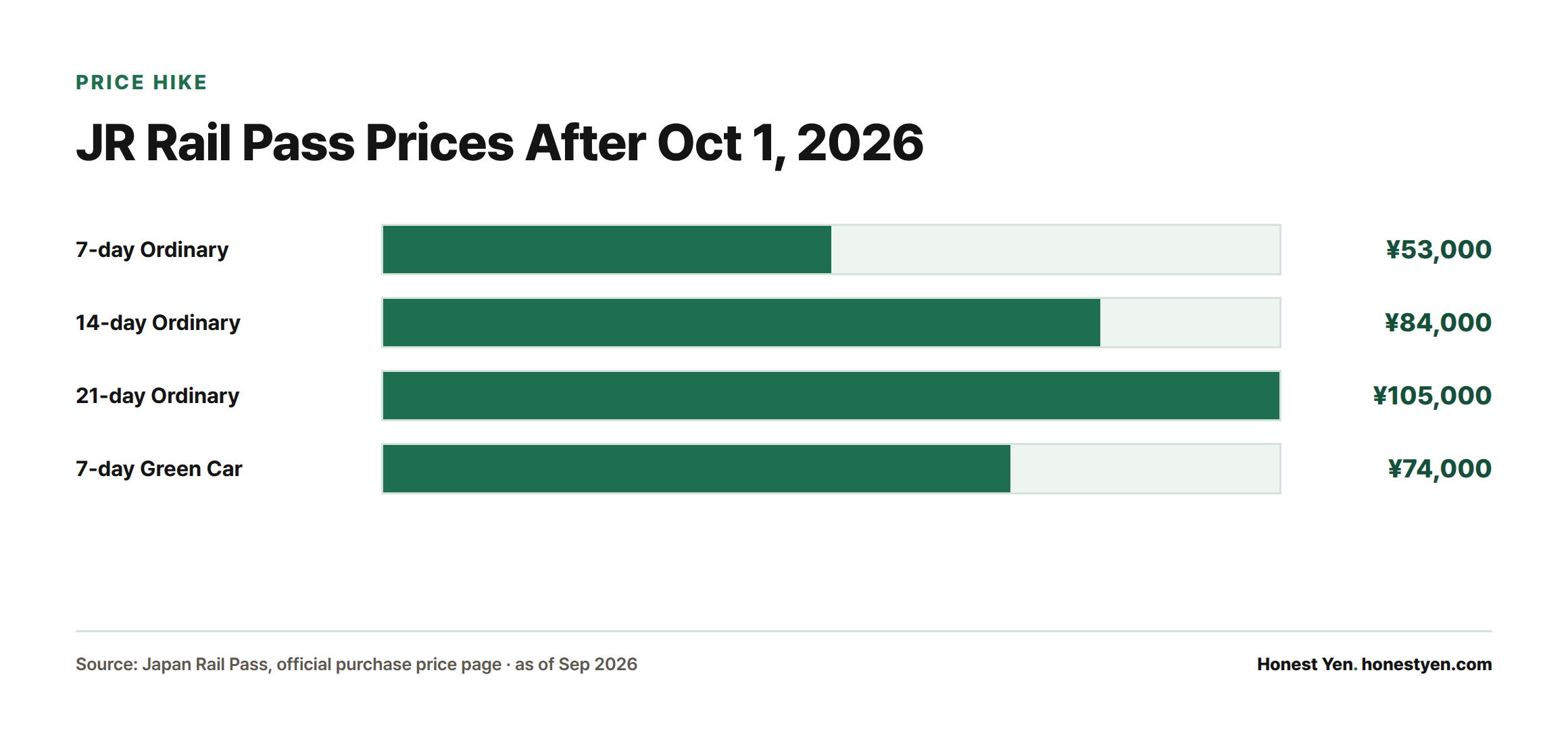
Green Car passes rise by similar amounts, with the 7-day Green pass going from ¥70,000 to ¥74,000[1].
Kyoto’s revised accommodation tax bands take effect March 1, 2026[5]. A stay priced at ¥100,000 or more per person per night now carries a ¥10,000 tax, against ¥200 for rooms under ¥6,000[4].
Osaka raised its own bands on September 1, 2025, with the top tier rising to ¥500 per person per night for rooms of ¥20,000 or more[6].
How to spend less
Buy IC card fares over cash where the difference is real: the Skyliner from Narita costs ¥2,465 by IC card against ¥2,470 by paper ticket[3].
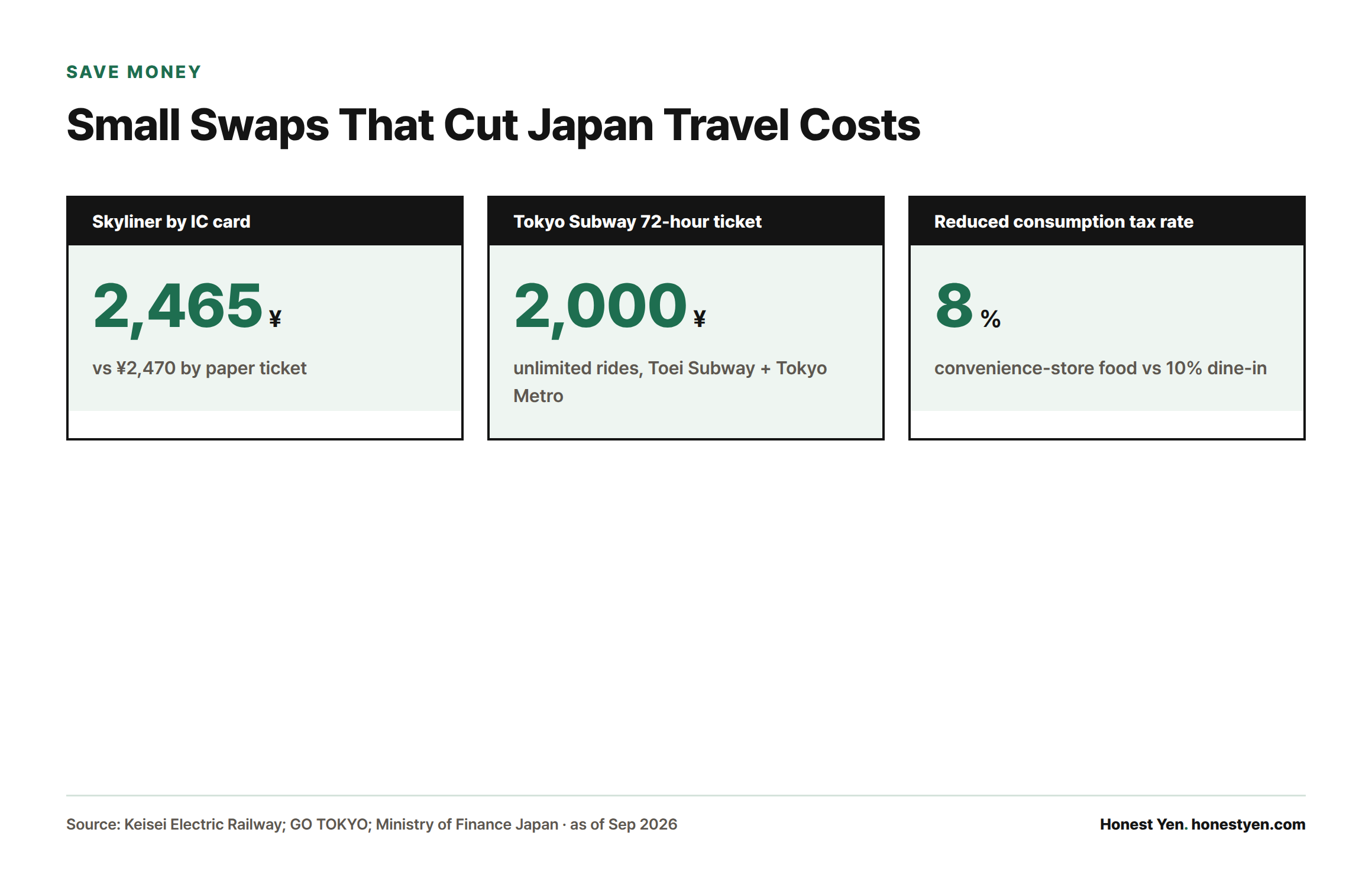
In central Tokyo, a Tokyo Subway 72-hour ticket costs ¥2,000 for unlimited rides on Toei Subway and Tokyo Metro lines, cheaper than paying per trip across three sightseeing days[2].
Convenience-store and takeaway food is taxed at Japan’s reduced 8% rate, against the 10% standard rate that applies to dine-in restaurant meals[8].
Anyone planning to use a Japan Rail Pass should buy it before September 30, 2026, since exchange orders bought by that date lock in the lower, pre-increase price[1].
A luxury week adds up to about ¥427,000 per person
A luxury week pairs 7 nights of ryokan-tier lodging with one 7-day Japan Rail Pass[1] and one teamLab Planets visit[7]. That adds up to roughly ¥427,000 per person: ¥45,000 × 7 nights, plus the ¥50,000 pass, plus ¥3,600 admission, plus food.
Japan’s own visitor survey shows a higher number than most estimates
Japan’s Tourism Agency reported that international visitors spent an average of ¥221,000 per person in the first quarter of 2026, over an average stay of 10.3 nights[10]. Actual visitor spending, once flights, shopping, and splurge nights are averaged in, lands closer to mid-range than to budget.
What changes in November 2026: tax-free shopping switches to a refund
Japan’s instant tax-free discount at the register runs until October 31, 2026[4].
From November 1, 2026, a revised refund method applies[4]. Shoppers pay the consumption tax at purchase, and customs refunds the tax-equivalent amount at the airport once officials confirm the goods are leaving Japan[9].
Since April 1, 2025, tax-free shopping has not applied when a buyer ships purchases home by international parcel, though store-arranged direct shipping can still qualify[9].
The practical effect for a 2026 trip budget is a cash-flow one: shoppers front the tax and collect it back before departure instead of seeing it discounted on the spot. A full breakdown of the arithmetic is in this tax-free math explainer.
Quick answers
Is $100 a day enough for Japan?
At roughly ¥7,100 for a backpacker day in Tokyo, hostel bed and one paid sight included, a $100 daily budget covers that style with room to spare. That holds at most exchange rates. It gets tighter once sit-down meals or paid transport passes are added most days.
How much cash should I bring for the first day?
Enough to cover the IC card’s ¥500 refundable deposit and one or two cash-only stops[2].
Some small shrines, family-run restaurants, and ryokan still take cash only, so carrying a mix rather than relying on a card alone is the safer default for day one.
Is the Japan Rail Pass still worth buying after the price rise?
For a single long-distance round trip, often not. For a multi-city itinerary using the pass most days, the per-day cost still beats buying individual tickets, even at the post-October 1 price of ¥53,000 for 7 days[1].
Sources
- Japan Rail Pass, official purchase price page
- GO TOKYO, IC cards and discount transport tickets
- Keisei Electric Railway, Skyliner fares from major stations
- Kyoto City Tourism Association, tax rules and accommodation tax bands
- Kyoto City Tourism Association, accommodation tax change notice
- Osaka Convention & Tourism Bureau, accommodation tax rate changes
- teamLab Planets TOKYO, official ticket store
- Ministry of Finance Japan, consumption tax rates
- Japan National Tourism Organization, Japan’s tax exemption system
- Travel Voice, Japan Tourism Agency visitor spending data, Q1 2026