Yen Exchange Fees in 2026: What Airport Counters, Cards, and ATMs Really Cost
As of late August 2026, the gap between the worst and best ways to turn dollars, euros, or pounds into yen is still wide enough to matter. Below are real rates pulled from official sources on the same day, not marketing claims about “90% preferential rates” or “zero fees” — so you can see exactly what each method costs on a typical exchange.
The short answer
Pay by card wherever possible using a card that doesn’t add its own foreign-transaction markup, and withdraw only the cash you actually need from a Seven Bank or Japan Post Bank ATM. Skip the airport currency counter except for a small emergency amount. That combination consistently lands closest to the mid-market rate — the “true” exchange rate before anyone adds a margin.
What each method actually costs
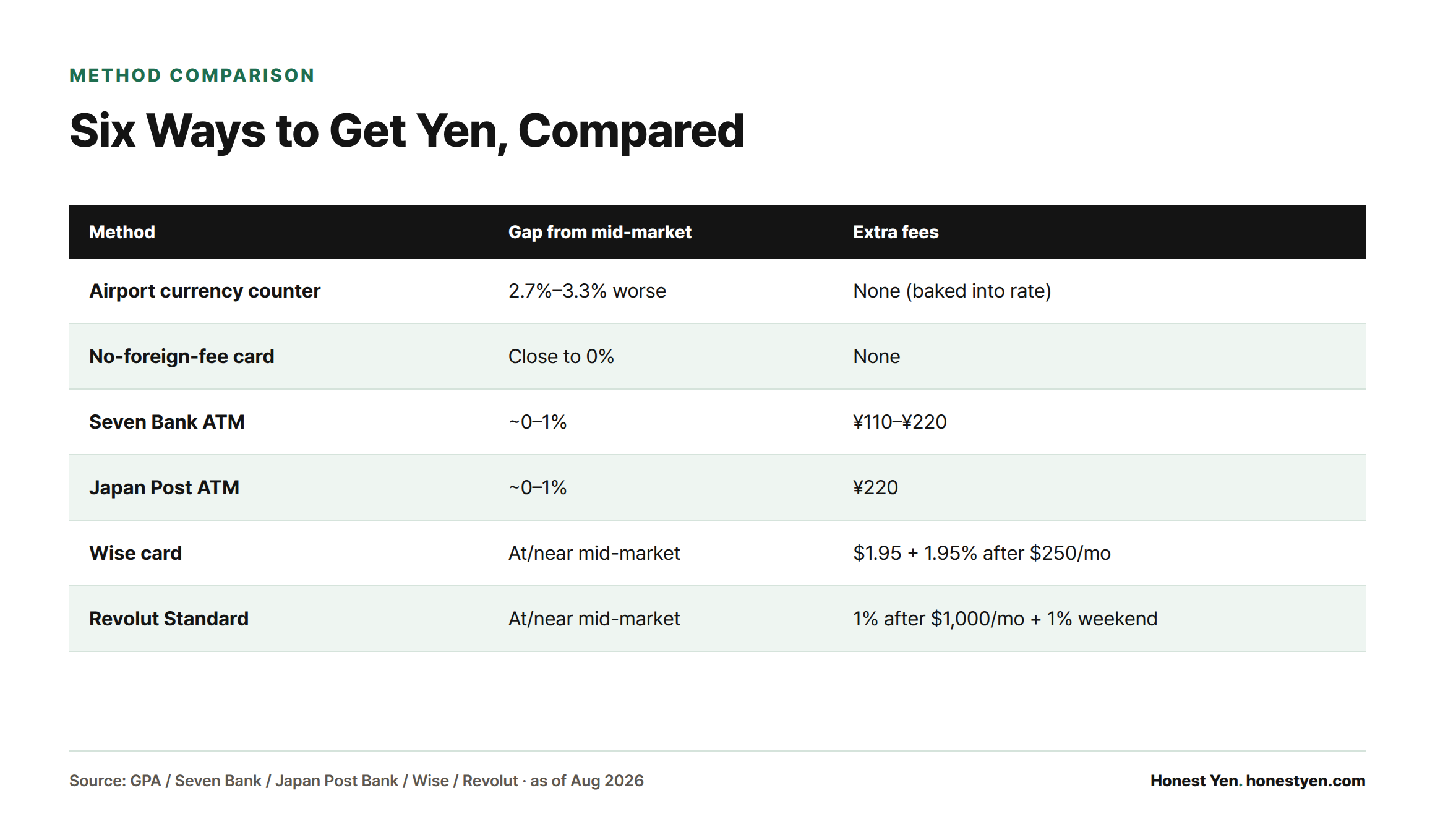
| Method | Gap from mid-market rate | Extra flat fees |
|---|---|---|
| Airport currency counter (cash) | About 2.7%–3.3% worse[1][2][3] | None, but it’s baked into the rate |
| Home bank branch counter | Varies by bank, often similar to airport counters | Sometimes a service fee on top |
| No-foreign-fee card, spent directly | Close to 0% (network rate) | None if issuer waives foreign transaction fees |
| Seven Bank / Japan Post ATM cash withdrawal | Near network rate (~0–1%) | ¥110–¥220 Seven Bank[4]; ¥220 Japan Post[5], plus any fee your own bank charges |
| Wise card | At or near mid-market | ATM: first $250/month free, then $1.95 + 1.95%[6] |
| Revolut (Standard plan) | At or near mid-market up to the allowance | Free exchange up to $1,000/month, 1% above it; 1% weekend surcharge[7] |
The real cost of exchanging at the airport
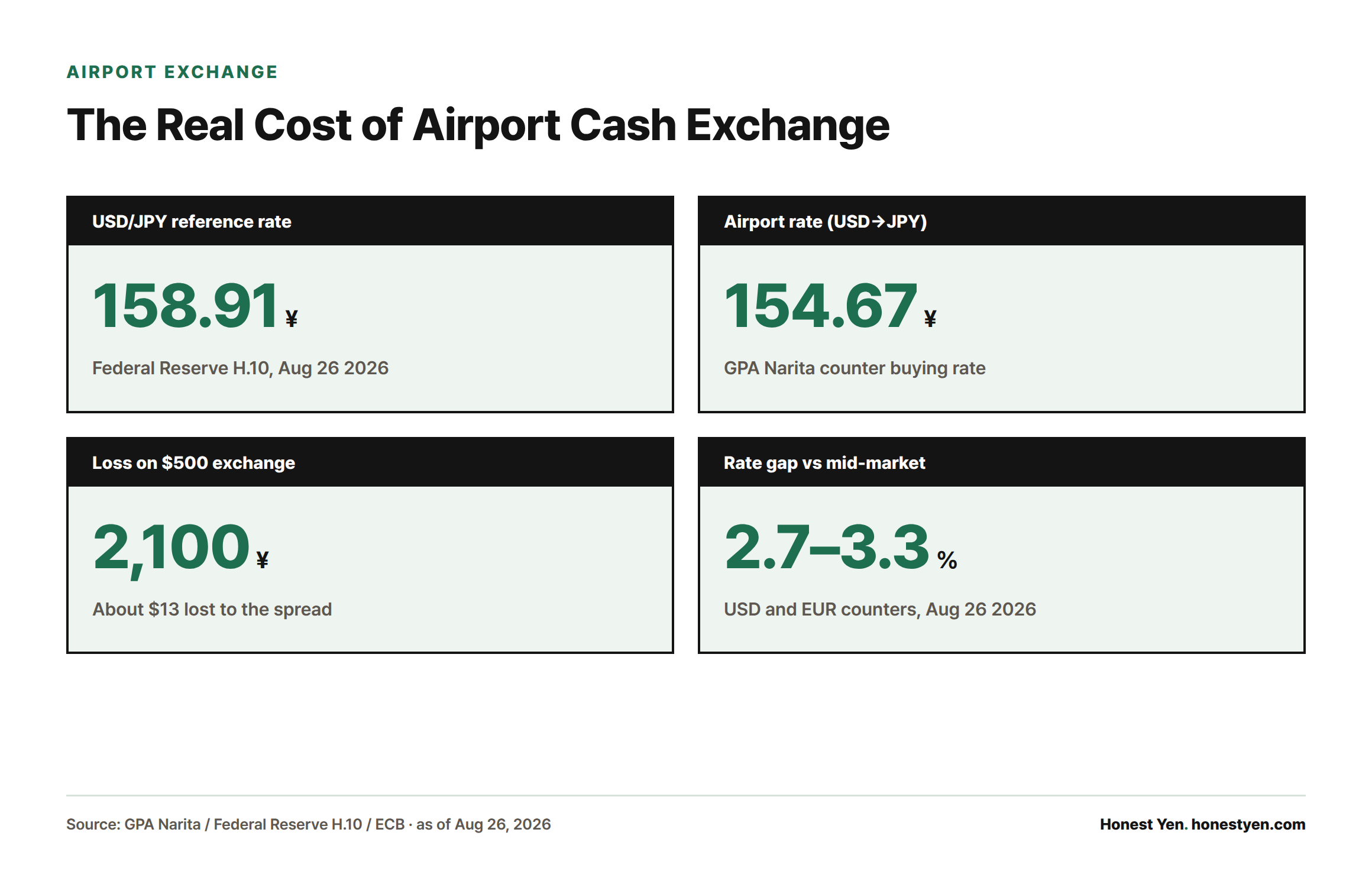
On August 26, 2026, Narita Airport’s GPA exchange counters were buying yen at ¥154.67 per US dollar and selling yen at ¥162.67 per dollar[1]. The US Federal Reserve’s most recent reference rate that week put the dollar at ¥158.91[2] — meaning a traveler converting $500 in cash at the airport received about ¥77,335 instead of the ¥79,455 the reference rate implies, a loss of roughly ¥2,100 (about $13) on a single exchange. The euro side is similar: GPA’s counter bought yen at ¥179.82 and sold at ¥191.82 per euro, against the European Central Bank’s same-day reference rate of ¥185.62[1][3] — a spread of roughly 3.1%–3.3% in either direction. Airport counters aren’t a scam; they’re simply pricing in convenience. It’s a reasonable place for a small top-up if you land with zero cash, not for your whole trip’s budget.
Wise vs Revolut for a Japan trip
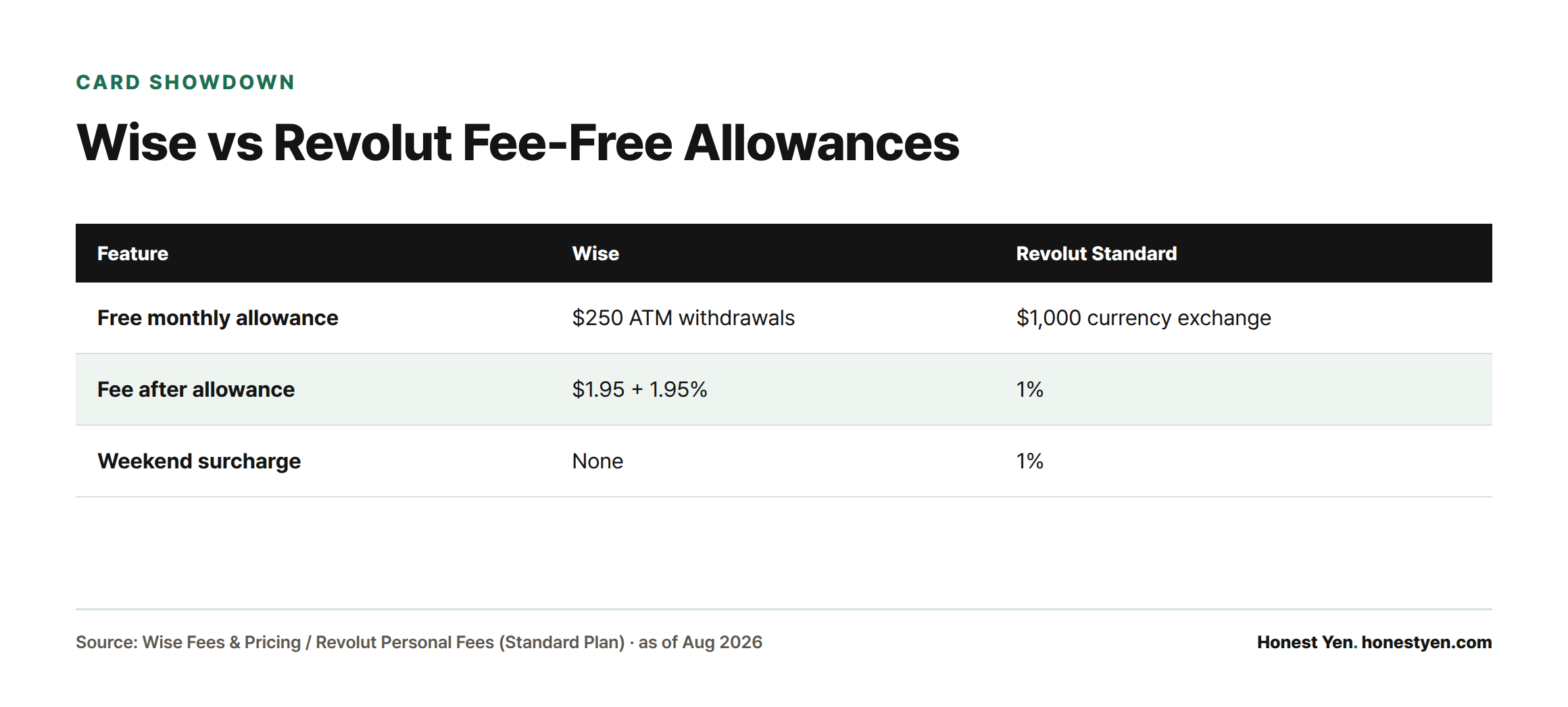
Both cards let you spend in yen at close to the mid-market rate and both are widely accepted for tap payments in Japan. The practical difference is in the free allowances. Wise gives $250 of fee-free ATM withdrawals per calendar month, then charges $1.95 plus 1.95% on the rest[6]. Revolut’s Standard plan allows up to $1,000 of fee-free currency exchange per month before a 1% fee kicks in, plus a 1% surcharge on weekend exchanges[7]. For a one-to-two-week trip where most spending is by card and cash withdrawals stay modest, either works out close to identical. If you expect to withdraw a lot of cash, Wise’s ATM allowance is the one to watch; if you’ll be converting a larger lump sum at once, Revolut’s monthly cap and weekend surcharge matter more.
Avoid the Dynamic Currency Conversion trap
At Japanese ATMs and some shops, you may be asked whether you want to be charged in yen or in your home currency. This is Dynamic Currency Conversion (DCC): the merchant, not your card network, sets that exchange rate, and Visa’s own guidance confirms it comes with its own markup and fees on top of the transaction[8]. Always choose to be charged in Japanese yen — your card issuer will apply its own conversion, which is almost always cheaper.
How much cash to actually bring
Japan is more cashless than it used to be, but Japan’s official tourism board still advises keeping cash on hand: IC transit cards can only be topped up with cash at ticket machines, and rural shops, small guesthouses, and some restaurants may not take cards at all[9]. A practical range is roughly ¥20,000–¥30,000 in cash for a 3–4 night city-based trip, and ¥40,000–¥60,000 for a week that includes rural stops or day trips — enough to cover IC top-ups (see our guide on paying at convenience stores in Japan), temple donation boxes, and the odd cash-only izakaya, while keeping the rest on a card. If you’re arriving with zero yen, complete your Visit Japan Web registration before departure so immigration and customs go quickly, then withdraw cash at a Seven Bank ATM in the arrivals area rather than the currency counter next to it.
When to exchange
There’s no reliably “best day” to exchange yen — daily currency swings are usually smaller than the 2–3% spread a bad exchange method already costs you, so timing the market matters far less than choosing the right method. The one timing rule worth following: don’t exchange a large amount at your home bank or the airport in the days right before departure out of habit. Set up your travel card and load it in advance, then convert only the small cash buffer you need close to departure.
Card vs cash withdrawal: which is cheaper
Card payment is almost always cheaper than withdrawing cash, because it skips the ATM operator’s flat fee entirely and still uses a near-mid-market rate if your card has no foreign transaction fee. Cash withdrawals make sense only for the portion of your budget you know will go to cash-only situations — IC card top-ups, rural transport, small traditional restaurants, and shrine or temple donations.
Frequently asked questions
How much yen should I exchange for a 3–4 day trip vs a week?
Roughly ¥20,000–¥30,000 in physical cash covers a short city trip’s cash-only needs; ¥40,000–¥60,000 is a safer buffer for a week, especially with rural stops. Keep the rest on a card.
Is exchanging at the airport really a bad deal?
Yes, measurably — on the sampled day above it cost about 2.7%–3.3% more than the reference rate, or roughly ¥2,100 lost on a $500 exchange[1][2][3]. It’s fine for a small emergency top-up, not your main exchange method.
Is card payment or ATM cash withdrawal cheaper?
Card payment, in almost every case — it avoids the ATM operator’s flat fee and typically prices closer to the mid-market rate.
Sources
- GREENPORT AGENCY (Narita Airport currency exchange), Today’s Exchange Rate
- Federal Reserve Board, Foreign Exchange Rates (H.10)
- European Central Bank, Euro Foreign Exchange Reference Rates
- Seven Bank, Notice on ATM Fees for Overseas-Issued Visa/PLUS Cards
- Japan Post Bank, International ATM Service
- Wise, Fees & Pricing
- Revolut, Personal Fees (Standard Plan)
- Visa, Dynamic Currency Conversion Explained
- Japan National Tourism Organization, Cashless Payments in Japan