Beppu Day Trip From Fukuoka: The Hell Tour + Onsen Itinerary, Minute by Minute (August 2026)
This post may contain affiliate links. If you book or buy through them, we may earn a commission at no extra cost to you.
A Beppu day trip from Fukuoka means roughly 4 to 5 hours on buses or trains before you’ve seen a single hot spring. That math scares a lot of travelers off, but it is doable if you start early, pick 3 to 5 of the seven “hells” instead of all of them, and lock in one onsen instead of hopping between several. Below is a realistic, hour-by-hour version of that plan, as of August 2026.
The recommended course at a glance
Take the earliest highway bus or JR Sonic limited express out of Fukuoka, join the sightseeing bus that loops through the hells, eat lunch and try jigoku-mushi (hell-steamed) cooking in Kannawa, then finish with one sand-bath or regular onsen near Beppu Station before heading back. That single loop covers the two things people actually come to Beppu for — the hells and a real bath — without the backtracking that eats up a day-tripper’s clock.
Is a Beppu day trip from Fukuoka actually realistic?
Do the transit math before you commit. The nonstop highway bus between Fukuoka (Hakata Bus Terminal / Tenjin) and Beppu takes about 2 hours 20 minutes each way and costs ¥3,250 one-way (from ¥2,950 with the online advance-purchase discount), with a schedule and fare revision effective September 1, 2026[1]. The JR Sonic limited express is faster at roughly 2 hours 1 minute, with a standard non-reserved fare of ¥6,380 (¥4,180 base fare + ¥2,200 limited express charge), or from ¥2,950 with a non-refundable advance online ticket[2].
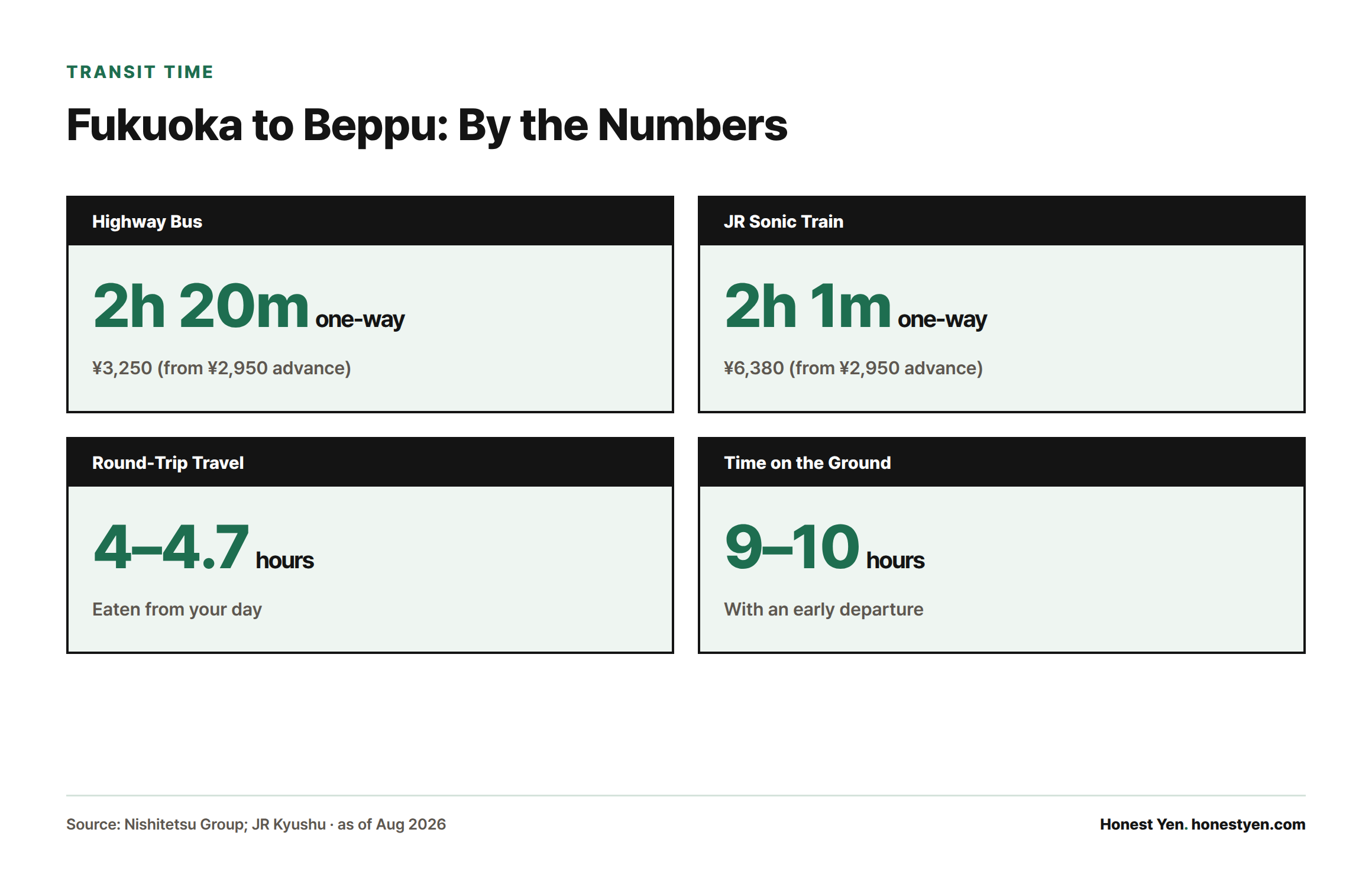
Either way, round-trip travel eats 4 to 4.7 hours of your day. Catch one of the first departures (buses run from around 6:30 AM) and you land in Beppu before 9 AM with roughly 9 to 10 hours on the ground before the last practical evening departure. That is enough time for the hell tour, lunch, and one onsen — but not for all seven hells plus multiple bath houses plus the ropeway. Treat this as a full, early-to-late day, not a leisurely one. If you’d rather not commute both ways in one day, an overnight in Beppu removes the time pressure entirely (see the FAQ below).
The Seven Hells: which ones actually earn a stop
Beppu’s “hells” (jigoku) are boiling, mineral-colored hot spring pools you view rather than bathe in. There are seven, and four — Umi Jigoku, Shiraike Jigoku, Chinoike Jigoku, and Tatsumaki Jigoku — are designated National Scenic Spots[3]. Most sit in the Kannawa and Shibaseki districts, a short bus ride from Beppu Station.
| Hell | Highlight |
|---|---|
| Umi Jigoku (Sea Hell) | Cobalt-blue pool, the most photographed of the seven |
| Chinoike Jigoku (Blood Pond Hell) | Vivid red pool, iconic image of Beppu |
| Tatsumaki Jigoku (Tornado Hell) | Geyser that erupts on a cycle, not continuously |
| Shiraike Jigoku (White Pond Hell) | Milky-white pool with an aquarium annex |
| Oniyama Jigoku (Demon Mountain Hell) | Crocodile enclosure heated by the spring |
| Kamado Jigoku (Oven Hell) | Multiple small pools, easy walk-through layout |
| Bouzu Jigoku (Monk’s Head Hell) | Bubbling grey mud pools |
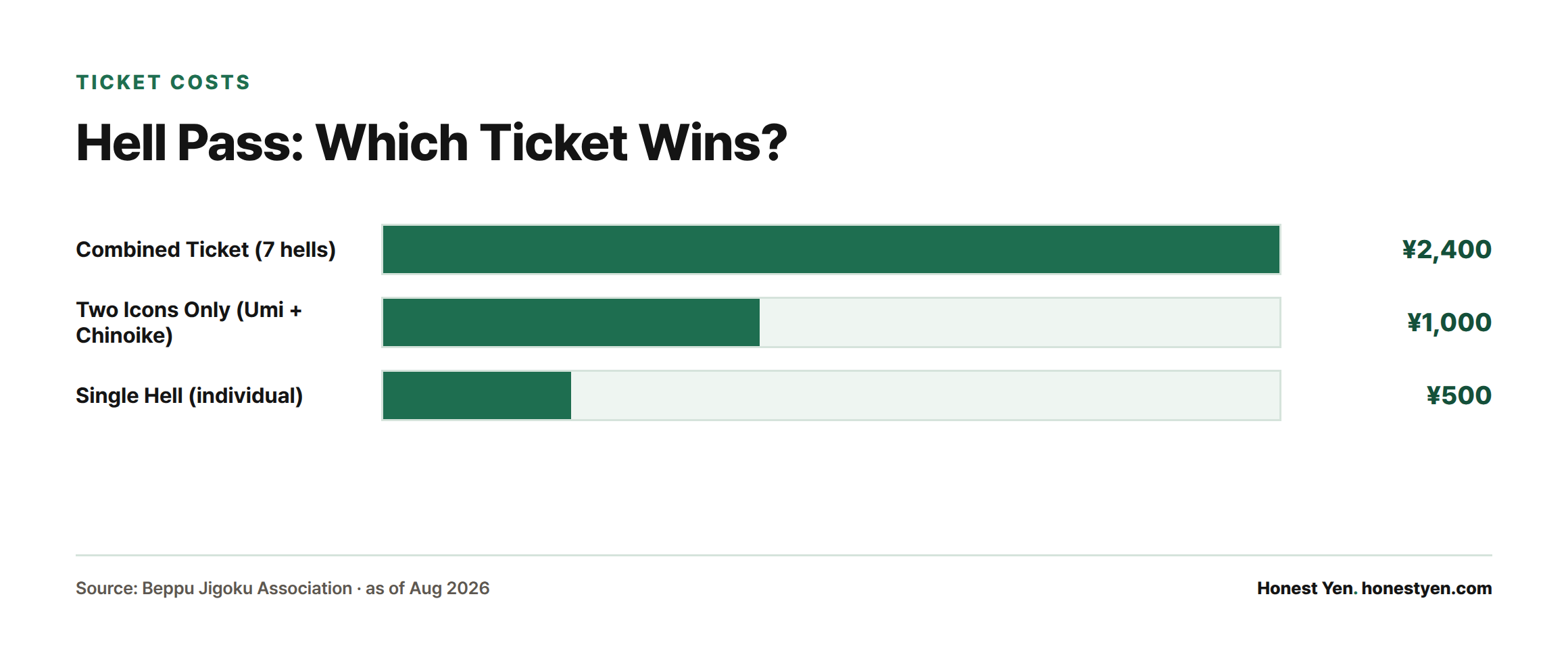
A combined ticket covering all seven costs ¥2,400 for adults and ¥1,200 for children (elementary/middle school), valid for two days from purchase; hours are 8:00 AM to 5:00 PM year-round[4]. Individual entry runs ¥500 for adults and ¥250 for children per hell[4]. Do the arithmetic before buying: five or more individual tickets already costs more than the combined pass, so if you’re visiting five or more hells, buy the combined ticket. If you’re short on time, skipping straight to Umi Jigoku and Chinoike Jigoku — the two most photographed and both National Scenic Spots — costs ¥1,000 combined and takes under 90 minutes including transfers, which suits a tight day-trip schedule better than chasing all seven.
Sightseeing bus vs. riding city buses yourself
Kamenoi Bus runs a guided sightseeing bus that loops through all seven hells in about 3 hours, departing Kitahama Bus Center at 9:10 AM or 1:50 PM and Beppu Station’s east exit shortly after[5]. The fare is ¥4,500 for adults and already includes admission to all seven hells, so it works out close to what you’d pay for the combined ticket plus a taxi. Advance reservation is required — bookings open two months ahead and the bus does sell out, so reserve by phone (0977-23-5170) or through the operator’s booking site before you travel[5]. E-ticket resellers also sell the standalone hells combined ticket online if you’d rather skip the ticket counter[6].
The trade-off: the guided bus is fixed-pace and doesn’t stop long enough to linger, and if it’s sold out for your date, you’re on regular city buses, which run frequently between Beppu Station/Kitahama and the Kannawa hell cluster but require you to navigate stops and buy hell tickets yourself. For a first visit on a tight day-trip clock, the sightseeing bus removes the guesswork; if you want to linger at one or two hells, do it yourself by city bus.
Lunch and the jigoku-mushi steam-cooking experience
Kannawa, the hub for most of the hells, is also where “jigoku-mushi” (hell-steamed) cooking comes from — food cooked in baskets set over natural steam vents. Jigokumushi Kobo Kannawa, the best-known public facility, is open 10:00 AM–7:00 PM (last order 6:00 PM), closed the third Wednesday of each month[7]. No reservation is needed or accepted — take a numbered ticket at the entrance and steam your own food or a pre-set course; steaming baskets run ¥340 (small) to ¥550 (large) for 20 minutes, with pre-set meals like the “jigoku-mushi tamatebako” around ¥2,100[7]. Budget 45–60 minutes including the walk-in wait, which can stretch at midday.
Finish with an onsen: what actually fits a day trip
Sand baths (suna-yu) are the fastest way to get an authentic Beppu bath experience into a tight schedule. Takegawara Onsen, a 10-minute walk from Beppu Station, is the most convenient for a day-tripper: the sand bath costs ¥1,500, is open 8:00 AM–10:30 PM (last entry 9:30 PM), and is closed the third Wednesday of each month[8]. Budget 40–50 minutes total — about 15 minutes buried in hot sand, plus changing and rinsing off before and after. Its regular indoor bath is separate and costs ¥300. If Kannawa is more convenient than backtracking to the station, the beachfront Beppu Kaihin Suna-yu sand bath near Shoningahama is the other well-known option, though it sits farther from the hells cluster and adds travel time.
Minute-by-minute itinerary
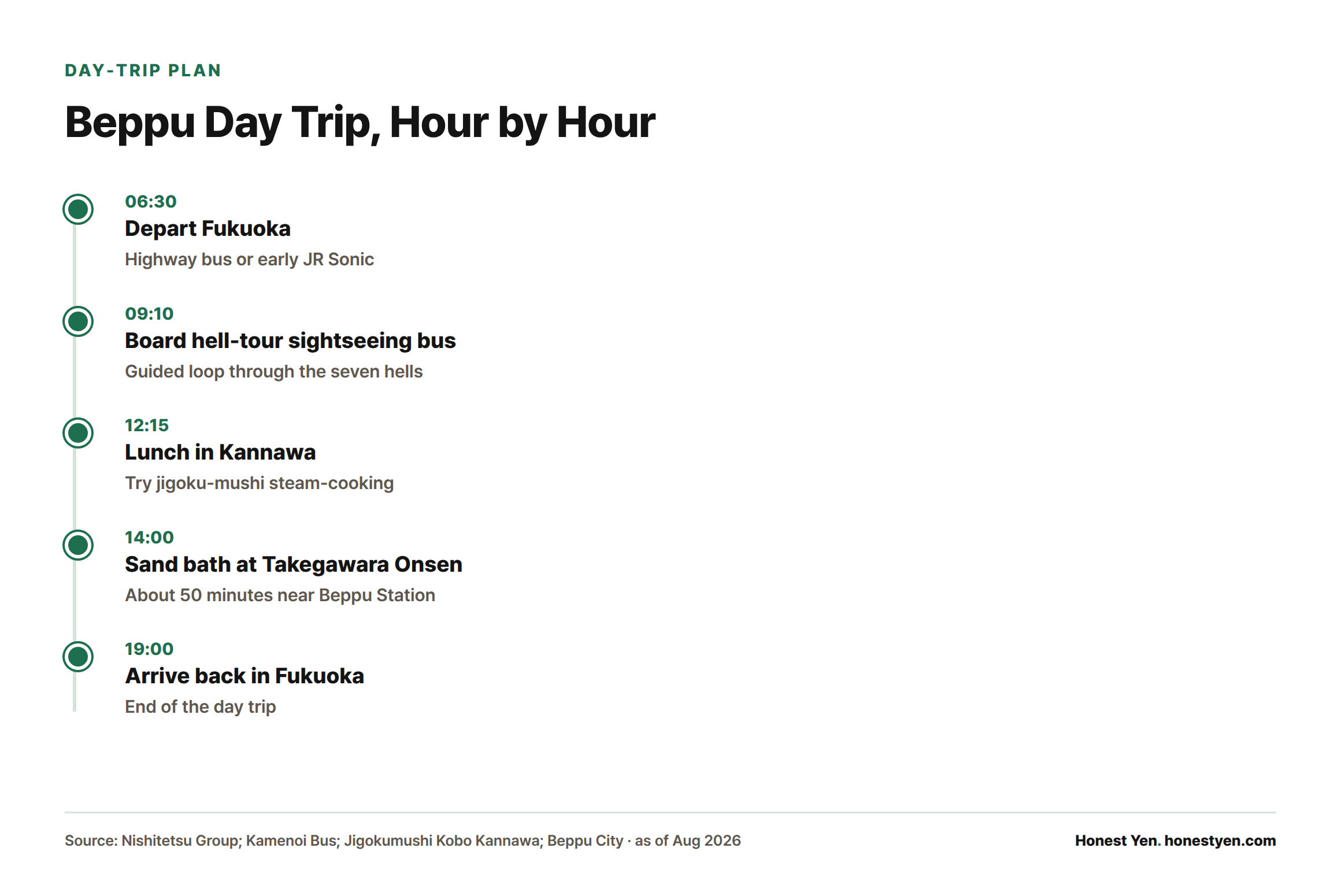
This is a realistic single-day template built around confirmed travel times and opening hours. Treat the clock times as illustrative and check the live timetable close to your travel date.
| Time | What to do |
|---|---|
| 06:30 | Depart Fukuoka (Hakata Bus Terminal, nonstop highway bus) or catch an early Sonic from Hakata Station |
| 08:50–09:00 | Arrive Beppu (Kitahama Bus Center / Beppu Station) |
| 09:10 | Board the Kamenoi hell-tour sightseeing bus (reserved in advance) |
| 09:10–12:10 | Guided loop through the seven hells, returning to Kitahama/Beppu Station |
| 12:15–13:15 | Lunch and jigoku-mushi steam-cooking in Kannawa |
| 13:15–13:45 | Bus back toward Beppu Station |
| 14:00–14:50 | Sand bath at Takegawara Onsen |
| 15:00–16:30 | Free time: Beppu Ropeway, shopping street, or a second onsen if time allows |
| 17:00–18:00 | Depart Beppu for the return bus or train |
| 19:00–20:30 | Arrive back in Fukuoka |
Beppu Ropeway and other add-ons
If your timetable leaves a gap, the Beppu Ropeway climbs Mount Tsurumi in about 10 minutes and is roughly 15 minutes by car or taxi from Beppu Station. Round-trip fare is ¥1,800 for adults (¥1,200 one-way); hours run seasonally, with the last ascent in the late afternoon[9]. It only fits a day trip if you skip either a second onsen or a few of the hells — don’t try to stack all three.
Booking your transport
For the highway bus, book online through the operator’s site or a reservation platform, especially for early-morning and Friday/weekend departures, which fill up. If a Fukuoka-Beppu day trip is part of a longer Kyushu loop, it’s worth comparing against routes like the Fukuoka–Yufuin highway bus, since some travelers combine Beppu with a Yufuin stop instead of returning to Fukuoka the same day. For the train, JR Kyushu’s own booking site offers the cheapest advance fares (from ¥2,950), but those tickets are locked in once purchased, so only use them if your return time is fixed. If you’re staying in Fukuoka the night before, departure point matters: Hakata Bus Terminal and Hakata Station both work for the bus and train respectively, while Tenjin adds a short subway ride first — see our guide to where to stay in Fukuoka if you haven’t booked a base yet.
FAQ
Is a Beppu day trip from Fukuoka really doable?
Yes, but only with an early start (first bus/train around 6:30 AM) and a trimmed itinerary — the hell tour, lunch, and one onsen. Trying to also fit the ropeway and a second bath in the same day usually means cutting hells instead.
Do I need to see all seven hells?
No. If you’re pressed for time, Umi Jigoku and Chinoike Jigoku alone cover the two most iconic sights for ¥1,000 combined. The full combined ticket (¥2,400) only pays off once you’re visiting five or more.
Sightseeing bus tour or public buses?
The guided sightseeing bus is easier for a first-time, single-day visit since it bundles transport and admission and removes route-planning, but it must be reserved in advance and can sell out. Public buses are cheaper and more flexible if the tour is full or you want to linger.
Can I fit an onsen bath into a day trip?
Yes — budget under an hour for a sand bath. Takegawara Onsen, near Beppu Station, is the most time-efficient option since it doesn’t require a detour.
Does the jigoku-mushi cooking studio need a reservation?
No. Jigokumushi Kobo Kannawa doesn’t accept reservations; you take a numbered ticket on arrival, so build in wait-time buffer around lunch hours.
Day trip vs. overnight — which is better?
A day trip works if you’re based in Fukuoka and want a taste of the hells plus one bath. An overnight in Beppu (or nearby Yufuin) is the better choice if you want to try multiple onsen facilities, soak at night, or add the ropeway without rushing.
Sources
- Nishitetsu Group, Fukuoka–Oita/Beppu highway bus (Toyo no Kuni-go) fares and schedule
- JR Kyushu, Sonic limited express Fukuoka–Oita/Beppu route information
- Visit Oita (official Oita Prefecture tourism site), Beppu Jigoku Meguri overview
- Beppu Jigoku Association, admission fees and hours
- Kamenoi Bus, Jigoku Meguri sightseeing bus tour details
- Yunotabi, Beppu Jigoku combined ticket information
- Jigokumushi Kobo Kannawa, official site (hours, menu, policy)
- Beppu City, Takegawara Onsen official information
- Visit Oita (official Oita Prefecture tourism site), Beppu Ropeway fares and access