teamLab Planets vs Borderless: The Real Cost Comparison

Key takeaways
- Pick teamLab Planets for a single Tokyo visit if you want a barefoot, physical experience rather than a purely visual one.
- Planets adult tickets start at ¥4,000[1] and Borderless adult tickets start at ¥3,800[4], so Borderless is not automatically the pricier venue.
- Figures below come from teamLab’s own ticket store and Tokyo’s official tourism site, as of September 2026.
This post may contain affiliate links. If you book or buy through them, we may earn a commission at no extra cost to you.
Planets wins if you only have one day
Pick teamLab Planets first. It is barefoot and wet, and the art responds to your body instead of staying on a screen you view from a distance.
Pick teamLab Borderless instead if scale and photography matter more than getting wet, or if Planets has no slot left for your date.
Both museums sit in Tokyo. Neither ticket works with a Japan Rail Pass, and IC cards such as Suica or Pasmo only cover the trains getting you there, not admission.
Planets and Borderless prices, side by side
The table below combines teamLab’s ticket store and Tokyo’s official tourism listings into one comparison.
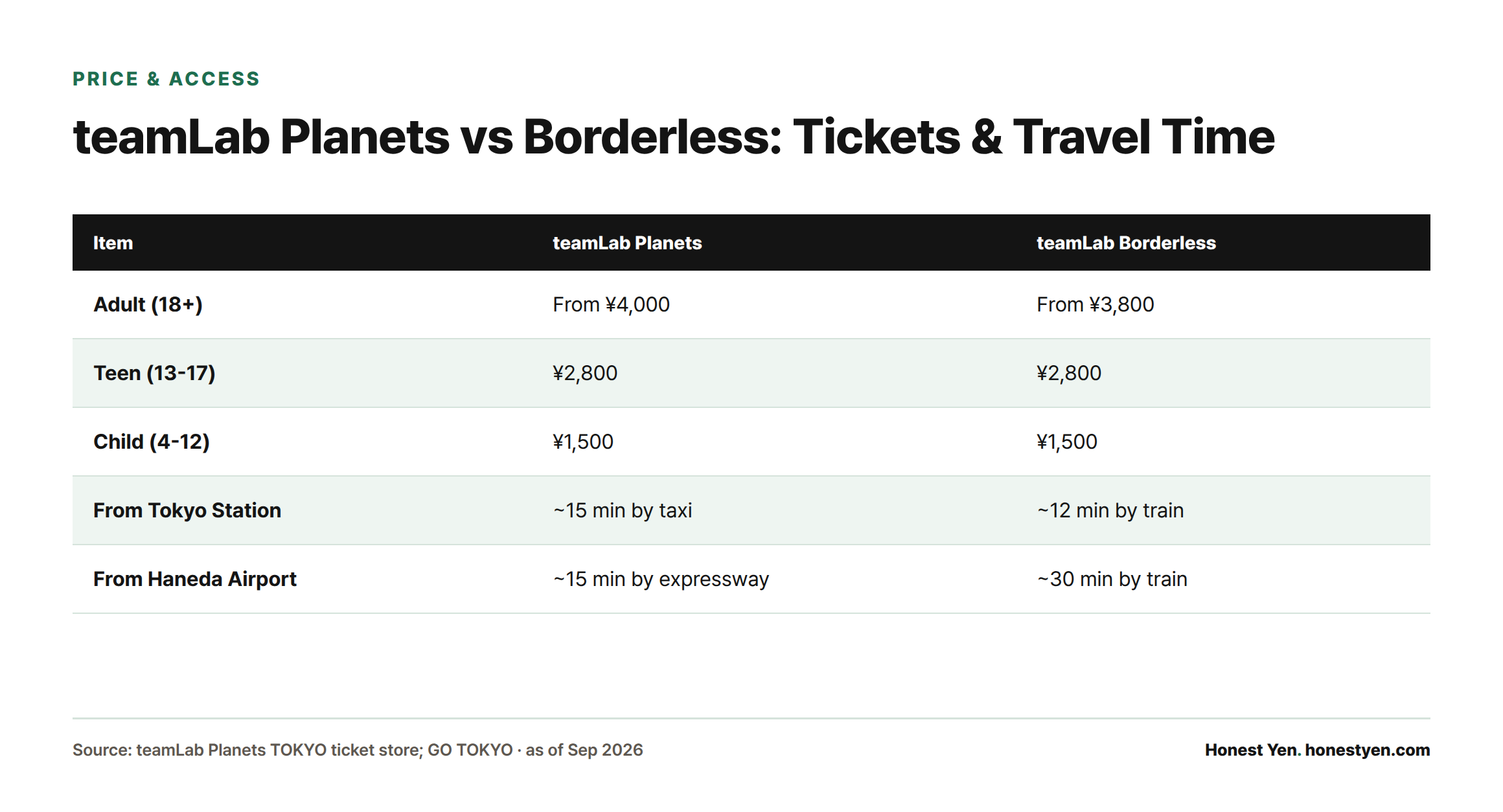
| Item | teamLab Planets | teamLab Borderless |
|---|---|---|
| Adult (18+) | From ¥4,000[1] | From ¥3,800[4] |
| Teen (13-17) | ¥2,800[1] | ¥2,800[4] |
| Child (4-12) | ¥1,500[1] | ¥1,500[4] |
| Youngest children | Not listed | Age 3 and under: free[4] |
| Disability discount | From ¥2,000[1] | — |
| On-site purchase surcharge | — | +¥200[4] |
| Opening hours | Last entry 60 min before close[3] | 9:00–21:00[4] |
| From Tokyo Station | About 15 min by taxi[2] | About 12 min by train[4] |
| From Haneda Airport | About 15 min by expressway[2] | About 30 min by train[4] |
| Location | Toyosu, Koto City[3] | Azabudai Hills, Minato City[4] |
Planets also sells a ¥12,000 Premium Pass[1] covering ages 4 and up.
Planets is wet and physical, Borderless is dry
Planets is built so guests walk through water[1], immersing their whole body in installations that change with each visitor’s movement.
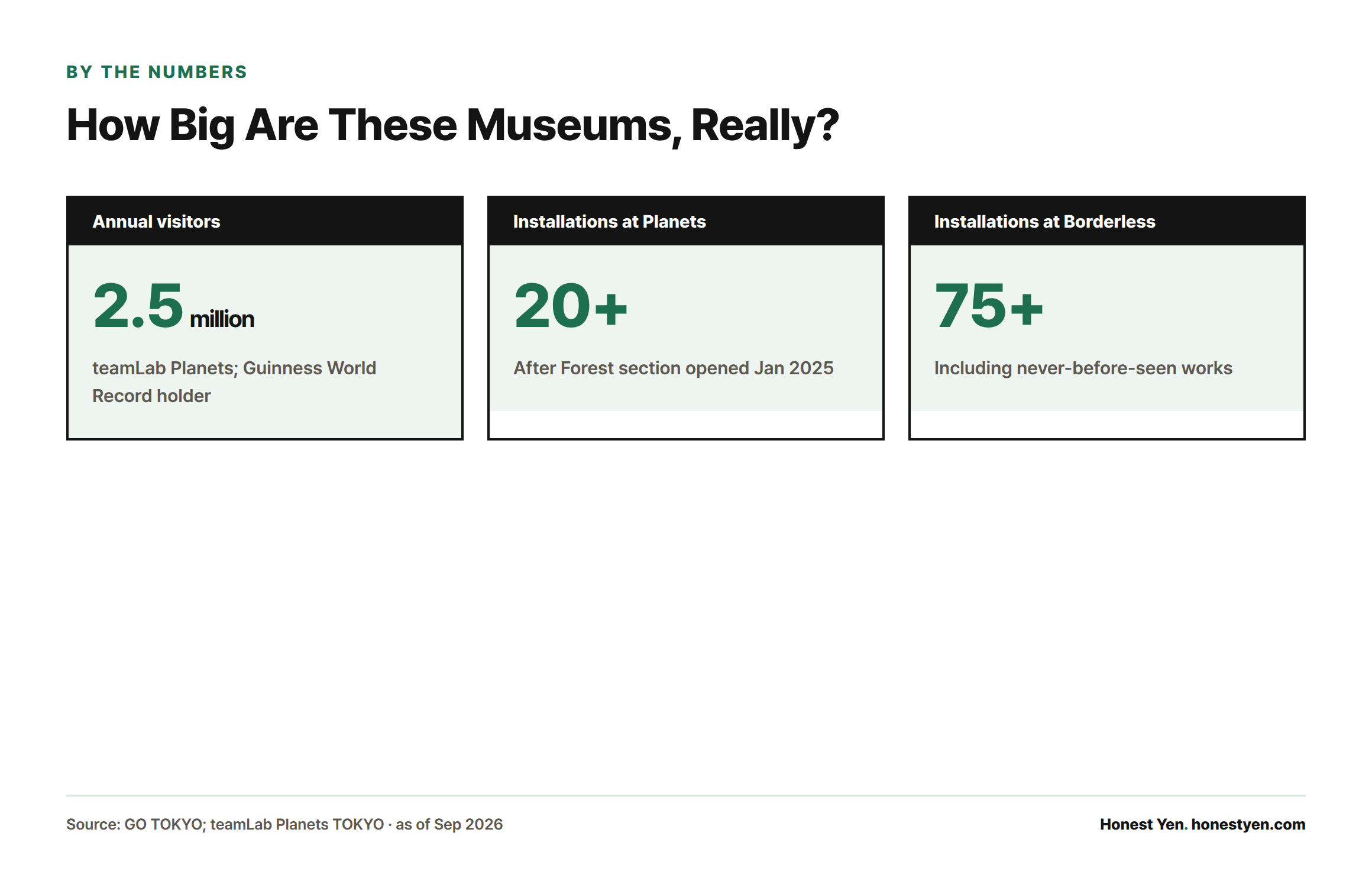
A Forest section with three educational zones opened at Planets in January 2025[3], bringing the museum to more than 20 art installations.
teamLab Planets draws over 2.5 million visitors a year and holds the Guinness World Record for the most visited museum dedicated to a single group or artist.[3]
Borderless is a “museum without a map” built from projection rooms[4], with more than 75 works, including several never-before-seen pieces.
Both venues sell dynamic-priced tickets in advance
Borderless recommends buying tickets online ahead of your visit and adds an on-site purchase fee of ¥200.[4]
Planets confirms your slot by emailing a QR-code ticket two days before your visit date, so entry is tied to a specific date and time.[1]
Both venues price tickets by date rather than a flat rate, so the same adult ticket can move higher or lower depending on which day you book.[1]
That kind of on-site markup shows up in other parts of Japan travel too, as detailed in How Much Extra Will You Really Pay in Japan? Four Hidden Fees, With the Math.
What teamLab actually costs, worked out
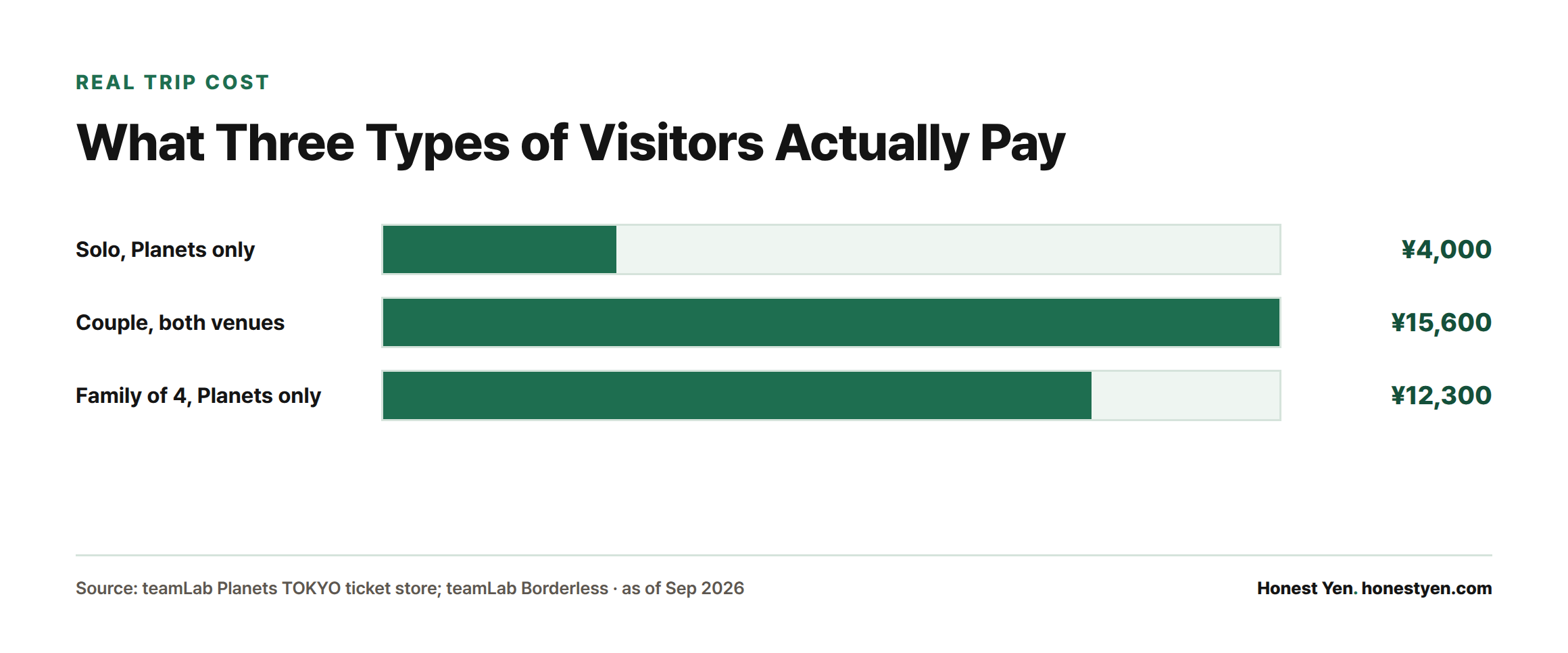
Starting prices are not the same as what a real visit costs. Here are three scenarios built from the prices above.
| Item | Solo, Planets only | Couple, both venues, separate days | Family of 4, Planets only |
|---|---|---|---|
| Adult tickets | 1 × ¥4,000 | 2 × ¥4,000 + 2 × ¥3,800 | 2 × ¥4,000 |
| Teen ticket (age 15) | — | — | 1 × ¥2,800 |
| Child ticket (age 8) | — | — | 1 × ¥1,500 |
| Total | ¥4,000 | ¥15,600 | ¥12,300 |
The solo visitor pays for one Planets adult ticket, ¥4,000.[1]
The couple’s total adds two Planets adult tickets to two Borderless adult tickets: ¥4,000 × 2 + ¥3,800 × 2 = ¥15,600.[1][4]
The family of 4 pays two adult tickets plus one teen and one child ticket at Planets: ¥4,000 × 2 + ¥2,800 + ¥1,500 = ¥12,300.[1]
For how these totals fit into a wider Tokyo budget, see Japan Trip Cost by Travel Style: The 2026 Numbers, Sourced and Dated.
Pick Planets or Borderless by traveler type
Pick Planets if you’re a couple or solo traveler on a first Tokyo trip and want one physical, barefoot memory rather than a long photo session.
Pick Planets if you’re traveling with children aged 4 to 12, since the water rooms suit shorter visits and the child ticket is the same ¥1,500 at either venue.[1][4]
Pick Borderless if you’re a photographer chasing large, dry rooms, since more than 75 installations give more compositions per hour than Planets’s smaller footprint.[4]
Pick Borderless if a Planets slot is sold out for your date, since the two museums cover different artworks despite sharing the same art collective.
Both venues fit in one Tokyo trip
Doing both is realistic on the same trip if you split them across separate days. Each visit takes a half day, and travel between the two adds real time.
From Tokyo Station, Planets is about 15 minutes by taxi[2], while Borderless is about 12 minutes away by train via Kamiyacho Station.[4]
The extra cost of doing both is one more adult ticket, ¥3,800 to ¥4,000 depending on which venue you add second.[1][4]
Barefoot rules, wet clothes and what to bring
Both museums are barefoot, timed-entry experiences, so shoes go into a locker at the door.
At Planets, water reaches knee height in some rooms, so clothing gets wet. Planets provides rental garments rather than leaving shorts optional, and a spare towel is worth packing for your legs and feet.
Planets lists a discounted disability ticket starting at ¥2,000.[1]
Do Planets and Borderless show the same artworks?
No. Planets is a water-and-forest space in Toyosu built around full-body immersion[1], while Borderless is a separate projection-based museum in Azabudai Hills with more than 75 of its own works.[4]