Japan Train Travel With Kids: Fares, Ages, and Passes
This post may contain affiliate links. If you book or buy through them, we may earn a commission at no extra cost to you.
Japan’s railways set the child fare age band at 6 to 11, with kids under 6 riding free unless they occupy a seat.[2]
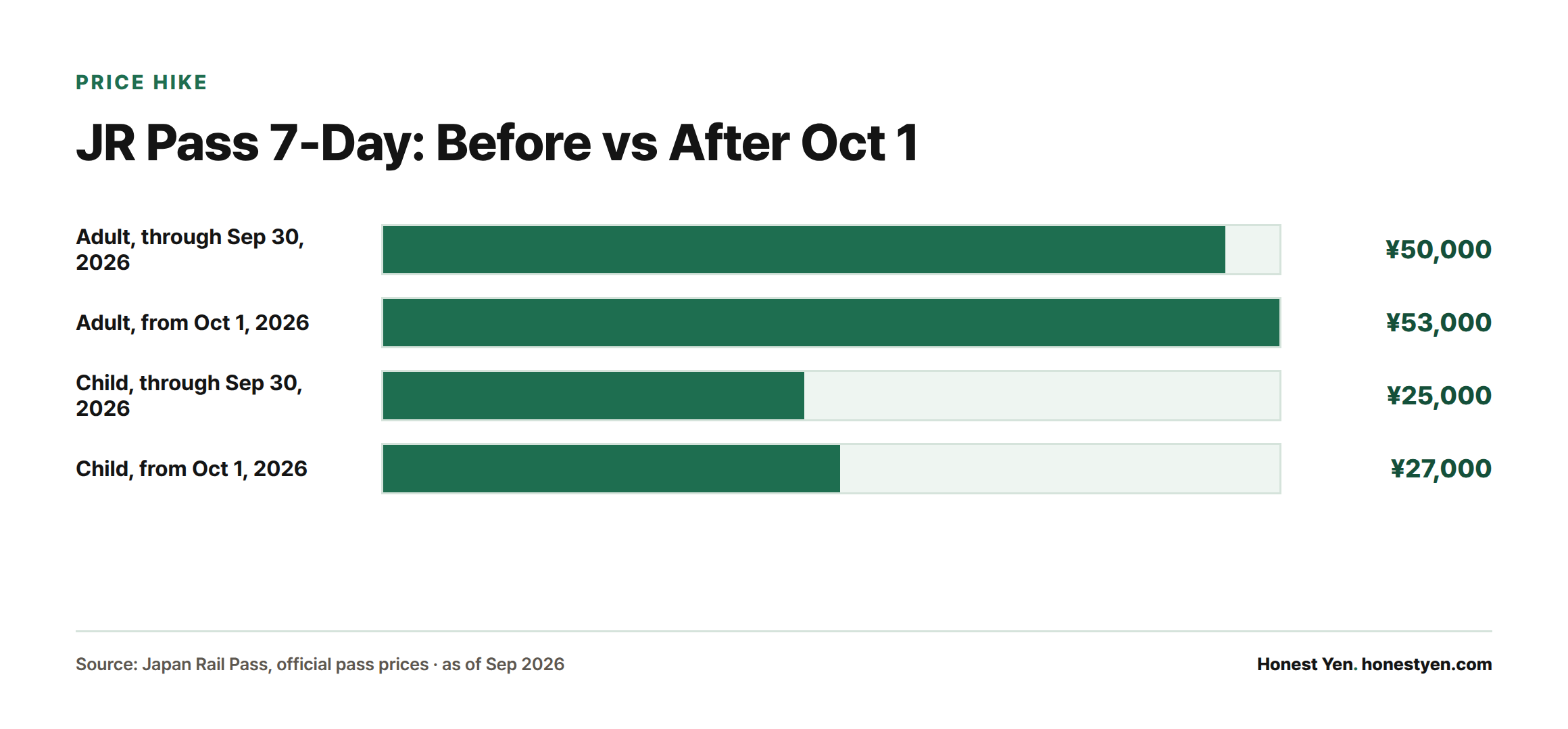
As of September 2026, that age rule stays fixed, but the nationwide Japan Rail Pass gets more expensive on October 1, 2026, which changes the math for multi-city family trips.[1]
| Japan Rail Pass (7-day, Ordinary) | Adult | Child |
|---|---|---|
| Through September 30, 2026[1] | ¥50,000 | ¥25,000 |
| From October 1, 2026[1] | ¥53,000 | ¥27,000 |
Who counts as a baby, child, or adult
JR Central splits riders into four bands: babies under 1, infants 1 to 5, children 6 to 11, and adults 12 and up.[2]
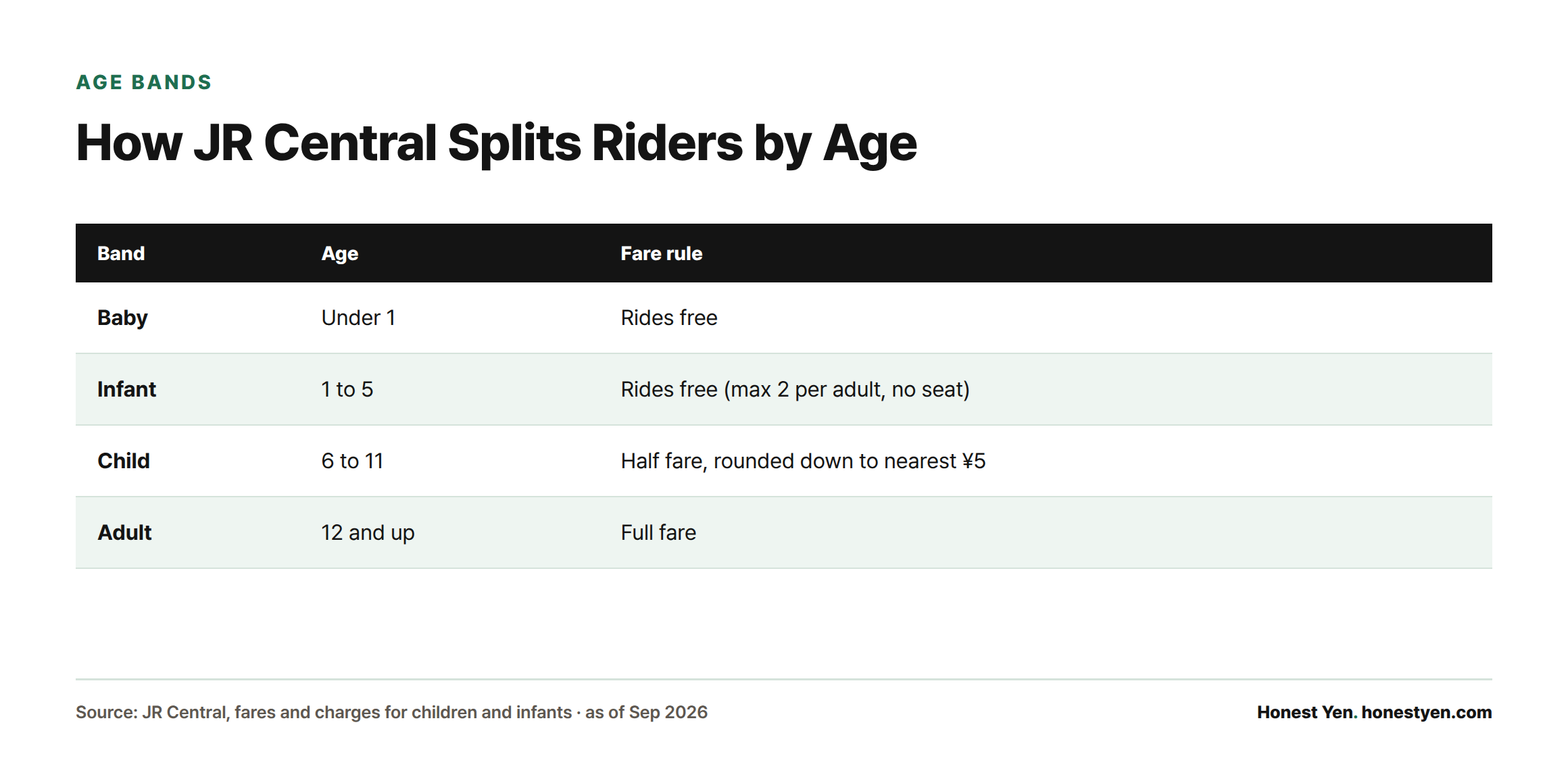
One wrinkle catches families off guard. A 12-year-old still in elementary school is treated as a child, not an adult, on JR Central trains.[2]
A 6-year-old who hasn’t entered elementary school yet still counts as an infant.[2] For the Japan Rail Pass specifically, a child who was 11 when the exchange voucher was issued keeps the child rate even after turning 12.[1]
What a child ticket actually costs
A child’s basic fare, limited express charge, and reserved seat fee are all half the adult price, with the result rounded down to the nearest ¥5.[2]
Infants and babies ride free with a paying adult. Three exceptions apply: a third infant traveling with the same adult needs a fare, and so does an infant who occupies a reserved seat or one who travels alone.[2]
Those rules apply on JR lines. Private railways such as Keisei set their own child fares and age rules.
Is the Japan Rail Pass worth it with kids?
Before October 1, 2026, a 7-day nationwide Ordinary Pass cost ¥50,000 for an adult and ¥25,000 for a child.[1]
The 14-day pass runs ¥84,000 adult and ¥42,000 child, and the 21-day pass runs ¥105,000 adult and ¥53,000 child.[1]
For a family covering three or more cities by Shinkansen over a week, that flat price buys unlimited rides and no per-trip decisions. For one region or under four days, point-to-point tickets usually cost less, since the pass has to outrun several separate fares before it pays off.
Families sticking to one region should compare the nationwide pass against a regional one; see our Kansai Area Pass vs Kansai Wide Area Pass breakdown for one example.
Getting a child IC card for ages 6 to 11
A Child PASMO needs official identification that confirms the child’s age at the time of issue.[7] A passport is the simplest document a visiting family can show.
The card stays valid through March 31 of the year the child turns 12.[7] After that it converts to an adult PASMO through a separate procedure, and only one Child PASMO or Child Suica can be issued per child.[7]
PASMO cards, including the child version, require a ¥500 deposit paid at issuance.[7]
Strollers, luggage, and reserving seats together
Strollers are exempt from the Shinkansen’s oversized baggage rules on the Tokaido Shinkansen, so they need no reservation and no fee.[3]
The Sanyo Shinkansen has the same exemption.[4]
Baggage with combined length, width, and height of 160 to 250cm does need a seat with an oversized baggage area, reserved in advance.[4] Travel without that reservation and the fee is ¥1,000, including tax.[4]
A stroller doesn’t need to fit any size limit at all, since it’s exempt outright. The practical move is to reserve seats in the last row of a car, where the space behind the seats gives extra room for the stroller and suitcases together.
For families carrying full suitcases plus a stroller, our Shinkansen oversized baggage guide covers the reservation step in more detail.
What it actually costs: three family trips, worked out
Prices below are per one-way trip or per pass, not round trip.
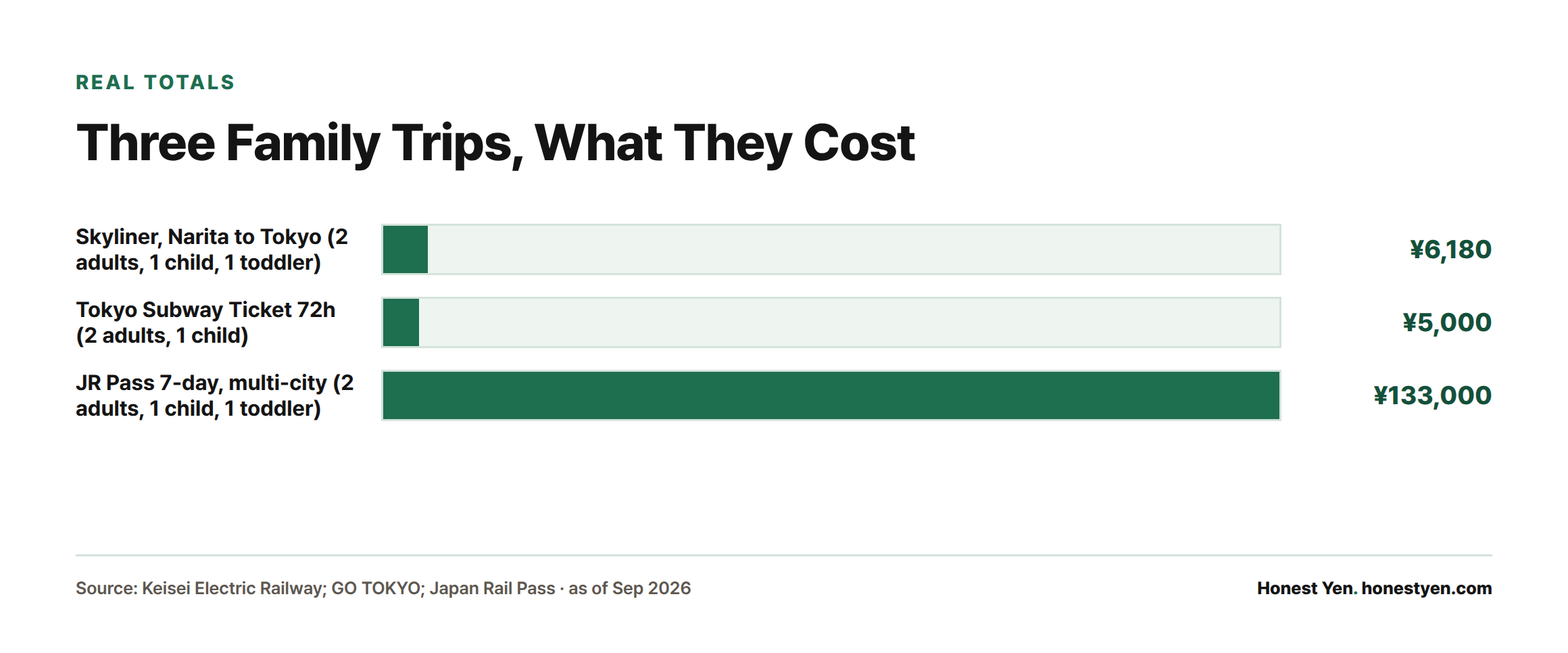
| Trip | Fare |
|---|---|
| Narita to Tokyo, Keisei Skyliner: 2 adults, 1 child (6–11 age band), 1 toddler (under 6) | Adult fare × 2: ¥4,940[6] |
| Child fare × 1: ¥1,240[6] | |
| Toddler, no seat needed: ¥0[2] | |
| Total: ¥6,180 | |
| 3 days in Tokyo, Tokyo Subway Ticket (72h): 2 adults, 1 child (6–11 age band) | Adult ticket × 2: ¥4,000[5] |
| Child ticket × 1: ¥1,000[5] | |
| Total: ¥5,000 | |
| 7 days, multi-city, JR Pass (7-day): 2 adults, 1 child (6–11 age band), 1 toddler (under 6) | Adult pass × 2: ¥106,000[1] |
| Child pass × 1: ¥27,000[1] | |
| Toddler, no seat needed: ¥0[2] | |
| Total: ¥133,000 |
The Skyliner leg works out to ¥2,470 × 2 + ¥1,240 = ¥6,180. The 3-year-old doesn’t need a fare unless she takes a reserved seat, exceeds the two-infant limit per adult, or travels alone.[2]
The Tokyo pass adds up to ¥2,000 × 2 + ¥1,000 = ¥5,000.[5]
Three separate Tokyo Metro 24-Hour Tickets for the same family, bought one per day, would cost ¥700 × 2 + ¥350 = ¥1,750 per day.[5]
Over three days that’s ¥5,250, or ¥250 more than the 72-hour Subway Ticket. The 24-hour ticket only covers Tokyo Metro lines, not the Toei Subway lines the 72-hour ticket also includes.[5]
For the 7-day multi-city trip, the pass total is ¥133,000. Two or more long-distance Shinkansen legs across a week typically cost more than the child’s pass alone. Families visiting three or more cities in a week tend to come out ahead with the pass. See our Nozomi vs Hikari vs Kodama fare comparison to price a specific route before deciding.
Boarding etiquette that matters with kids in tow
Queue in the marked lines painted on the platform rather than clustering near the doors. Save phone calls and loud conversation for the areas between cars, not the main seating deck.
None of this changes because a child is along. Staff and other passengers expect the same quiet boarding whether a family has a stroller or not.
Frequently asked questions
Do babies and toddlers ride free on Japanese trains?
Yes, up to age 5, as long as they don’t take a reserved seat, Green Car seat, or bed, and no more than two infants travel per paying adult.[2]
Is the Japan Rail Pass worth it for a family with kids?
For a week or longer covering three or more cities by Shinkansen, usually yes. For one region or under four days, point-to-point tickets are usually cheaper.
How do you get a child IC card for a kid visiting Japan?
Bring ID that confirms the child’s age, such as a passport, to a participating station and apply for a Child PASMO. It stays valid until March 31 of the year the child turns 12.[7]